World's First LMFP Project with a Capacity over 100,000 mt/year Commissioned in Qujing, Yunnan

Published: Sep 20, 2022 11:16 (GMT+8)
Source: SMM
According to official news from Dynanonic, the company's 110,000 mt/year lithium iron manganese phosphate (LMFP) project was officially put into operation in Qujing, Yunnan on September 19, 2022.

According to official news from Dynanonic, the company's 110,000 mt/year lithium iron manganese phosphate (LMFP) project was officially put into operation in Qujing, Yunnan on September 19, 2022. The project is located in the Xicheng Industrial Area of Qujing Economic Development Zone. The construction of the project started in January 2022 and lasted 8 months, with a total investment of 2.59 billion yuan. It is the world's first LMFP project with an annual capacity over 100,000 mt.  
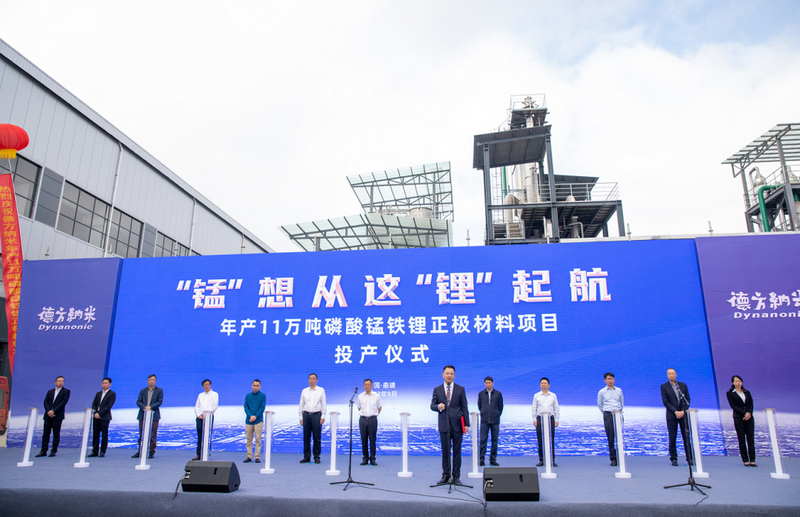
Credit: The WeChat officiant account of Dynanonic

Dynanonic is a leading lithium iron phosphate (LFP) manufacturer in China. Its core product is nano LFP, which has been widely used in new energy vehicles, energy storage systems and other fields. In terms of production, Dynanonic has built four major production bases, boasting a total production capacity of 260,000 mt of LFP. The company also plans to add 80,000 mt of LFP capacity in Sichuan by the end of 2022. Therefore, it is expected to have a LFP capacity of 345,000 mt by the end of 2025.

In fact, LMFP can be regarded as an upgraded version of LFP because manganese element is added to LFP to effectively combine the advantages of iron and manganese elements. At the same time, the high voltage of manganese is tapped into to break through the energy density upper limit of LFP batteries. The comparison between LMFP and LFP/NMC cathode materials is listed as followed.

LMFP vs LFP: LMFP has higher energy density (about 10-20%) than LFP. However, the addition of manganese element makes it less conductive, which poses higher demand for electrolyte.

LMFP vs NMC cathode materials: LMFP outperforms the other in terms of cost effectiveness, security, and cycle life, but is overshadowed in terms of energy density and conductivity.

On the whole, LMFP can be regarded as an upgraded version of LFP, which makes up for the latter's shortcomings in energy density and better fill the market gap between LFP and NMC cathode materials.

Apart from Dynanonic, there are many other enterprises engaged in the production of LMFP.

(1) Litai Lithium Energy. The company already has LMFP production lines with a capacity of 2,000 mt/year, and it has planned to add a capacity of another 3,000 mt in the future. (2) Ronbay Technology. After acquiring Tianjin SKLD Technology in July 2022, the company has now achieved monthly output of 100 mt LMFP for two-wheeled electric vehicles. Ronbay Technology's investor survey report in August revealed that the company’s LMFP output has increased significantly to 200 mt/month. Moreover, the company is actively carrying out research and development as well as cooperation with core downstream customers. (3) Easpring Material Technology. According to the latest news, the company's LMFP materials have so far been sent for sample certification. (4) Lopal Tech. The company is currently conducting verification work for client application. (5) Guanghua Sci-Tech. The company plans to invest 247 million yuan to build 36,000 mt of LMFP and LFP production capacity.

Generally, Dynanonic said that the company's LMFP project will enhance its advantages with distinctive in production capacity. After the 110,000 mt/year LMFP project is commissioned, it becomes the largest LMFP cathode material project in China. In the field of LMFP development, Dynanonic takes a leading position among its counterparts in terms of strategic layout and progress. According to its long-term plan, the company is expected to have a production capacity of 440,000 mt of LMFP in 2025, and at the same time, the annual production capacity of cathode lithium supplement is also scheduled to reach 25,000 mt.

Data Source Statement: Except for publicly available information, all other data are processed by SMM based on publicly available information, market communication, and relying on SMM's internal database model. They are for reference only and do not constitute decision-making recommendations.

For any inquiries or for more information, please contact: lemonzhao@smm.cn
For more information on how to access our research reports, please contact:service.en@smm.cn
Related News
[SMM News] Solis starts lithium drilling at Campo Grande
7 hours ago
[SMM News] Solis starts lithium drilling at Campo Grande
Read More
[SMM News] Solis starts lithium drilling at Campo Grande
[SMM News] Solis starts lithium drilling at Campo Grande
Solis Minerals has started diamond drilling at its Campo Grande Lithium Project in Brazil's Araçuaí-Salinas Lithium Valley. The company plans five holes totalling about 1,000 m, with planned depths of up to 200 m, to test lithium pegmatites across a 500 m corridor. The targets rest on coincident multi-element geochemical anomalies at surface and on historical auger drilling results. Historical work by Rio Tinto and later mapping and geochemical work by Solis defined the targets. Solis has also mapped a new pegmatite swarm of three coherent outcrop zones between planned holes DHCG-001 and DHCG-004. The program will test the continuity, geometry and lithium potential of the pegmatites beneath surface, starting where mapped pegmatites coincide with geochemical anomalies. Solis says Campo Grande's geology and geochemistry are comparable to PLS Group's Colina Lithium Project, about 100 km to the southwest. Separately, Solis has completed seven drill holes at its Mandacaru Lithium Project in Brazil, with assay results pending.
7 hours ago
[SMM News] Charger re-commences drilling at Medcalf lithium deposit
7 hours ago
[SMM News] Charger re-commences drilling at Medcalf lithium deposit
Read More
[SMM News] Charger re-commences drilling at Medcalf lithium deposit
[SMM News] Charger re-commences drilling at Medcalf lithium deposit
Charger Metals has mobilized a second drill rig to its Lake Johnston Lithium Project in Western Australia as part of a 10,000 m program targeting resource growth. Diamond and reverse circulation rigs are now operating at the Medcalf lithium deposit, and RC drilling began just over a week ago. The program will double the meters drilled at Medcalf. The drilling targets extensions and infill at the Medcalf inferred mineral resource estimate of 10.6 Mt grading 1% Li₂O. Drilling has further defined the Medcalf West Exploration Target of 3-5 Mt at 1-1.4% Li₂O. The program also aims to provide diamond core for metallurgical and geotechnical test work. Following the recent Medcalf resource upgrade, which raised contained Li₂O by 34%, Charger's board has committed to a Scoping Study on the Lake Johnston Project. The current resource sits on a predominantly 40 m x 80 m drilling grid, including 10,936 m of drilling at a cost of $32 per tone of contained Li₂O. The program is fully funded from Charger's sale of the Bynoe Lithium Project to Core Lithium for $3.75 million cash, received on 17 July 2026. Lake Johnston lies 450 km east of Perth in the Yilgarn Province, about 70 km from the Earl Grey Lithium Project, where Covalent Lithium began mining and commissioning in March 2024.
7 hours ago
[SMM News] Savannah raised over $40 million to develop the Portuguese lithium project
7 hours ago
[SMM News] Savannah raised over $40 million to develop the Portuguese lithium project
Read More
[SMM News] Savannah raised over $40 million to develop the Portuguese lithium project
[SMM News] Savannah raised over $40 million to develop the Portuguese lithium project
On September 23(rd), Savannah Resources raised US$30 million for its Barroso Lithium Project in Portugal, via 408 million shares at £0.055/share, including US$11.2 million from subscription agreements with major shareholders. Combined with US$15.5 million cash on hand, funds go toward long lead item fabrication, access road works, EPCM contracting, plant engineering, permitting, and land use rights. Barroso's July 2026 phase one DFS outlined a 14-year mine life at 183,000 t/y lithium oxide, 5.5% grade, based on US$1,788/t pricing yielding US$3.2 billion EBITDA, US$1.9 billion free cash flow, and US$913 million post-tax NPV. The deposit holds 39 million tones at 1.05% Li2O for 411,900 tones contained, Europe's largest hard-rock spodumene resource. The funding advances one of the few large-scale hard-rock lithium sources under development outside China linked African and South American supply chains, feeding EU critical raw material diversification targets.
7 hours ago