Sales of NEVs Totalled at 896,000 Units Worldwide in June, and BYD Ranked First in the First Half

Published: Jul 29, 2022 11:24
Source: SMM
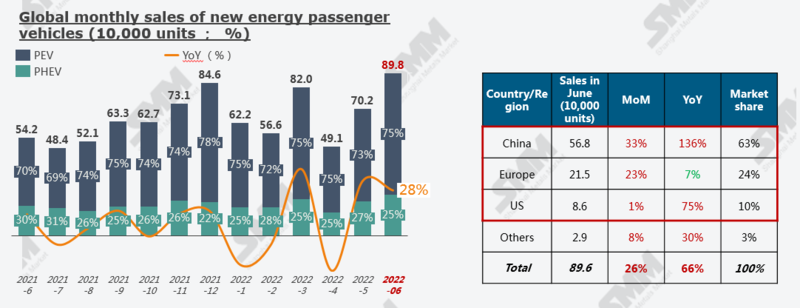
A total of 896,000 new energy vehicles were sold worldwide in June, up 26% MoM and 66% YoY. Among them, 672,000 pure electric cars were sold, an increase of 30% month-on-month, accounting for 75% of the total sales, while 225,000 plug-in hybrid electric cars (PHEVs) were sold, an increase of 15% month-on-month, accounting for 25%.

SHANGHAI, Jul 29 (SMM) – A total of 896,000 new energy vehicles were sold worldwide in June, up 26% MoM and 66% YoY. Among them, 672,000 pure electric cars were sold, an increase of 30% month-on-month, accounting for 75% of the total sales, while 225,000 plug-in hybrid electric cars (PHEVs) were sold, an increase of 15% month-on-month, accounting for 25%. As the biggest NEV market in the world, China sold 568,000 NEVs in June, an increase of 33% MoM and accounting for 63% of the global market. Europe sold 215,000 NEVs in June, an increase of 23% MoM. The top seven countries in Europe were Germany, France, Britain, Norway, Italy, Sweden and Belgium, which together accounted for over 80% the sales in Europe. The United States sold just 86,000 NEVs in June, up 1% MoM.
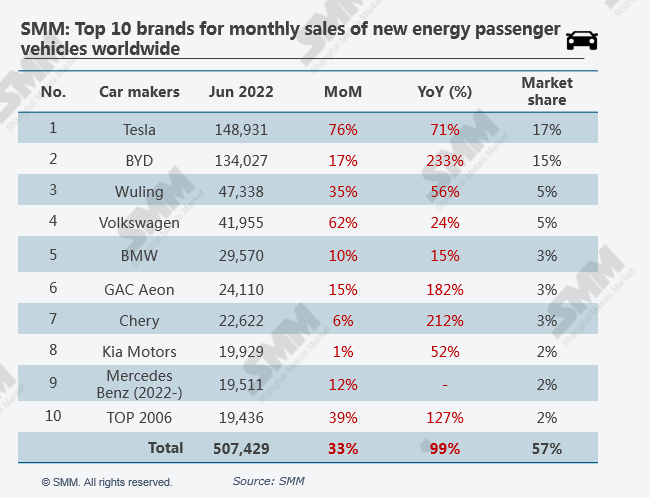
Tesla, the top car company in terms of sales, sold 148,931 unit in June, an increase of 76% month-on-month and 71% year-on-year. According to Tesla's Q2 financial report, its Shanghai and California factories both reached their highest monthly output in the second quarter. The California factory had an annual production capacity of over 650,000 units, and the Berlin Gigafactory had an annual production capacity of over 250,000 units. Tesla's four major factories all reported increasing production capacity. Elon Musk, Tesla's CEO, said that Tesla's car production might grow higher in the second half of this year. In June, BYD's global sales totalled 134,027 units, an increase of 17% month-on-month and a year-on-year increase of 233%, ranking second. BYD has sold more than 100,000 units for four consecutive months. Unlike Tesla that only sold electric vehicles suach as Model Y and Model 3, BYD's sales varied in terms of car models, and pure electric cars and plug-in hybrid electric cars were both included. In the new energy market, BYD's sales in the first half of 2022 exceeded 640,000 units, surpassing Tesla to rank first in the world. According to BYD's official estimates, BYD's total sales in 2022 will reach 1.5 million units, and are expected hit 2 million units if the supply chain is well established.
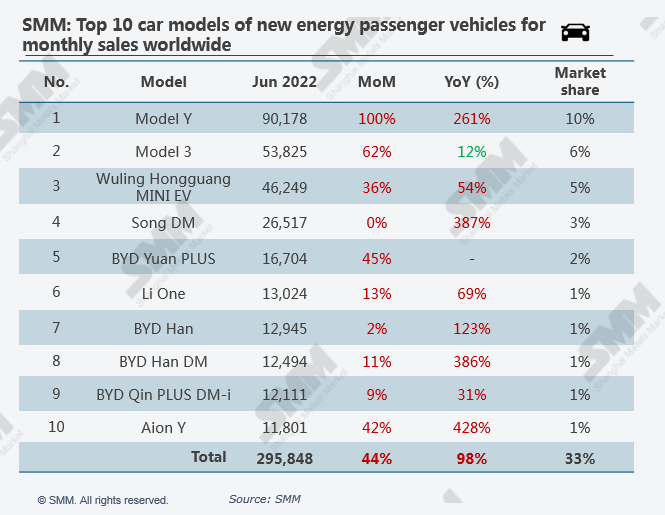
In terms of car models, Model Y, Model 3 and Wuling Hongguang MINI still remained the top three. The sales of Model Y were 90,000 units in June, an increase of 100% month-on-month and a year-on-year increase of 261%, while the sales of Model 3 in June were 54,000 units, up 63% on the month and down 12% on the year. The decline was attributed to the pandemic which led to suspended production at Tesla's Shanghai factory and reduced overseas exports. According to Der Spiegel, the German Ministry of Economic Affairs plans to end the subsidies for PHEV purchases earlier at the end of this year, and reduces the cash subsidies for purchasing electric vehicles by one-third from 2023. The Times also reported that the British government in June cancelled the policy of providing 1,500 pounds of subsidies for electric vehicles purchases. All these policies had affected the sales of electric vehicles. In June, five BYD models made it to the top ten list. Among them, Qin PLUS, whose sales had declined due to the rectification of production lines in its Changsha plant, sold 12,111 units after the rectification, an increase of 9% month-on-month and 31% year-on-year. 
At the same time, NEVs sales in Germany, Britain, France and Italy, who contributed most of the sales in Europe, fell by 10%, 1%, 9%, and 10% year-on-year respectively despite of increase on the month. This was mainly due to the impacts of Russian-Ukrainian war and subsiding subsidies. At present, the improved supply in the Chinese market and the rising oil prices have boosted the new energy market. The month-on-month increase in NEV sales in June was also significantly driven by favourable policies. In particular, some subsidies and new car consumption vouchers are effective only for first comers or may expire at the end of June, further boosting the sales of automobiles in June.
 

Data Source Statement: Except for publicly available information, all other data are processed by SMM based on publicly available information, market communication, and relying on SMM's internal database model. They are for reference only and do not constitute decision-making recommendations.

For any inquiries or for more information, please contact: lemonzhao@smm.cn
For more information on how to access our research reports, please contact:service.en@smm.cn
Related News
[SMM Analysis] Portugal Cancels Construction of Integrated Lithium Mining and Processing Industry
18 hours ago
[SMM Analysis] Portugal Cancels Construction of Integrated Lithium Mining and Processing Industry
Read More
[SMM Analysis] Portugal Cancels Construction of Integrated Lithium Mining and Processing Industry
[SMM Analysis] Portugal Cancels Construction of Integrated Lithium Mining and Processing Industry
18 hours ago
[SMM Flash] SADC Urged to Shift from Raw Mineral Exports to Processing, Zimbabwe's Lithium Ban Cited as Model
23 hours ago
[SMM Flash] SADC Urged to Shift from Raw Mineral Exports to Processing, Zimbabwe's Lithium Ban Cited as Model
Read More
[SMM Flash] SADC Urged to Shift from Raw Mineral Exports to Processing, Zimbabwe's Lithium Ban Cited as Model
[SMM Flash] SADC Urged to Shift from Raw Mineral Exports to Processing, Zimbabwe's Lithium Ban Cited as Model
UN Economic Commission for Africa executive secretary Claver Gatete has called on the Southern African Development Community (SADC) to move from raw mineral exports toward local processing and value addition, calling the region a testing ground for Africa's broader mineral strategy. Demand for critical energy transition minerals including lithium could more than triple by 2030 under net-zero scenarios, with Africa holding about 30% of global reserves but just 1% of lithium output, the smallest share among minerals cited. Zimbabwe was named SADC's primary lithium resource holder, alongside the DRC (cobalt), South Africa (platinum, manganese) and Zambia (copper), with Gatete pointing to Zimbabwe's unprocessed lithium export ban as a policy model for the region. Minerals contribute about 10% of SADC's GDP, 25% of exports and 20% of government revenues, but only 7% of direct employment. SMM View: Gatete's remarks lend regional policy weight to Zimbabwe's ongoing beneficiation push, reinforcing the rationale behind its concentrate export ban as domestic sulfate capacity comes online.
23 hours ago
Sinomine's Bikita Lithium Sulfate Plant Begins Construction, Targets 2027 Completion Amid Zimbabwe's Export Ban Push
Aug 14, 2026 23:09
Sinomine's Bikita Lithium Sulfate Plant Begins Construction, Targets 2027 Completion Amid Zimbabwe's Export Ban Push
Read More
Sinomine's Bikita Lithium Sulfate Plant Begins Construction, Targets 2027 Completion Amid Zimbabwe's Export Ban Push
Sinomine Resource Group's Zimbabwe unit, Masingo Lithium Technology, has obtained EIA approval for its 100,000 t/y lithium sulfate plant at Bikita, moving the project into full construction with contractors China Railway No. 9 Group and Shandong Dadi now on site. Completion is targeted for mid-2027. The clearance formalizes a plan first disclosed in September 2024 and reaffirmed via Sinomine's RMB 5.2 billion ($764 million) fundraising in May 2026, rather than signaling new capital commitment. Bikita becomes Zimbabwe's third Chinese-backed lithium sulfate project, joining Huayou's 50,000 t/y Arcadia plant commissioned July 2026, running near 60% of capacity as of late July and Yahua's Kamativi facility construction started February 2026, capacity undisclosed. Combined announced capacity across all three approaches 200,000+ t/y once complete, ahead of Zimbabwe's January 2027 concentrate export ban. SMM View: Arcadia's slower than nameplate ramp is the key benchmark here if Bikita follows a similar curve at double the capacity, full-rate output likely slips into 2028 despite a mid-2027 completion date. With all three plants now past groundbreaking, Zimbabwe's beneficiation push has shifted from policy to physical build out, the next signal to watch is how strictly the export ban is enforced against each plant's actual commissioning timeline, not just its announced one.
Aug 14, 2026 23:09
Sales of NEVs Totalled at 896,000 Units Worldwide in June, and BYD Ranked First in the First Half - Shanghai Metals Market (SMM)