Silicon Wafer Supply Likely to Become Surplus with over 120 GW Capacity to Be Commissioned in 2022

Published: Jun 23, 2022 15:09 (GMT+8)
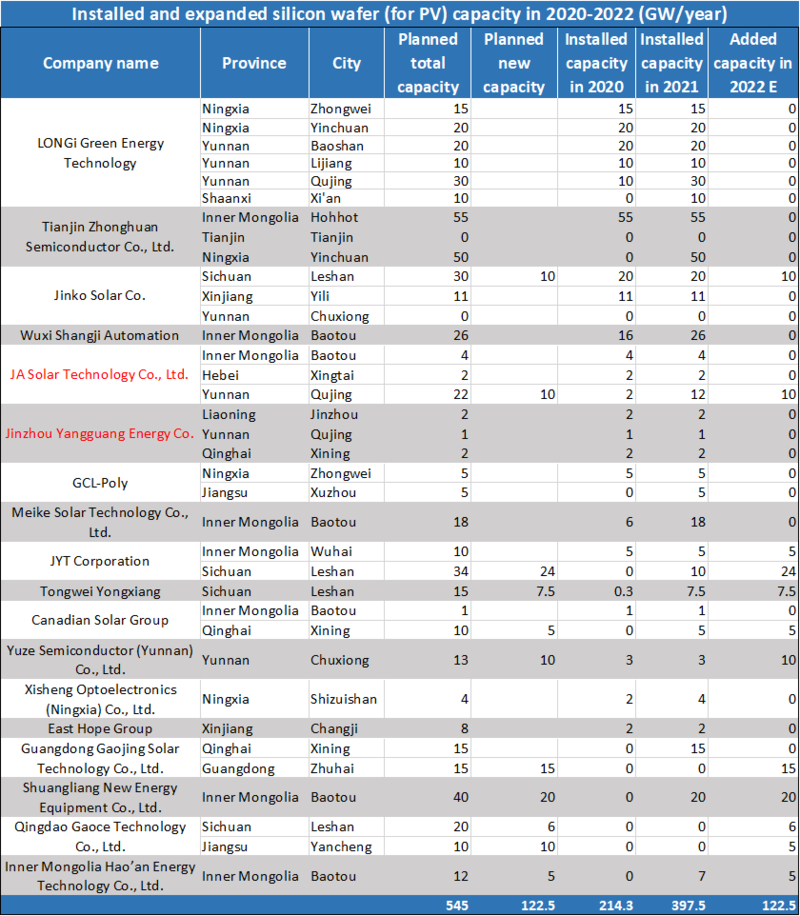
According to SMM statistics, domestic silicon wafer capacity is expected to increase by 122.5GW in 2022 on top the total capacity about 398GW at the end of 2021. In positive scenario, installed capacity of PV is likely to rise by 240 GW in 2022, based on which the overcapacity of silicon wafers may further aggravate.

SHANGHAI, Jun 23 (SMM) - According to SMM statistics, domestic silicon wafer capacity is expected to increase by 122.5GW in 2022 on top the total capacity about 398GW at the end of 2021. In positive scenario, installed capacity of PV is likely to rise by 240 GW in 2022, based on which the overcapacity of silicon wafers may further aggravate.

SMM has learned that in 2022, with the combined push of the domestic policy and economic development, the expected new installed capacity of PV will be 80-90GW; while overseas, in the case of robust development in the fossil energy shortage and renewable energy sectors, 150GW of installed PV capacity will be added, which equals to a total added demand for silicon wafers at 288GW. Meanwhile, as China's silicon wafer production capacity takes up more than 98% of the world's total, it is projected that there will be a further surplus of silicon wafer capacity in 2022.

At the same time, it is not difficult to see from the domestic existing and expanded capacity table that, the expansion of silicon wafer capacity has shown signs of slowdown, and some top-tier enterprises have basically stopped the expansion of silicon wafer production lines.
In addition, large-sized silicon wafers can not only reduce the manufacturing cost of silicon materials, but also contain the manufacturing cost of slices and cell modules. Due to the market's preference for large-sized silicon wafers, the new production lines are basically all 182mm and 210mm production lines.

According to SMM understanding, by the end of 2022, the gross production capacity of 182mm wafers or above will reach more than 400GW, accounting for nearly 80% of the total.


Data Source Statement: Except for publicly available information, all other data are processed by SMM based on publicly available information, market communication, and relying on SMM's internal database model. They are for reference only and do not constitute decision-making recommendations.

For any inquiries or for more information, please contact: lemonzhao@smm.cn
For more information on how to access our research reports, please contact:service.en@smm.cn
Related News
[SMM Chromium Week Review] 'Port Stocks Draw Down as Departures Extend Gains, Zimbabwe Tightens Chrome Mining Rules'
6 hours ago
[SMM Chromium Week Review] 'Port Stocks Draw Down as Departures Extend Gains, Zimbabwe Tightens Chrome Mining Rules'
Read More
[SMM Chromium Week Review] 'Port Stocks Draw Down as Departures Extend Gains, Zimbabwe Tightens Chrome Mining Rules'
[SMM Chromium Week Review] 'Port Stocks Draw Down as Departures Extend Gains, Zimbabwe Tightens Chrome Mining Rules'
Published: Sept 25, 2026
6 hours ago
[SMM Chromium Flash] FS Mining Details $500m Zimbabwe Ferrochrome Smelter and Power Plant Plans
11 hours ago
[SMM Chromium Flash] FS Mining Details $500m Zimbabwe Ferrochrome Smelter and Power Plant Plans
Read More
[SMM Chromium Flash] FS Mining Details $500m Zimbabwe Ferrochrome Smelter and Power Plant Plans
[SMM Chromium Flash] FS Mining Details $500m Zimbabwe Ferrochrome Smelter and Power Plant Plans
FS Mining, a South African-registered company developing a chrome mine in Zimbabwe, is advancing plans for a US$500 million investment split between a US$100 million ferrochrome smelter and a US$400 million thermal power project, director Dr. Precious Mabuza said in an interview published September 25. The company is currently building a US$15 million wash plant as its first phase of development, and is progressing through the technical, engineering and financing stages of the planned smelter and power plant, with construction timelines dependent on completing feasibility work and securing the necessary approvals. The smelter is planned to begin with 16.5 MVA of sintering plant capacity, paired with a 25MW thermal power station in the project's first phase. Mabuza said the longer-term vision is to expand the power-generation component to 320MW, with the company hoping to extend rural electrification to communities surrounding its operations once the plant is built out. Eventual chrome production volumes will be determined once the final furnace configuration, engineering design and operating parameters are concluded, she said. Mabuza framed the investment around Zimbabwe's push for greater domestic beneficiation, noting the government has banned the export of raw minerals, including chrome, to force local value addition. She said the mine currently employs 100 people, with the company targeting 1,500 jobs at the smelter and power station once operational, and roughly 5,000 jobs across the wider value chain including mining, logistics, services and construction. The reliable baseload electricity from the planned thermal power station is central to the project's strategy, intended to support both the smelting operation and, eventually, electrification for nearby communities.
11 hours ago
[SMM Chromium Flash] Outokumpu Unveils EvoMaterials Technology to Boost Ferrochrome's Chromium Content
11 hours ago
[SMM Chromium Flash] Outokumpu Unveils EvoMaterials Technology to Boost Ferrochrome's Chromium Content
Read More
[SMM Chromium Flash] Outokumpu Unveils EvoMaterials Technology to Boost Ferrochrome's Chromium Content
[SMM Chromium Flash] Outokumpu Unveils EvoMaterials Technology to Boost Ferrochrome's Chromium Content
Outokumpu has unveiled EvoMaterials, a proprietary sulfidation-based technology platform designed to increase the chromium content and chromium-to-iron ratio of ferrochrome, with potential to extend to nickel, molybdenum, and metals recovered from waste streams. The company said its Kemi mine in Finland, the EU's only operating chrome mine, gives EvoMaterials a strategic starting point in enriched ferrochrome and chromium metal aimed at space, aviation and defense applications, and that over the longer term the technology could help establish a fully Western supply chain for critical chromium materials, while also being economically competitive against conventional production routes. Development began in the US in 2021, supported in part by a non-exclusive MIT patent license. Outokumpu CTO Stefan Erdmann said the process can recover critical materials from resources previously treated as waste. Testing is under way at a Massachusetts lab, with a pilot plant in New Hampshire set to scale the technology from 1 kg to 1 mt by early 2027, ahead of a targeted industrial-scale plant in 2030 at a US or European site still to be decided. CEO Kati ter Horst framed the platform as addressing the need for supply chains that are lower-carbon, geopolitically resilient and economically competitive at once.
11 hours ago