Lun aluminum inventory fell to a new low of more than 17 years. Shanghai aluminum inventory is at a two-month low.

Published: Apr 18, 2022 15:47
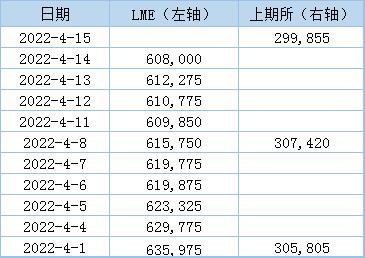
London Metal Exchange (LME) data show that Len aluminum inventories fell again after surging 119000 tons to 880975 tons on Feb. 10. Lun aluminum inventories fell slightly last week, with the latest inventory level at 608000 tons, the lowest level in more than 17 years. Data released last week showed that Shanghai aluminium inventories fell in the week of April 15, with weekly inventories falling 2.46 per cent to 299855 tonnes to a two-month low.

London Metal Exchange (LME) data showed that Len aluminum stocks jumped 119000 tons to 880975 tons on February 10, and then fell again. Len aluminum inventories fell slightly last week, with the latest inventory level at 608000 tons, the lowest level in more than 17 years.

Data released last week showed that Shanghai aluminium inventories fell in the week of April 15, with weekly inventories falling 2.46 per cent to 299855 tonnes to a two-month low.

Note: generally speaking, declining stocks in domestic and foreign exchanges will support the futures price, otherwise, it will be bad for the futures price.

Comparison of Aluminum inventory between LME and previous Institute since 2020

The following is the aluminum inventory data of LME and the previous Stock Exchange since April 2022: (in tons)

Data Source Statement: Except for publicly available information, all other data are processed by SMM based on publicly available information, market communication, and relying on SMM's internal database model. They are for reference only and do not constitute decision-making recommendations.

For any inquiries or for more information, please contact: lemonzhao@smm.cn
For more information on how to access our research reports, please contact:service.en@smm.cn
Related News
Data: SHFE, DCE market movement (Jul 16)
6 mins ago
Data: SHFE, DCE market movement (Jul 16)
Read More
Data: SHFE, DCE market movement (Jul 16)
The following table shows the ferrous and nonferrous metals movement on the SHFE and DCE on 16 Jul , 2026
6 mins ago
[SMM Analysis] The Southeast Asian secondary aluminum market remains in the doldrums, while the import window has improved but transactions are yet to recover.
18 mins ago
[SMM Analysis] The Southeast Asian secondary aluminum market remains in the doldrums, while the import window has improved but transactions are yet to recover.
Read More
[SMM Analysis] The Southeast Asian secondary aluminum market remains in the doldrums, while the import window has improved but transactions are yet to recover.
[SMM Analysis] The Southeast Asian secondary aluminum market remains in the doldrums, while the import window has improved but transactions are yet to recover.
This week, the Southeast Asian secondary aluminum market overall remained in the doldrums, with aluminum scrap and ADC12 prices remaining under pressure. As LME aluminum prices continued to consolidate on a subdued note, downstream consumption recovery was slow, market purchases were still mainly for rigid demand, and the overall trading atmosphere was mediocre. Meanwhile, overseas quotes continued to pull back, which improved China’s import profitability from earlier levels. Some Southeast Asian resources flowed back into the Chinese market, but spot transactions still failed to show a significant increase in volume.
18 mins ago
China's Cast Aluminum Alloy Inventory Falls for Seventh Week, Pace Slows Amid Weak Demand
1 hour ago
China's Cast Aluminum Alloy Inventory Falls for Seventh Week, Pace Slows Amid Weak Demand
Read More
China's Cast Aluminum Alloy Inventory Falls for Seventh Week, Pace Slows Amid Weak Demand
[SMM Aluminum Alloy Flash] This week, China's social inventory of cast aluminum alloy ingots fell 5,600 mt WoW to 29,700 mt, marking the seventh consecutive week of destocking. Cumulative destocking reached 33,200 mt, but the pace slowed compared to the prior two weeks. The industry operating rate remains low, with limited new warehouse inflows. Meanwhile, the spot-futures price spread stayed in a relatively favorable range, prompting traders to focus on selling, which drove continuous destocking. However, as the traditional consumption off-season deepens, overall market demand remains weak, constraining the destocking magnitude to some extent.
1 hour ago