The freight rate fell for 12 weeks in a row! Shanghai blockade and global port congestion impact on the gathering market

Published: Apr 13, 2022 09:09
[freight rates have fallen for 12 weeks in a row! With the severe epidemic situation in Shanghai and the continuous impact on the container shipping market by the global port blockage, the SCFI index fell 12 times to the lowest level since August last year. On April 8, the Shanghai Shipping Exchange announced that the latest Shanghai export container freight index (SCFI) fell to 4263.66 points, a weekly decline of 1.96%, a record decline for 12 consecutive weeks. Freight rates on both the European line and the western line fell, with the European line at a 10-month low, but the eastern line rebounded.
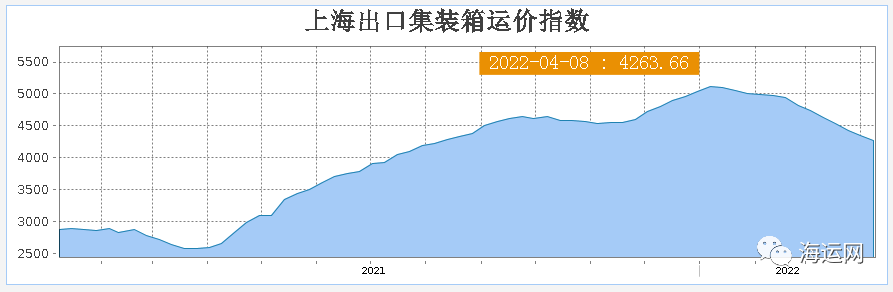
With the severe epidemic situation in Shanghai and the continued impact of global congestion on the container shipping market, the SCFI index fell 12 times to its lowest level since August last year.

On April 8, the Shanghai Shipping Exchange announced that the latest Shanghai export container freight index (SCFI) fell to 4263.66 points, a weekly decline of 1.96%, a record decline for 12 consecutive weeks. Freight rates on both the European line and the western line fell, with the European line at a 10-month low, but the eastern line rebounded.

Among them, the freight rate per FEU of the far East to the US West Line fell by 56 US dollars, or 0.7%, to US $7860, falling for five consecutive weeks and setting a new low so far this year; the freight rate per TEU of the far East to the US East Line rebounded by US $186 to US $10581, an increase of 1.8%; and the freight rate per TEU of the far East to Europe line fell to US $6157 in a row, the lowest since June last year.

People in the industry pointed out that recently, in order to prevent a strike by dock workers in the United States and the West, manufacturers began to transfer goods to the East of the United States, but the shipping space in the East of the United States is already less than that of the United States and West, and the problem of blocking the port has not been solved, so the freight rate of the East Line of the United States has risen.

In terms of the overall trend of freight rates, it is expected that freight rates will still fall slightly in mid-April, and freight rates, which were originally expected to recover in the second half of April, may have to wait until early May before they begin to rise. The main reason is that the collection and transportation companies began to draw boats on the western line of the United States, and after the release of the epidemic in Shanghai and other places, the tide of shipments is expected, which will be able to push up freight rates.

Despite the continuous decline in the SCFI index, freight rates are actually still at historic highs. However, people in the industry also believe that it may be difficult for freight rates to reach new highs, and freight rates this year are unlikely to increase as much as last year, but will not decline too much, but will remain volatile at high levels.

On the other hand, although the current shortage of space has eased somewhat, the slightly loose space and the ease of congestion will help to improve ship turnover, even if freight rates decline slightly, as long as cargo volume remains high and freight rates remain relatively high, the performance of container carriers this year is unlikely to be lower than that of last year.

About 10 per cent of the world's container ships are unable to move because of port jams in China and other parts of the world, according to ONE.

ONE CEO Jeremy Nixon said at the Marine Money conference in Singapore on April 5 that container ships are stuck in congested areas and consume a lot of fuel, and if the bottleneck can be solved, the service will be on time again.

Last year, there were 5587 ships carrying 24.7 million containers in the global container fleet, according to USDA data, which means about 500 ships are now queuing up to load and unload goods, according to Bloomberg estimates.

The COVID-19 epidemic has entered its third year, and the global supply chain is still hit by manpower shortages and outbreaks. Industry insiders say that although congestion at ports on the west coast of the United States has finally eased after several months of delays, cities such as Shanghai and Shenzhen have been blocked, resulting in an increase in queues for ships off the coast of China, which could worsen cargo delays in the coming months and push up freight rates.

Data Source Statement: Except for publicly available information, all other data are processed by SMM based on publicly available information, market communication, and relying on SMM's internal database model. They are for reference only and do not constitute decision-making recommendations.

For any inquiries or for more information, please contact: lemonzhao@smm.cn
For more information on how to access our research reports, please contact:service.en@smm.cn
Related News
Silver Prices Swing Wildly with Center Moving Upward; Spot Silver Shifts from Discount to Premium [SMM Silver Weekly Review]
6 hours ago
Silver Prices Swing Wildly with Center Moving Upward; Spot Silver Shifts from Discount to Premium [SMM Silver Weekly Review]
Read More
Silver Prices Swing Wildly with Center Moving Upward; Spot Silver Shifts from Discount to Premium [SMM Silver Weekly Review]
[SMM Silver Weekly Review: Silver Prices Swing Wildly with Center Moving Up; Spot Shifts from Discount to Premium] This week, silver prices swung wildly with the center moving slightly higher. Stronger-than-expected nonfarm payrolls initially pressured silver prices, but the subsequent continuous weakening of the US dollar drove a rebound, and spot quotes shifted from discounts to premiums. Macro factors were mixed, and the market awaited guidance from CPI and the US Fed meeting, with wild swings expected in the short term. Inventory saw a slight buildup of 6 mt, ETF holdings edged up, and wait-and-see sentiment strengthened.
6 hours ago
WPIC Revises 2026 Platinum Market to 265,000 oz Surplus as Investment Demand Weakens
7 hours ago
WPIC Revises 2026 Platinum Market to 265,000 oz Surplus as Investment Demand Weakens
Read More
WPIC Revises 2026 Platinum Market to 265,000 oz Surplus as Investment Demand Weakens
[SMM Flash] The World Platinum Investment Council (WPIC) has revised its 2026 platinum market balance to a 265,000 oz surplus, reversing its previous forecast for a 297,000 oz deficit. The latest Platinum Quarterly, published on September 9, showed a second-quarter surplus of 244,000 oz as total supply increased 1% year on year to 1.91 million oz while demand fell 16% to 1.66 million oz. The revision largely reflects investment outflows during the first half of 2026 rather than a significant recovery in mine supply. Despite the full-year surplus forecast, WPIC says above-ground inventories remain constrained following three consecutive years of substantial deficits. The organisation expects the market to swing from a 548,000 oz surplus in H1 to a 283,000 oz deficit in H2, as investment selling moderates. The H2 balance remains a forecast rather than a confirmed outcome.
7 hours ago
Platinum could outperform gold price as debasement trade regains momentum – WPIC
7 hours ago
Platinum could outperform gold price as debasement trade regains momentum – WPIC
Read More
Platinum could outperform gold price as debasement trade regains momentum – WPIC
7 hours ago
The freight rate fell for 12 weeks in a row! Shanghai blockade and global port congestion impact on the gathering market - Shanghai Metals Market (SMM)