Be careful! New regulations on lithium battery transportation come into effect on April 1

Published: Mar 25, 2022 13:27 (GMT+8)
Attention! According to the official (IATA) of the International Air Transport Association, IATA has revised the regulations governing the separate transportation of lithium batteries, which actually came into effect on January 1, 2022, but there will be a transition period before March 31, 2022 to comply with the new regulations, and the new rules will come into effect after April 1.

According to the official (IATA) of the International Air Transport Association, IATA has revised the regulations for the separate transportation of lithium batteries, which actually came into effect on January 1, 2022, but there will be a transitional period before March 31, 2022 to comply with the new rules, and the new rules will come into effect after April 1.

This regulatory change is mainly a revision of the multi-page packaging instructions PI 965 and PI 968 of the 63rd edition of the International Air Transport Association dangerous goods regulations. The most significant impact of this dangerous goods regulation change is the deletion of PI 965 as lithium-ion cells and batteries (including mobile power sources) and PI 968 as packaging instructions for lithium metal / primary cells and batteries. This change does not affect PI 966, PI 967, PI 969 or PI 970 for Section II lithium-containing battery products. According to the provisions of part II, neither lithium-ion batteries nor lithium-metal batteries can be transported.
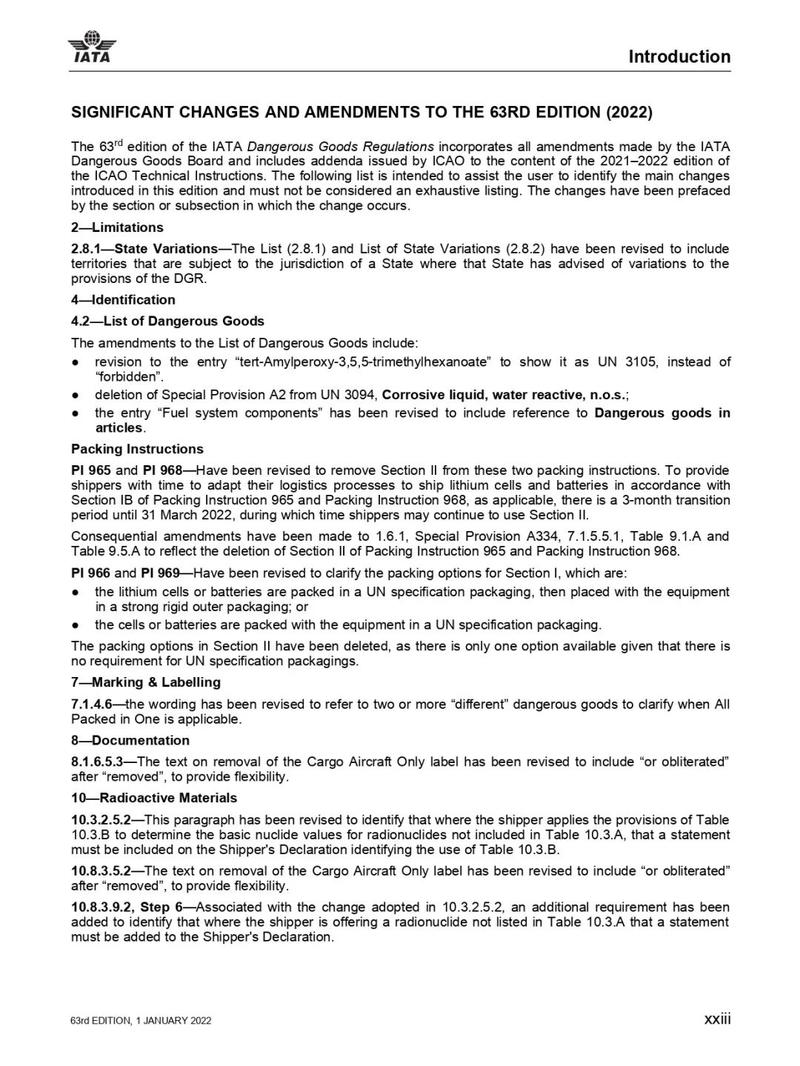
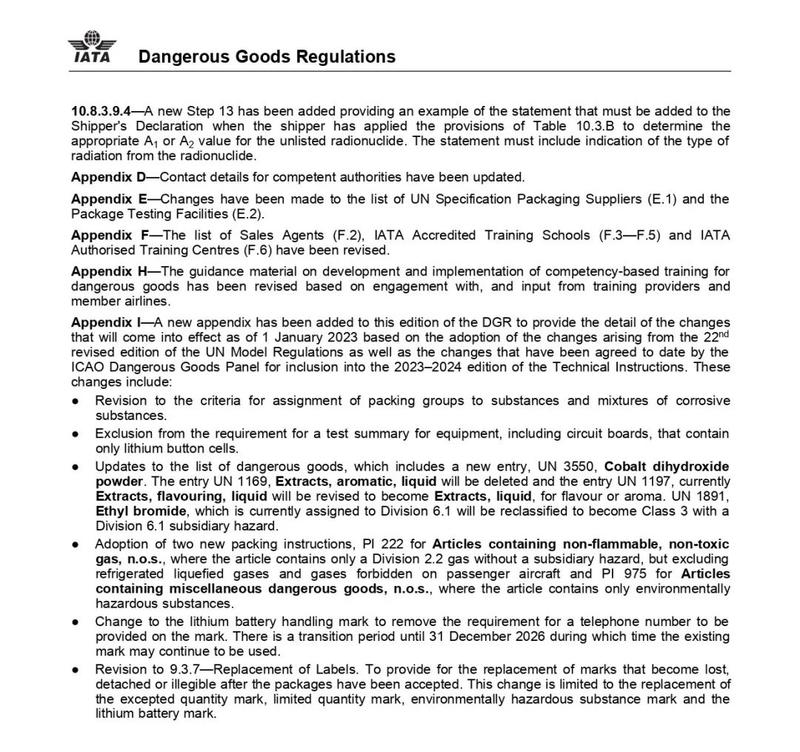
In this way, all shippers who ship lithium batteries themselves are required to complete the declaration, marking and labelling of dangerous goods, as well as complete training in the air transportation of dangerous goods.

Shippers of lithium batteries have become accustomed to annual changes in transport rules, while air transport rules seem to change more frequently than other modes of transport (rail, road, sea and inland waterways). The reasons for these changes include the increase in the transportation of lithium batteries. Lithium batteries are now available for everything from mobile phones to bicycles, motorcycles, drones, trucks and a variety of scientific, medical and industrial equipment.

In addition, lithium battery accidents continue to pose a threat to safety, as if the regulations are not fully met, the battery may rapidly heat up to 400 °C while releasing toxic gases. Some airlines have invested in sealing systems that can withstand lithium battery fires, but these systems are costly and add to the cost of the supply chain, which will inevitably be borne by the shipper.

From April 1st, both lithium-ion batteries and lithium-metal batteries must be declared in accordance with the terms of IA or IB. It should be noted that this rule change does not apply to lithium batteries included in equipment or lithium batteries packaged in air transportation equipment.

In addition, the ADR (Road), RID (Railway) or IMDG (Shipping) regulations remain unchanged, and special clause 188 does make it easier to use lithium-ion batteries below 100 Wh (watt-hours) and lithium-metal batteries with a total lithium metal content of less than 2 g. Differences in rules between different modes of transport reflect different risks but also increase the complexity faced by shippers many of whom use multiple modes of transport.

The practical effect of these changes is that many packages with only lithium batteries must become larger, if only to leave enough room for the hazards and handling labels and other information that must appear on each package. According to Section IA, the shipper needs two labels, and according to Section IB, two labels and one mark are required, and the labels and marks must comply with the minimum size standards stipulated in the IATA regulations.

The shipper also needs to prepare the shipper's statement for each shipment of self-shipped lithium batteries, which are subject to full acceptance by the ground handling agent, and then enter the Captain's notice, which lists the dangerous goods that have been loaded on the aircraft.

Shippers will face higher transport costs because airlines, handling agents, integrators and freight forwarders must do more to ensure compliance. Air freight rates for most aviation divisions have risen sharply as a result of the epidemic, rising fuel prices, high demand for freight capacity, and the recent Russian-Ukrainian crisis that led to the cancellation of some capacity. Sadly, more cost increases are just around the corner.

Over time, it will become increasingly clear whether this latest regulatory amendment will further improve security or cause obstacles and delays to legitimate shippers and distributors. For all participants in the supply chain, not changing lithium battery regulations for a few years will also be a welcome respite.

Data Source Statement: Except for publicly available information, all other data are processed by SMM based on publicly available information, market communication, and relying on SMM's internal database model. They are for reference only and do not constitute decision-making recommendations.

For any inquiries or for more information, please contact: lemonzhao@smm.cn
For more information on how to access our research reports, please contact:service.en@smm.cn
Related News
[SMM News] Solis starts lithium drilling at Campo Grande
1 hour ago
[SMM News] Solis starts lithium drilling at Campo Grande
Read More
[SMM News] Solis starts lithium drilling at Campo Grande
[SMM News] Solis starts lithium drilling at Campo Grande
Solis Minerals has started diamond drilling at its Campo Grande Lithium Project in Brazil's Araçuaí-Salinas Lithium Valley. The company plans five holes totalling about 1,000 m, with planned depths of up to 200 m, to test lithium pegmatites across a 500 m corridor. The targets rest on coincident multi-element geochemical anomalies at surface and on historical auger drilling results. Historical work by Rio Tinto and later mapping and geochemical work by Solis defined the targets. Solis has also mapped a new pegmatite swarm of three coherent outcrop zones between planned holes DHCG-001 and DHCG-004. The program will test the continuity, geometry and lithium potential of the pegmatites beneath surface, starting where mapped pegmatites coincide with geochemical anomalies. Solis says Campo Grande's geology and geochemistry are comparable to PLS Group's Colina Lithium Project, about 100 km to the southwest. Separately, Solis has completed seven drill holes at its Mandacaru Lithium Project in Brazil, with assay results pending.
1 hour ago
[SMM News] Charger re-commences drilling at Medcalf lithium deposit
1 hour ago
[SMM News] Charger re-commences drilling at Medcalf lithium deposit
Read More
[SMM News] Charger re-commences drilling at Medcalf lithium deposit
[SMM News] Charger re-commences drilling at Medcalf lithium deposit
Charger Metals has mobilized a second drill rig to its Lake Johnston Lithium Project in Western Australia as part of a 10,000 m program targeting resource growth. Diamond and reverse circulation rigs are now operating at the Medcalf lithium deposit, and RC drilling began just over a week ago. The program will double the meters drilled at Medcalf. The drilling targets extensions and infill at the Medcalf inferred mineral resource estimate of 10.6 Mt grading 1% Li₂O. Drilling has further defined the Medcalf West Exploration Target of 3-5 Mt at 1-1.4% Li₂O. The program also aims to provide diamond core for metallurgical and geotechnical test work. Following the recent Medcalf resource upgrade, which raised contained Li₂O by 34%, Charger's board has committed to a Scoping Study on the Lake Johnston Project. The current resource sits on a predominantly 40 m x 80 m drilling grid, including 10,936 m of drilling at a cost of $32 per tone of contained Li₂O. The program is fully funded from Charger's sale of the Bynoe Lithium Project to Core Lithium for $3.75 million cash, received on 17 July 2026. Lake Johnston lies 450 km east of Perth in the Yilgarn Province, about 70 km from the Earl Grey Lithium Project, where Covalent Lithium began mining and commissioning in March 2024.
1 hour ago
[SMM News] Savannah raised over $40 million to develop the Portuguese lithium project
1 hour ago
[SMM News] Savannah raised over $40 million to develop the Portuguese lithium project
Read More
[SMM News] Savannah raised over $40 million to develop the Portuguese lithium project
[SMM News] Savannah raised over $40 million to develop the Portuguese lithium project
On September 23(rd), Savannah Resources raised US$30 million for its Barroso Lithium Project in Portugal, via 408 million shares at £0.055/share, including US$11.2 million from subscription agreements with major shareholders. Combined with US$15.5 million cash on hand, funds go toward long lead item fabrication, access road works, EPCM contracting, plant engineering, permitting, and land use rights. Barroso's July 2026 phase one DFS outlined a 14-year mine life at 183,000 t/y lithium oxide, 5.5% grade, based on US$1,788/t pricing yielding US$3.2 billion EBITDA, US$1.9 billion free cash flow, and US$913 million post-tax NPV. The deposit holds 39 million tones at 1.05% Li2O for 411,900 tones contained, Europe's largest hard-rock spodumene resource. The funding advances one of the few large-scale hard-rock lithium sources under development outside China linked African and South American supply chains, feeding EU critical raw material diversification targets.
1 hour ago