Recently, China Automotive Power Battery Industry Innovation Alliance (hereinafter referred to as "Battery Alliance") released monthly data on power batteries in February this year. Data show that the loading of power batteries in China increased significantly this month compared with the same period last year, among which lithium iron phosphate batteries increased rapidly.

Monthly installed capacity of power batteries in China; photo source: battery Alliance
With the overall rise, the gap between lithium iron phosphate and ternary has been further widened.
According to the Battery Alliance, the number of cars loaded with power batteries in China reached 13.7 GWH in February, an increase of 145.1 percent over the same period last year and a decrease of 15.5 percent from the previous month. This corresponds to the overall sales of new energy vehicles in February. According to the China Automobile Association, sales of new energy vehicles in China reached 334000 in February, a year-on-year increase of 1.8 times and a month-on-month decline of 22.7%. It is reported that the month-on-month decline is mainly affected by the Spring Festival.
In terms of production, China's power battery output in February totaled 31.8 GWH, an increase of 236.2% over the same period last year and 7.1% month-on-month growth. This is not completely consistent with the overall production of new energy vehicles in February. According to the China Automobile Association, China's output of new energy vehicles reached 368000 in February, a year-on-year increase of two times and a month-on-month drop of 18.6 per cent. To some extent, this shows that power battery manufacturers are actively preparing goods.
It is also worth noting that the total loading of ternary batteries in February was 5.8 GWH, up 75.6% from the same period last year, down 19.9% from the previous month; and lithium iron phosphate batteries totaled 7.8GWH, up 247.3% from the same period last year, down 12.3% from the previous month. In terms of production, the output of ternary batteries in February was 11.6%, accounting for 36.6% of the total output, an increase of 127.2% over the same period last year and 7.6% from the previous year; the output of lithium iron phosphate batteries was 20.1%, accounting for 63.1% of the total output, up 364.1% from the same period last year and 6.7% from the previous year.
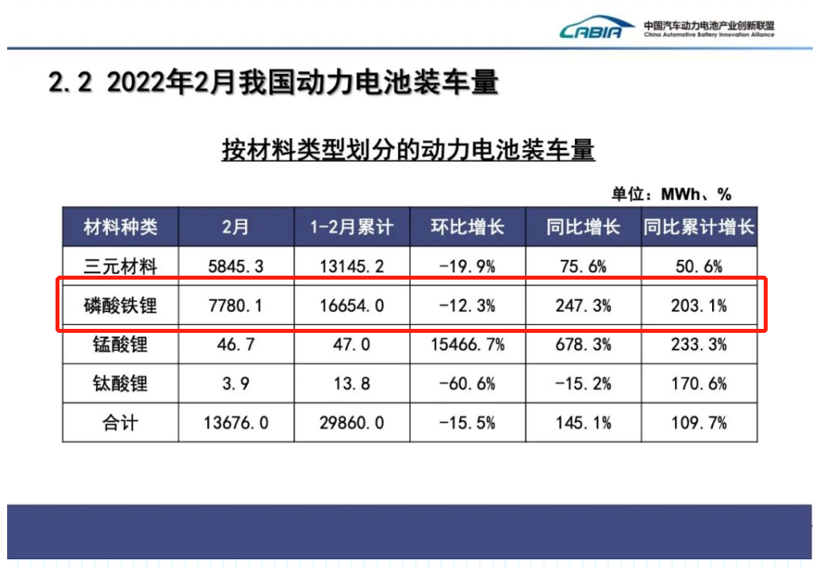
The loading of lithium iron phosphate batteries rose sharply in February compared with the same period last year. Photo: battery Alliance
Thus it can be seen that the loading capacity and output of lithium iron phosphate continue to exceed that of ternary batteries, and the growth rate is significantly higher than that of ternary batteries. Because of this, the gap between the two is further widening compared with January. This also proves once again that with the continued prosperity of the new energy vehicle market and the acceleration of major manufacturers, the application of lithium iron phosphate battery is accelerating.
In retrospect, from 2018 to 2020, the proportion of ternary batteries was higher than that of lithium iron phosphate batteries due to the tendency of subsidy policy. However, since 2021, thanks to technological iterations, cost advantages and subsidies, car companies and battery companies have equipped different positioning models with different power batteries, and the installation of lithium iron phosphate batteries has begun to accelerate.
In 2021, the loading capacity and output of lithium iron phosphate batteries exceed that of ternary batteries. Among them, the total loading of ternary batteries was 74.3 GWH, accounting for 48.1% of the total, and that of lithium iron phosphate batteries was 79.8 GWH, accounting for 51.7% of the total. The total output of ternary batteries is 93.9 GWH, accounting for 42.7% of the total output, and the output of lithium iron phosphate batteries is 125.4 GWH, accounting for 57.1% of the total output.
In the follow-up, in view of the relevant manufacturers to further increase the production expansion layout of lithium iron phosphate, lithium iron phosphate battery is expected to continue to maintain prosperity. It is also worth noting that the previous rise in raw material prices combined with the recent surge in nickel prices may further benefit the growth of lithium iron phosphate batteries.
Related data show that the London Metal Exchange LME nickel recently staged an unprecedented surge, as high as 100000 US dollars / ton mark. You know, nickel is the key material for lithium-ion batteries. As one of the two major technological directions of power battery, ternary lithium battery refers to the lithium battery of ternary cathode material which uses lithium nickel cobalt manganate or lithium nickel cobalt aluminate. In ternary lithium battery, the role of nickel is to provide higher energy density and larger storage capacity.
Therefore, the sharp rise in nickel price is likely to lead to a rise in the cost of new energy car companies, especially those using ternary batteries, and the possibility of price increase will also increase again in order to ensure gross profit margin. On the other hand, it will also make car companies pay more attention to lithium iron phosphate batteries with price advantages.
Analysts at the Galaxy Automotive Research Institute said that the development trend of lithium iron phosphate batteries is already obvious. Even if there is no problem of rising nickel prices, most enterprises will choose to use lithium iron phosphate batteries. However, the rise in nickel prices may prompt some enterprises to increase the number of lithium iron phosphate batteries. "of course, due to the rise in the price of lithium carbonate, the cost difference and cost-effective advantage between lithium iron phosphate batteries and ternary batteries are shrinking. But in the short term, if lithium iron phosphate battery has a cost-effective advantage, most enterprises will give priority to it. "
The degree of concentration is still high, but the share of second-tier manufacturers has increased.
According to the data of Battery Alliance, a total of 35 power battery enterprises in China's new energy vehicle market were installed in February. Among them, the power battery loads of the top 3, top 5 and top 10 power battery companies are 10.6GWh, 11.7GWh and 13.0 GWH respectively, accounting for 77.7%, 85.4% and 94.8% of the total load, respectively.
According to the data for the whole of last year, the power battery loads of the top three, the top five and the top 10 power battery companies were 114.6GWh, 128.9GWh and 142.5GWhh, accounting for 74.2%, 83.4% and 92.3% of the total, respectively. Therefore, compared with last year, the load concentration of power battery enterprises has been further improved.

February TOP15; of domestic power battery enterprises Photo Source: battery Alliance
Specifically, in February, among the top 10 enterprises in the loading capacity, the number of vehicles installed by one company in the Ningde era exceeded that of the other nine combined. But although the Ningde era is still dominant, there are still some subtle changes compared with January. For example, BYD, which ranks second, is closer to the Ningde era, while CNAC, which ranks third, accounts for an increase in the number of lithium electric cars compared to the previous one.
Of course, whether it is the narrowing of the distance between BYD and Ningde era, or the increase in the proportion of China New Airlines, it has something to do with the rapid increase of lithium iron phosphate batteries. According to previous data, the load of lithium iron phosphate of Innovation Aviation was 0.17GWhh in January, accounting for 1.93%, while in February, the loading capacity of lithium iron phosphate of China New Airlines reached 0.28GWhh, accounting for 3.61%.
It is also worth noting that previous data from the Battery Alliance showed that in January, the top 3, top 5 and top 10 power battery companies loaded 12.7GWh, 14.1 GWh and 15.3 GW respectively, accounting for 78.6%, 87.1% and 94.8% of the total, respectively. Although the top 10 power battery companies still accounted for 94.8% of battery loads in February, the top three and top five accounted for less than in January. This means that the market share of second-line battery manufacturers has increased to a certain extent.
It is well known in the industry that in the past two years, under the influence of factors such as the rise in raw materials and the surge in demand, more and more car companies have sought "two supplies" and "three supplies" through various ways. such as Volkswagen's stake in Guoxuan Hi-Tech, the joint venture between Geely and Funeng to build a battery plant, Daimler's stake in Funeng technology, and so on, to a certain extent, led to the market performance of second-tier battery manufacturers.
As mentioned earlier, AVIC ranked third in the number of lithium electric cars on the list in February this year. In addition, Guoxuan Hi-Tech, LG New Energy and Honeycomb Energy ranked fourth to sixth respectively, with a market share of more than 5% LG New Energy 2.59% and Honeycomb Energy 2.48%. In addition, more than 1% of the number of vehicles loaded are Jiewei Power, Yiwei Lithium Energy, Xin Wanda, Polyfluorodo and Funeng Technology.
In response, analysts at the Global Automotive Research Institute said that in the face of rising costs, especially the rising prices of raw materials, as well as the shortage of power batteries for high-end cars, many car companies will look for companies with better performance in the second gradient. For example, China New Airlines, Honeycomb Energy and so on. "for these enterprises, after becoming the 'second supply' of car companies, its volume will continue to rise, although the share is not particularly high, but the growth is still relatively obvious, and there will be a better performance in the follow-up."

![8월 배터리급 황화리튬 생산 분석: 4분기에 급증할까? [SMM 분석]](https://imgqn.smm.cn/usercenter/mpqgn20251217171727.jpg)