I. completion of investment in real estate development
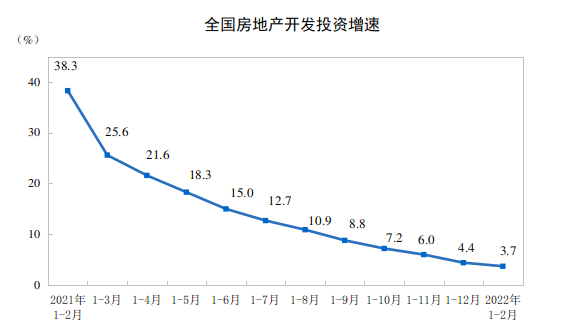
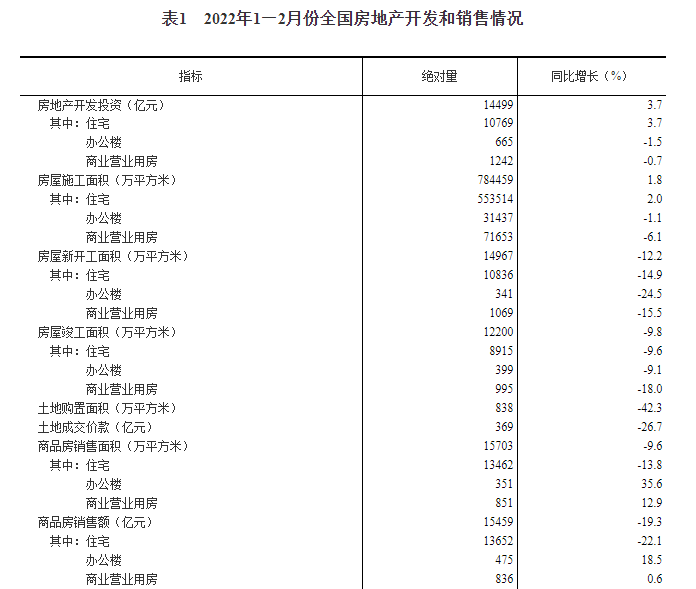
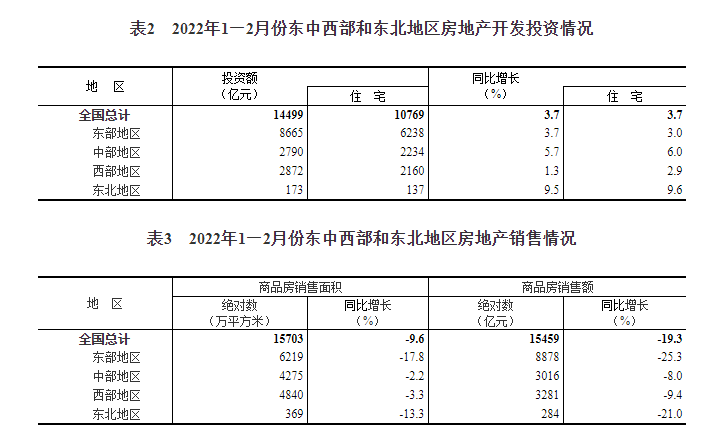
From January to February, national investment in real estate development totaled 1.4499 trillion yuan, an increase of 3.7 percent over the same period last year, of which residential investment was 1.0769 trillion yuan, up 3.7 percent.
From January to February, the housing construction area of real estate development enterprises was 7.84459 billion square meters, an increase of 1.8 percent over the same period last year, of which the residential construction area was 5.53514 billion square meters, up 2.0 percent; the new housing construction area was 149.67 million square meters, down 12.2 percent, of which the new housing construction area was 108.36 million square meters, down 14.9 percent; The floor space of houses completed was 122 million square meters, down 9.8 percent. Of this total, the area of residential buildings completed was 89.15 million square meters, down 9.6 percent.
II. Sales and waiting for sale of commercial housing
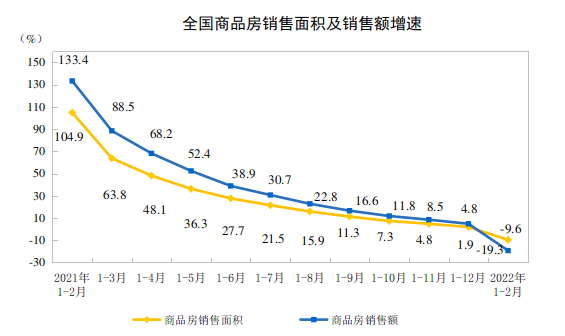
From January to February, the sales area of commercial housing was 157.03 million square meters, down 9.6 percent from the same period last year, of which residential sales decreased 13.8 percent; sales of commercial housing totaled 1.5459 trillion yuan, down 19.3 percent, of which residential sales fell 22.1 percent.
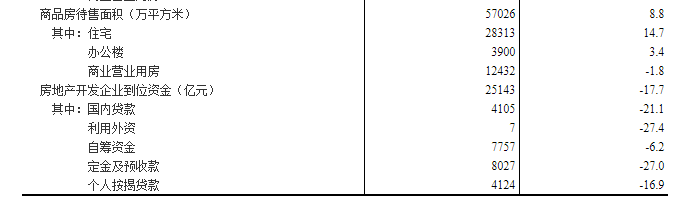
At the end of February, the area of commercial housing for sale was 570.26 million square meters, an increase of 60.03 million square meters over the end of 2021. Among them, the area for sale of residential buildings increased by 55.52 million square meters.
III. Funds in place for real estate development enterprises
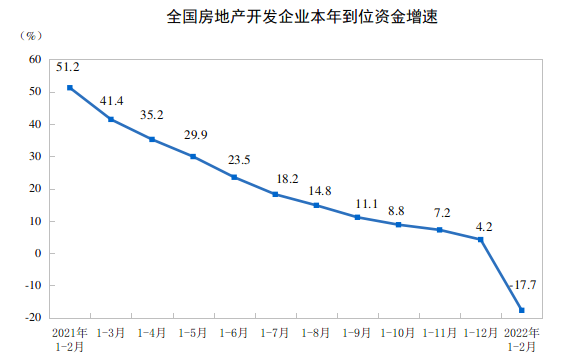
From January to February, the funds of real estate development enterprises reached 2.5143 trillion yuan, down 17.7% from the same period last year. Of this total, domestic loans totaled 410.5 billion yuan, down 21.1 percent from the same period last year; utilized foreign capital totaled 700 million yuan, down 27.4 percent; self-raised funds totaled 775.7 billion yuan, down 6.2 percent; deposits and prepayments totaled 802.7 billion yuan, down 27.0 percent; and personal mortgage loans totaled 412.4 billion yuan, down 16.9 percent.
IV. Prosperity Index of Real Estate Development
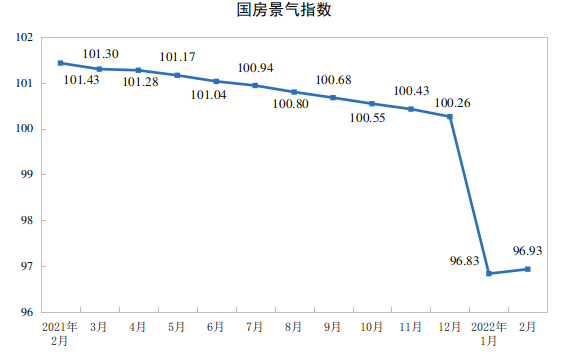
In February, the real estate development climate index (referred to as the "National Housing Prosperity Index") was 96.93.
Notes
1. Index interpretation
Investment completed by real estate development enterprises this year: refers to all investments completed during the reporting period for housing construction projects, land development projects, public welfare buildings and land purchase fees. The indicator is cumulative data.
Commercial housing sales area: refers to the total contract area for the sale of newly built commercial houses during the reporting period (that is, the building area recognized in the formal sale and purchase contract signed by both parties). The indicator is cumulative data.
Sales of commercial housing: refers to the total contract price for the sale of newly built commercial houses during the reporting period (that is, the total contract price recognized in the formal sale and purchase contract signed by both parties). This index is the same caliber as the sales area of commercial housing, and it is also cumulative data.
Commercial housing for sale area: refers to the commercial housing construction area that has not yet been sold or leased among the commercial housing construction area that has been completed for sale or rental at the end of the reporting period, including the housing area completed in the previous year and completed in the current period, however, it does not include the unsalable or rented housing areas such as demolition, unified construction, public supporting buildings, real estate companies' self-use and revolving houses, which have been completed in the reporting period.
Real estate development enterprises put in place funds this year: refers to various monetary funds and sources that can actually be used for real estate development during the reporting period of real estate development enterprises. Specifically subdivided into domestic loans, the use of foreign capital, self-financing, deposit and advance collection, personal mortgage loans and other funds. The indicator is cumulative data.
Building construction area: refers to the total building area constructed by real estate development enterprises during the reporting period. Including the area of new construction in the current phase, the housing area in which the construction continued in the previous period, the housing area in which the construction was suspended and resumed in the current period, the housing area completed in the current phase and the housing area in which the construction was suspended after the construction in the current phase. The construction area of a multi-storey building refers to the sum of the building area of each floor.
New housing construction area: refers to the housing area of the new construction of the real estate development enterprise during the reporting period, taking the unit project as the accounting object. It does not include the floor area of houses that started in the previous period and continued construction in the reporting period, and the floor area of buildings that were suspended in the previous period and resumed in the current period. The construction of the house shall be based on the date on which the house officially begins to break the earth trench (foundation treatment or permanent pile). The new construction area of the house refers to the total floor area of the whole house and cannot be calculated separately.
The completed area of the house: refers to the sum of the building area of each house that has been completed in accordance with the design requirements, meets the living and use conditions, passes the acceptance appraisal or meets the completion acceptance standard, and can be formally transferred for use during the reporting period.
Land purchase area: refers to the land area of real estate development enterprises that have obtained the right to the use of land by various means during the year.
Land transaction price: refers to the final amount of land use right transactions conducted by real estate development enterprises. In the primary market of land, it refers to the final allocation of land, the price of "recruitment and auction" and the transfer price; in the secondary market of land, it refers to the final contract price such as land transfer, lease, mortgage and so on. The transaction price of land is of the same caliber as the purchase area of land, and the average purchase price of land can be calculated.
two。 Statistical range
All real estate development and operation legal entities with development and operation activities.
3. Investigation method
A comprehensive survey is conducted on a monthly basis (except January).
4. A brief description of the National Real Estate Development Prosperity Index
The National Real Estate Development Prosperity Index (abbreviated as "National Housing Prosperity Index") follows the theory of economic cycle fluctuation, based on the theory and analysis method of business cycle, using time series, multivariate statistics and econometric analysis methods, taking real estate development investment as the benchmark index, selects the relevant indicators of real estate investment, capital, area and sales, excluding the influence of seasonal factors, including random factors. It is compiled by the growth rate cycle method, and the historical data are revised every month according to the newly added data. The National Housing Prosperity Index chooses 2012 as the base year and sets its growth level at 100. In general, the National Housing Prosperity Index of 100 points is the most appropriate level of prosperity, between 95 and 105 points is a moderate level of prosperity, below 95 is a lower level of prosperity, and more than 105 is a high level of prosperity.
5. Division of eastern, central, western and northeast regions
The eastern region includes 10 provinces (cities) of Beijing, Tianjin, Hebei, Shanghai, Jiangsu, Zhejiang, Fujian, Shandong, Guangdong and Hainan; the central region includes 6 provinces (cities) of Shanxi, Anhui, Jiangxi, Henan, Hubei and Hunan; the western region includes 12 provinces (municipalities and autonomous regions) of Inner Mongolia, Guangxi, Chongqing, Sichuan, Guizhou, Yunnan, Tibet, Shaanxi, Gansu, Qinghai, Ningxia and Xinjiang. The northeast region includes three provinces: Liaoning, Jilin and Heilongjiang.
![This Week, Platinum and Palladium Experienced Significant Pullbacks, End-Use Demand Recovered, and Spot Market Trading Was Normal [SMM Platinum and Palladium Weekly Review]](https://imgqn.smm.cn/usercenter/obeMy20251217171735.jpg)
![Silver Prices Continue to Pull Back, Suppliers Remain Reluctant to Sell, Spot Market Premiums Hard to Decline [SMM Daily Review]](https://imgqn.smm.cn/usercenter/LVqfJ20251217171736.jpg)