The overall decline in Shanghai tin inventory fell to its lowest level in nearly a month.

Published: Feb 23, 2022 10:35
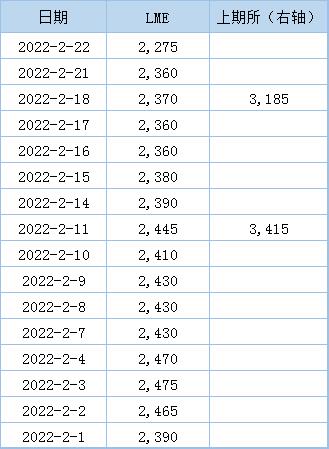
[Shanghai tin inventory overall decline to a nearly one-month low] data released by LME show that Lunxi inventory has fluctuated in a range recently. Lunxi inventory has fallen after rising to a 13-month high of 2475 tons on February 3. Lunn tin inventory as a whole still declined in the last week and fell sharply yesterday, with the latest inventory level of 2275 tons.

Data released by LME show that Lunxi inventory fluctuates in a range recently. Lunxi inventory fell after rising to a 13-month high of 2475 tons on February 3. Lunxi inventory as a whole still declined last week and fell sharply yesterday, with the latest inventory level of 2275 tons.

Shanghai tin inventories fell slightly in the week of February 18, falling 6.73 per cent to 3185 tonnes, a relatively high level in seven and a half months, according to data released last week.

Note: generally speaking, declining stocks in domestic and foreign exchanges will support the futures price, otherwise, it will be bad for the futures price.
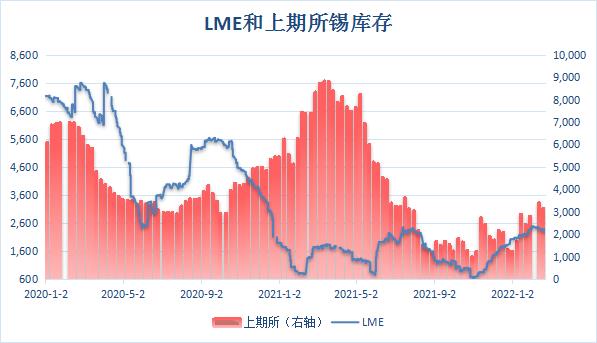
Comparison of tin inventory between LME and previous stock since 2020

The following is the tin inventory data of LME and Shanghai Stock Exchange since February 2022: (in tons)
Data Source Statement: Except for publicly available information, all other data are processed by SMM based on publicly available information, market communication, and relying on SMM's internal database model. They are for reference only and do not constitute decision-making recommendations.

For any inquiries or for more information, please contact: lemonzhao@smm.cn
For more information on how to access our research reports, please contact:service.en@smm.cn
Related News
Data: SHFE, DCE market movement (Aug 28)
Aug 28, 2026 15:53
Data: SHFE, DCE market movement (Aug 28)
Read More
Data: SHFE, DCE market movement (Aug 28)
The following table shows the ferrous and nonferrous metals movement on the SHFE and DCE on 28 Aug , 2026
Aug 28, 2026 15:53
【SMM Flash】Russia's Sulphuric Acid Producers Face Antitrust Probes; Intensifying Sulphur Supply Crunch
Aug 28, 2026 13:32
【SMM Flash】Russia's Sulphuric Acid Producers Face Antitrust Probes; Intensifying Sulphur Supply Crunch
Read More
【SMM Flash】Russia's Sulphuric Acid Producers Face Antitrust Probes; Intensifying Sulphur Supply Crunch
Russia's Sulphuric Acid Producers Face Antitrust Probes; Astrakhan Gas Plant Struck Again, Intensifying Sulphur Supply Crunch Russia's Federal Antimonopoly Service (FAS) announced on August 26 that it has initiated antitrust cases against four sulphuric acid producers for allegedly maintaining monopolistically high prices during 2024-2025. The companies include Mednogorsk Copper and Sulphur Combine, Sredneuralsk Copper Smelter, Svyatogor, and Karabashmed. All hold dominant positions in the wholesale sulphuric acid market and face turnover-based fines if violations are confirmed. On the supply side, Ukraine's General Staff confirmed that two U-272 gas separation units at the Astrakhan Gas Processing Plant were struck on the night of August 24. The facility, operated by Gazprom, accounts for nearly 60% of Russia's sulphur output. According to Rosstat, Russia's sulphur production fell 23% year-on-year in the first half of 2026, driven by unplanned outages at the Astrakhan and Orenburg gas plants. Previous attacks had already shifted Russia from a major exporter to a net importer of sulphur. On June 25, the government signed Decree No. 785 extending the industrial sulphur export ban through December 31, 2026. The latest strike on Astrakhan is set to further tighten global sulphur supply.
Aug 28, 2026 13:32
[SMM Flash] Temporary Controls on Phosphate Fertiliser Exports Are Expected to Be Lifted
Aug 28, 2026 13:26
[SMM Flash] Temporary Controls on Phosphate Fertiliser Exports Are Expected to Be Lifted
Read More
[SMM Flash] Temporary Controls on Phosphate Fertiliser Exports Are Expected to Be Lifted
[SMM Flash] Temporary Controls on Phosphate Fertiliser Exports Are Expected to Be Lifted
According to the latest policy developments, starting from September 1, 2026, China will resume normal export declaration for agricultural phosphate fertilisers. The earlier phased export controls (suspension of declarations) implemented from March 14 to August 31 were intended to prioritise ensuring fertiliser supply for China’s spring ploughing season; the ban is set to expire and be lifted at month-end August. From September 1, monoammonium phosphate (MAP), diammonium phosphate (DAP), and various types of agricultural phosphorus-containing compound fertilisers will resume export customs clearance. As direct exports of Iranian phosphate fertilisers (finished products such as MAP/DAP), which account for about 10% of global fertiliser trade volume, are restricted, international phosphate fertiliser prices are currently significantly higher than those in China. In the Baltic region, MAP quotations converted into yuan are nearly 1,000 yuan higher than China’s EXW price. After exports are reopened, industry leaders with export capabilities are expected to repair performance by taking on export orders, and are expected to achieve a situation of increased export volumes during China’s off-season.
Aug 28, 2026 13:26
The overall decline in Shanghai tin inventory fell to its lowest level in nearly a month. - Shanghai Metals Market (SMM)