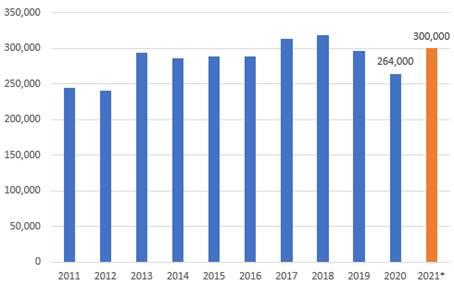
In 2021, the global output of tin mining mountains will be 300000 tons, an increase of 14% compared with 264000 tons in 2020.
This is the preliminary data released by the US Geological Survey (USGS), which also said that the average annual price of LME refined tin is expected to be 1500 cents per pound in 2021, up 93 per cent from 2020.
USGS added that transport bottlenecks, the reintroduction of COVID-19 blockade restrictions and rising demand for electronics and consumer goods led to supply constraints, which were the main reasons for the nearly doubling of refined tin prices in 2021.
The following is the global tin production, source: USGS 2021 preliminary data (in tons).
Global production has struggled to maintain an adequate supply of refined tin throughout the year to meet the rebound in consumer demand, the report said.
"epidemic-related measures, including work stoppages and border restrictions, have affected refined tin production in Myanmar, Indonesia, Malaysia and Rwanda," USGS said. Smelters in China and Malaysia have been temporarily closed for maintenance and annual repairs. "
In addition, the shortage of containers and bottlenecks at transport terminals exaggerate supply constraints. Globally, tin consumption of all alloys, chemical solders and tinned iron sheets will increase in 2021.
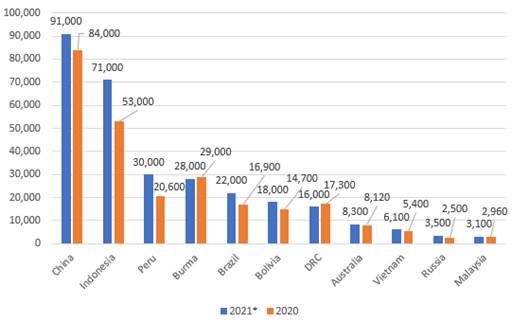
China is the largest producer of mining tin, with an output of 91000 tons, followed by 71000 tons in Indonesia and 30, 000 tons in Peru. China and Indonesia account for more than 50 per cent of global tin production.
The following are mine tin production by country, source: USGS 2021 preliminary data (in tons).
USGS also pointed out that the global tin resources are mainly distributed in West Africa, Southeast Asia, Australia, Bolivia, Brazil, Indonesia and Russia. If developed, recent annual production can be maintained for a long time in the future.