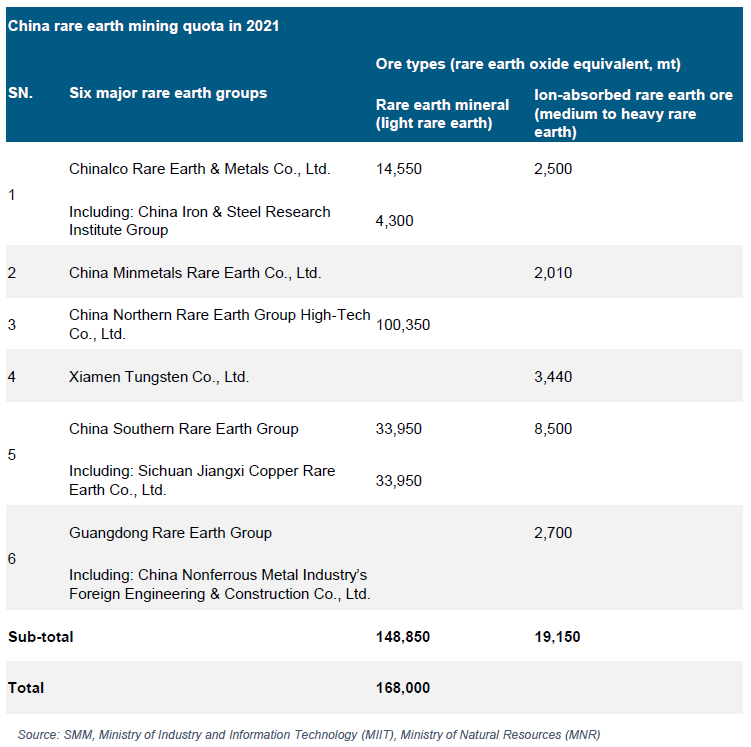
SHANGHAI, Feb 10 (SMM) - China’s rare earth mining and smelting/separation quotas stood at 168,000 mt and 162,000 mt respectively in 2021, according to the Ministry of Natural Resources (MNR) and the Ministry of Industry and Information Technology (MIIT). Among them, the mining quotas for ion-absorbed rare earth ores (primarily medium to heavy rare earth) and rare earth minerals (light rare earth) were 19,150 mt and 148,850 mt respectively. The quotas for rare earth mining and smelting/separation in 2020 came in at 140,000 mt and 135,000 mt respectively. In 2019, the total domestic mining quota for rare earth ores (rare earth oxide or REO) recorded 127,000 mt.
Based on the data in the past three years, China’s rare earth mining and smelting/separation quotas have been on the rise on the ground of expanding demand.
China's rare earth mining quotas increased 28,000 mt REO equivalent in 2021 on the year, all of which were for light rare earth elements. The quotas increased 8,000 mt in 2020 from a year ago, all of which were also for light rare earth elements.
Based on the quotas received by the six major groups, the Northern Rare Earth Group’s quota rose by 26,800 mt in 2021 year-on-year, and the Southern Rare Earth Group increased by 1,200 mt, all of which were for rare earth minerals (light rare earth elements).
Why are all the increments in quotas for light rare earth elements?
Rich in light rare earth resources
China has relatively abundant rare earth resources, with rare earth reserves accounting for approximately 23% of the world's total reserves. Among them, "more light rare earth in North China and more medium-to-heavy rare earth in South China" is the most important feature of China's rare earth resources. China's light rare earth mines are mainly distributed in northern areas such as Baotou, Inner Mongolia and Liangshan in Sichuan. Most light rare earth mines are available for industrial and scale mining.
However, the storage conditions of ion-absorbed rare earth (primarily medium-to-heavy rare earth) minerals are poor. The rare earth elements in the ion-absorbed rare earth ore are adsorbed in the soil in an ionic state, with scattered distribution and low abundance, making large-scale industrial mining difficult.
Preserving strategic resources of middle and heavy rare earth elements
Although China has been quite rich in light rare earth resources, the ion-absorbed rare earth resources are relatively scarce on this land. The ion-absorbed rare earth resources are indeed scarce on a global scale.
China's rare earth imports are mainly middle and heavy rare earth, including mixed rare earth carbonate ores from Myanmar or rare earth metal resources imported from the US.
Generally speaking, the foreign countries have relatively abundant middle and heavy rare earth elements while lack smelting and processing capacity. On the other hand, China’s middle and heavy rare earth resources seem to be more precious due to their scarcity, especially those with national strategic importance. Its subsequent development, application and sustainable development are the top priorities of the entire industry. Therefore, the mining quotas of China's middle and heavy rare earth mines remained the same in recent years.
The rapid development of the new energy and wind power industry boosted the demand for PrNd products
The increase or decrease of mining quotas is still to match downstream consumer demand.
With the extensive application of new energy vehicles and wind power in China and around the globe, the demand for neodymium iron boron (NdFeB) has been growing rapidly year by year. The most widely applied rare earth elements are light rare earth products such as praseodymium and neodymium.
Therefore, China’s annual increase in the mining quotas for light rare earth elements is also designed to meet the growing downstream demand.
China rare earth market analysis and outlook 2020-2022
Under the influence of multiple factors such as high downstream demand, supply reduction caused by COVID-19 pandemic, and policy support, the prices of most rare earth products rose significantly in 2020. Affected by the CVOID, some of the upstream rare earth enterprises’ production was constrained, hence the supply of mainstream rare earth oxides shrunk; while the market demand picked up, pushing up the prices to some extent.
Looking back into 2021, in light of expanding supply shortage, support from the cost side as well as policy support, the prices of most rare earth products have achieved significant increases in the year.
Light rare earth market
From the perspective of light rare earth, January to February 2021 was the seasonal high for magnetic materials companies to receive orders. More importantly, the financial pressures on companies are usually relatively small at the beginning of the year. Hence, upstream metal companies concentrated on purchasing and stocking before the Spring Festival, as downstream demand was robust. Therefore, the prices of PrNd oxide increased slightly.
While March ushered in a wave of resumed production after the Chinese New Year holiday, and spot prices rose afterwards. Then came the seasonal low of overseas purchases from May to July, when the prices of PrNd oxide corrected and stay congested. In July, the Yunnan-Myanmar border port was closed for pandemic control, and the import of rare earth ores from Myanmar was blocked. As domestic separation and smelting companies, especially in south China, rely heavily on imported ores from Myanmar, the blockage of border port tightened the ore supply, arising panics across the market. The prices of PrNd oxide also rose to above 600,000 yuan/mt. The panic sentiment dissipated later on, and the spot market turned weak and traded sideways in August and September.
From October to November, the ore supply was still tight, and domestic rare earth ore inventories dropped significantly. Furthermore, on the back of the shortage in terms of electricity and coal supply in the second half of 2021, the provinces in south China implemented power cuts with varied intensity, resulting in broadly lower operating rates. The support from the fundamentals strengthened, and PrNd oxide prices quickly rose to 850,000-860,000 yuan/mt. At the same time, power rationing raised the costs of auxiliary materials, offering strong support from the cost side.
In mid-to-early December, upstream manufacturers were quite reluctant to sell, and the downstream sector also turned away from high prices. In other words, the conflicting forces of the upstream and downstream were in play, putting the market in a stalemate, which temporarily stabilised the PrNd oxide prices.
Medium and heavy rare earth market
In terms of medium and heavy rare earth, the prices dysprosium and terbium shadowed the moves of mainstream PrNd products from January to March 2021 and rose, and then dropped slightly after the seasonal low for procurement arrived. The medium and heavy rare earth was in short supply from September to October, which provided strong upside momentum for medium and heavy rare earth products such as dysprosium and terbium. Due to the shortage of ion ore supply in China, the dynamics of the dysprosium and terbium market is highly correlated with the customs clearance of Myanmar ion ore. In mid-November, the relative authority in Yunnan issued the Orderly Resumption of Border Customs Clearance, which created strong bearish sentiment in the market. The prices of dysprosium and terbium slightly corrected amid market panics. In mid-to-early December, the market was comparatively quiet, and the purchasing demand was weak. Hence the prices of dysprosium and terbium stabilised for the moment.
Key factors that will affect China’s rare earth prices in 2022:
1. The global evolution of the COVID-19 pandemic
With the global spread of omicron COVID variant, the pandemic situation faced more challenges. Some countries such as Japan issued an entry prohibition announcement in November 2021 following the discovery of omicron in South Africa. The current evolvement of COVID will affect China's imports of rare earth ores to a certain extent.
2. Rare earth mining quota in 2021
The domestic mining of light and heavy rare earth ore accounts for 44% of the total supply of mainstream oxide products. The mining quota for light rare earth is 149,000 mt in 2021, an increase of 20% year-on-year; and the quota for medium and heavy rare earth ore totals 19,000 mt. As the mining of rare earth ore brings greater pressure on environmental protection, the annual mining quota of medium and heavy rare earth ore has not increased in the past few years. It is expected that, affected by domestic downstream demand, China's rare earth mining quotas are likely to continue to increase in 2022 compared with 2021, and the increase will still on light rare earth mineral products.
3. Rare earth import and export
The eurozone and the United States drafted an incentives scheme for the development of the rare earth industry by providing tax reductions and subsidies to smelting and separation companies. Lynas, incorporated in Australia, has extended its businesses to smelting and separation, demonstrating large overseas rare earth companies’ ambition to expand their industrial footprints further. The purpose is to wean from China rare earth products and reduce its exports of raw materials to China as well. If China’s import of raw materials decreases, it is likely to push up the prices of rare earth products from the supply and demand perspective.
4. Downstream companies’ demand
The increase in downstream demand in 2022 will mainly be contributed by new energy vehicles and wind turbines. It is clearly pointed out in the 2020 New Energy Automobile Industry Development Plan that the sales of new energy vehicles will account for about 25% of the total sales of new vehicles in the next five years, which will directly drive the demand for automotive motors - the downstream of rare earth permanent magnets. The cumulative sales of new energy vehicles from January to November 2021 stood at 2.99 million units, accounting for 12.7% of the total vehicle sales. In other words, there is still great potential for growth.
The era of carbon neutrality has been revealed. During the "14th Five-Year Plan" period, the wind power development plan proposes that by 2025, the average annual growth of installed capacity of wind power will not be less than 50 million kilowatts, which will directly drive the demand for wind turbines - also the downstream of rare earth permanent magnets. China's newly installed wind power capacity was 71.67 MW in 2020, and stood at 19.19 million kilowatts from January to October 2021. There is still a lot of room for growth in the future.
5. National Policy
Currently, there are six leading groups in the rare earth industry, which are in the process of integration from the policy level to better develop and preserve rare earth as a strategic resource. As such, China Minmetals Group and Chinalco issued a corporate merger announcement in September, 2021, and the China Rare Earth Group, jointly incorporated by China Minmetals, Chinalco, and Ganzhou Rare Earth Group, will be officially listed by the end of December, 2021. The horizontal integration process among rare earth enterprises in the south is accelerating, with the south focusing on heavy rare earth and the north highlighting light rare earth. The newly incorporated group may offer list prices for its mainstream products in the future, which will be able to guide the spot market.
Looking into 2022, China is likely to increase the mining quota of light rare earth, and will make certain changes to industrial policies as the downstream demand is likely to improve further. However, the COVID-19 pandemic is still estimated to bring new challenges to the industry. All of these factors will impact the price moves of domestic rare earth market, which is likely to hover at a high level, following the general trend in 2021.
To access full SMM China Rare Earth Industry Chain Annual Report 2021-2025, please contact Michael Jiang at michaeljiang@smm.cn or T: +86-21-51666812 |M:+86-1522-1415-920.
![Policy Tailwinds Combined with Rising Expectations of Improving Demand, Rare Earth Permanent Magnets Concept Strengthened, Xiangdian Co. Hit Daily Limit [SMM Express]](https://imgqn.smm.cn/usercenter/AJTtH20251217171744.jpg)
![Rare Earth Export Prices Saw Slight Correction This Week as Geopolitical Tensions and Supply Chain Restructuring Accelerated [SMM Rare Earth Ex-China Weekly Review]](https://imgqn.smm.cn/usercenter/UXEpx20251217171743.jpeg)