Judging from the current situation, the crazy increase in the price of battery raw materials will spread to the mainframe factory sooner or later.
Recently, Nikkei Asia reported that the price of electric car batteries could rise in 2022 after a decade of sharp decline as the supply of lithium and other raw materials could not meet the ballooning demand.
In fact, the news of the increase in battery prices began to spread in late 2021. In October last year, the release of a BYD "battery price increase contact letter" caused a sensation in the industry. According to the contact letter, BYD Lithium Battery decided to raise the unit price of battery products such as CO8M by no less than 20%, starting from November 1 last year.
Coincidentally, it is reported that a number of battery companies sent out their own price increases or like price increases last year.
Ganfeng Lithium Industry, a raw material supplier, issued a price adjustment letter on Oct. 9, announcing an increase of 100000 yuan per ton for the full range of lithium metal products. On October 17, Penghui Energy issued a price increase letter, listing various raw material projects and recent price changes, and said that the rising prices of raw materials were seriously out of stock at the same time, and most materials manufacturers still could not guarantee the supply when they asked for cash delivery.
On October 18, Guoxuan Hi-Tech sent a price adjustment negotiation letter. Guoxuan Hi-Tech said that with the rising prices of cathode materials, electrolytes, copper foil and aluminum foil, the company has done its best to reduce the impact of rising costs, but with little success, so the company plans to hold a second negotiation on the order already signed by the two sides.
The reason why they want to raise the price is not unexpected, it is all due to the rise in the price of raw materials. So how terrible is the increase in the price of raw materials, forcing these not-so-small battery companies to raise prices one after another?
According to the historical price of SMM, the prices of lithium metal, lithium carbonate and lithium iron phosphate have risen rapidly since 2021, especially lithium carbonate, as shown in the following chart:
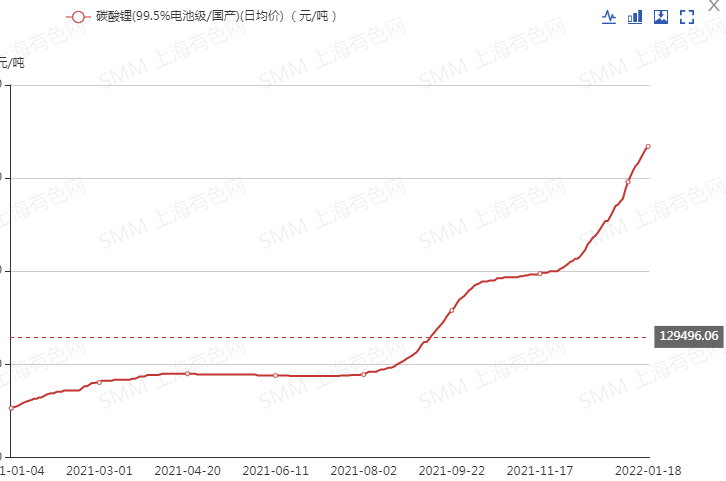
"Click to view the historical price of SMM Metals.
Not only that, the prices of cobalt and nickel have also been rising rapidly. Since January 2021, the price of cobalt has doubled to $70208 a tonne, while the price of nickel has jumped 15 per cent to $20045.
Price increase or does not increase the price? How do battery companies choose?
It's hard!
As mentioned in BYD's letter, raw materials for lithium batteries continue to rise in 2021, the price of cathode material lithium cobalt has increased by more than 200%, the price of electrolyte has increased by more than 150%, and the supply of negative materials has continued to be tight, resulting in a substantial increase in comprehensive costs. In the notice of price adjustment, Penghui Energy even made a list comparison of the prices of some of the larger increases in the prices of raw materials, in order to prove how much pressure is on the prices of raw materials.
Take Penghui Energy as an example, according to its latest quarterly report, operating income reached 1.44 billion yuan in the third quarter, up 24% from the same period last year, while net profit was 45.6 million yuan, down 35% from the same period last year.
Indeed, the current increase in power battery costs is generally between 30% and 40%, which has exceeded the gross profit margin of most power battery companies. If prices cannot be raised, it will be very difficult for most battery companies to make money, and over time, survival may be a problem.
Of course, there are battery companies that are less stressed, such as the Ningde era, and its gross margin does not seem to have been affected by the rising price of raw materials. According to the third-quarter results released by Ningde Times, the company's gross profit margin rose slightly compared with the second quarter.
Why the Ningde era can be left alone, because of the strength. At present, Ningde era has cooperation with almost all major automobile companies, and there is no worry that the products are not selling well.
And recently, Ningde era has acquired or invested heavily in many raw materials enterprises at home and abroad, including lithium, nickel, electrolyte, positive and negative batteries, which can maximize the increase in the price of related materials and reduce their impact on themselves.
Industry insiders said that the upstream raw material prices skyrocketed, downstream new energy vehicle demand is strong, sandwiched in the middle of the power battery manufacturers do not have too strong bargaining power. The sharp rise in prices upstream stems from a serious shortage of supply and demand, and there is no reason to reduce prices. Downstream new energy vehicle manufacturers still maintain the control of "the whole vehicle is king" in the automobile industry, so it is difficult to negotiate prices. therefore, power battery manufacturers have to bear the pressure brought by the rising prices of upstream materials silently.
Car companies: "waiting" is also an ordeal.
It's hard, too!
Although the mainframe factory holds the control of "the whole vehicle is king" in the automobile industry, battery companies have raised prices and can give up working with them to develop their own batteries. Yes, this is a good method, but don't you need raw materials for self-developed batteries? BYD is still going to raise the price.
For car companies, if the power battery company can not withstand the pressure to raise prices, there are two problems to be faced first. One is to decide whether to continue to work with power battery companies or develop their own batteries, what is certain is that no matter which one you choose, the result will be a rapid rise in costs.
Second, should the price of the whole car go up? Perhaps for manufacturers such as BYD and Tesla, because the base is strong enough, the cost caused by rising battery prices can be shared equally between higher production and sales, and due to brand effect, the degree of consumer acceptance of price increases may be relatively high; but for some general sales, enterprises in the rising period, consumers' tolerance is not so high, and a hasty price increase is similar to seeking a dead end.
It is understood that in response to the demand for higher prices of power battery enterprises, the feedback of some vehicle manufacturers is that they cannot accept the price increase of power batteries, but they are willing to ease the pressure on battery companies through other forms such as account period, binding cooperation, financial cooperation, and so on. There are also individual vehicle manufacturers said that they agreed to a small increase in the price of batteries for new models.
In any case, this wave of price increases is bound to have an impact on a number of power battery companies and increase pressure on mainframe manufacturers. If it is serious, it may lead to the elimination of a number of power battery companies.