SMM survey: what kind of metal do you like most in 2022?
On December 23, the Department of Energy Saving and Comprehensive Utilization of the Ministry of Industry and Information Technology issued a list of enterprises (the third batch) that meet the "Industrial norms and conditions for Comprehensive Utilization of waste Power Storage batteries for New Energy vehicles". A total of 20 enterprises were selected. They are Hebei Zhonghua Lithium Technology Co., Ltd., Honeycomb Energy Technology Co., Ltd., Jiangsu Oulite Energy Technology Co., Ltd., Nantong Bei New Energy Technology Co., Ltd., Zhejiang Tianneng New Materials Co., Ltd., Hangzhou Anying Technology Co., Ltd., Zhejiang New era Zhongneng cycle Technology Co., Ltd., Anhui Xunying Power Energy Technology Co., Ltd., Hefei Guoxuan High-tech Power Energy Co., Ltd. Chizhou Xien New material Technology Co., Ltd., Fujian Changqing New Energy Technology Co., Ltd., Jiangxi Tianqi Jintai Pavilion Co., Ltd., Jiangxi Ruida New Energy Technology Co., Ltd., Changsha Mining and Metallurgical Research Institute Co., Ltd., Hunan Kaidi Zhongneng Technology Co., Ltd., Jinchi Energy Materials Co., Ltd., Hunan Jinkai cycle Technology Co., Ltd., Jiangmen Langda Lithium Battery Co., Ltd., Guangdong Didu New Energy Co., Ltd., Pearson Environmental Protection Technology Co., Ltd.
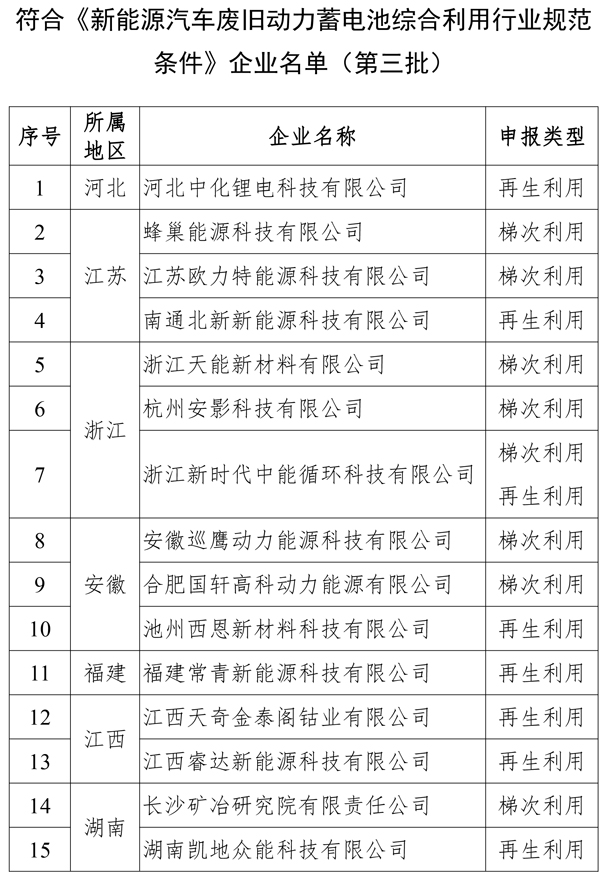
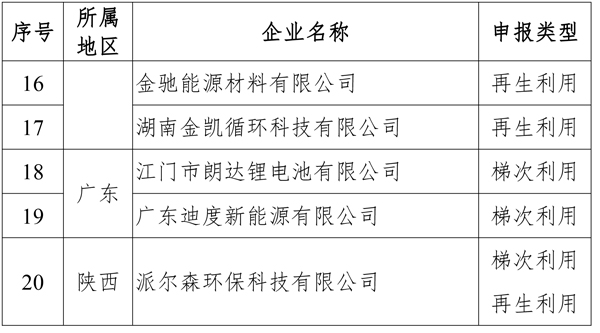
Among the above 20 companies, a total of 2 companies applied for echelon utilization and recycling at the same time, and 9 enterprises applied for echelon utilization and recycling only.
Together with the list of two batches of enterprises issued by the Ministry of Industry and Information Technology in December 2020 and September 2018, the "regular army" of the comprehensive utilization of waste power batteries for new energy vehicles has been expanded to 47.
According to the interim measures for the Administration of Recycling and Utilization of Power Storage batteries for New Energy vehicles jointly issued by the Ministry of Industry and Information Technology and other five departments in August this year, automobile manufacturing enterprises bear the main responsibility for the recovery of power batteries and should establish power battery recovery channels to be responsible for the recovery of waste power batteries produced after the use and scrapping of new energy vehicles. At the same time, automobile manufacturing enterprises, battery manufacturing enterprises, scrapped automobile recycling and disassembly enterprises and comprehensive utilization enterprises are encouraged to jointly build and share waste power battery recycling channels through various forms.
On December 3, the Department of Energy Saving and Comprehensive Utilization of the Ministry of Industry and Information Technology said that by the end of October this year, 10048 relevant enterprises had set up power battery recycling service outlets in 31 provinces, cities and autonomous regions across the country, and cultivated 26 key echelon and recycling enterprises. the recycling system has been initially established.
The global power battery recycling industry is expected to reach $12.2 billion in 2025 and $18.1 billion by 2030, according to market research and consulting firm MarketsandMarkets. China is one of the largest power battery recycling markets.
According to the "China Lithium Ion Battery Recycling and disassembly and echelon Utilization Industry Development White Paper (2021)" jointly released by research institutions EVTank, Ivy Economic Research Institute and China Battery Industry Research Institute, the theoretical recovery of lithium-ion batteries in the Chinese market reached 478000 tons in 2020, of which the theoretical recovery of automotive (EV) lithium power batteries has exceeded that of small-scale (Small) lithium-ion batteries, reaching 257000 tons. EVTank predicts that the theoretical recovery of lithium-ion batteries in China will reach 988000 tons by 2025, with a significantly faster growth rate. It is worth noting that another set of data disclosed in the white paper show that although the theoretical recovery volume of lithium-ion batteries in the Chinese market reached 478000 tons in 2020, the actual statistical actual recovery volume is only 196000 tons, accounting for only 41%. And a large proportion of the actual recovery volume is dealt with by enterprises that do not have the recycling qualification (the white list of battery recycling enterprises of the Ministry of Industry and Information Technology).
In addition, the white paper also shows that in 2020, lithium-ion battery recycling enterprises are still dominated by Bang Pu and Grimm. In terms of actual handling capacity, the two enterprises have a combined market share of more than 50%. However, the white paper also analyzes that the entire lithium-ion battery recycling industry lacks norms and standards, and a large number of small enterprises and even individuals are engaged in operating activities in the lithium battery recycling industry chain. There is a phenomenon of "Bad money drives out good" in the whole market.
The good news is that the regulation of the battery recycling industry is being strengthened at the policy level:
In September, the State Administration of Market Supervision (Standard Commission) issued the national standard "Recycling and Recycling of vehicle Power Battery", giving full play to the supporting role of the standard in economic and social development. The new national standard of "vehicle power battery recycling echelon utilization" includes two standards: "vehicle power battery recycling echelon utilization part 3-echelon utilization requirements" (GB/T 34015.3-2021) and "vehicle power battery recycling echelon utilization part 4-echelon utilization product identification" (GB/T 34015.4-2021).
On December 3, the Ministry of Industry and Information Technology said that it would work with relevant departments to promote the following work:
First, improve rules and regulations and strengthen regulatory constraints. We will speed up the study and formulation of departmental regulations on the measures for the recovery and Utilization of Power Storage batteries of New Energy vehicles, further clarify the specific regulatory responsibilities of relevant national and local departments, and refine the regulatory requirements of all aspects of power battery recycling. Strengthen regulatory constraints.
The second is to improve the recycling network and strengthen traceability management. We will explore and promote new business models such as "Internet + recycling", encourage enterprises in the upper and lower reaches of the industrial chain to jointly build common recycling channels, and build a number of centralized recycling service outlets. Study and establish the linkage mechanism of management and control of power battery recycling, strengthen online and offline collaborative traceability supervision and management, compass the responsibilities of relevant subjects, and improve the efficiency of supervision.
The third is to improve the standard system and speed up technological innovation. We will speed up the introduction of a number of national and industry standards for the recycling of power batteries, and do a good job in the promotion and implementation of the standards. Step up efforts to tackle key technologies such as efficient recycling, update and issue the National catalogue of Advanced and applicable Technologies and equipment for Comprehensive Utilization of Industrial Resources, speed up the popularization and application of advanced technology and equipment for power battery recycling, and upgrade the technical level of the industry.
The fourth is to increase policy support to empower the development of the industry. We will continue to implement standardized management in the industry for the comprehensive utilization of waste power batteries, and set up a number of benchmark enterprises for echelon and recycling. At the same time, we also encourage and guide financial institutions and social capital to innovate products and service models, and support the construction of power battery recycling enterprises and projects.
On December 10, 18 departments including the Ministry of Ecology and Environment jointly issued the work Plan for the Construction of waste-free cities during the 14th five-year Plan period, which is clear: speed up the green and low-carbon development of industry and reduce the pressure of industrial solid waste disposal. We will support leading enterprises in metal smelting, papermaking and automobile manufacturing to cooperate with renewable resources recovery and processing enterprises to build integrated green sorting, processing and distribution centers for scrap iron and steel, waste non-ferrous metals and waste paper, as well as waste power battery recycling centers.