[please check] SMM South China Nonferrous Metals Industry Annual meeting change notice
At the United Nations Climate change Conference held in Glasgow, England, countries' awareness of the urgency of controlling climate change has increased significantly. Some countries have proposed to increase global emission reduction efforts and speed up the process of emission reduction. It is necessary to make clear the goal of limiting the temperature rise to less than 1.5 degrees Celsius, because according to the current emission scale and emission reduction plan, the global temperature rise is still expected to be much more than 2 degrees Celsius. With disastrous consequences. Only when global greenhouse gas emissions reach a peak as soon as possible, and net zero greenhouse gas emissions are achieved in the second half of this century, can we reduce the ecological risks brought by climate change to the earth and the survival crisis to human beings.
Recently, the (IAI) of the International Aluminum Association launched a new emission reduction plan for the aluminum industry in response to the climate change goal of keeping the global average temperature rise within 2 degrees Celsius and striving within 1.5 degrees Celsius, to guide its members to take action to support the achievement of global emission reduction targets. The model is based on the net zero emission scenario model of the International Energy Agency before 2050, combined with the material flow analysis of the International Aluminum Association and the future aluminum demand scenario to measure the greenhouse gas emissions of the global aluminum industry.
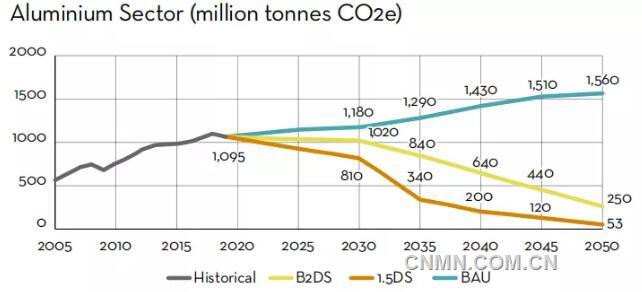
The results of the model show that according to the 1.5-degree warming scenario, the total greenhouse gas emissions of the global aluminum industry will be reduced by 95% in 2050 compared with 2018. It is also required to significantly reduce the carbon strength of primary aluminum from the current 16.1 tons of aluminum to 0.5 tons of carbon dioxide equivalent by 2050. Previously, under the scenario of ensuring a warming of less than 2 degrees Celsius, the total greenhouse gas emissions of the aluminum industry would be reduced by 77 percent in 2050, with 2.5 tons of carbon dioxide equivalent emitted by tons of aluminum.
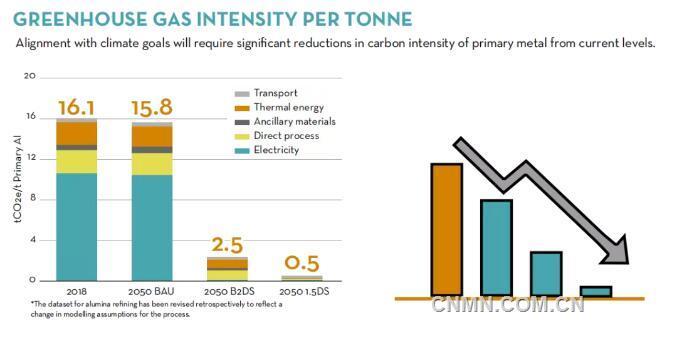
The 1.5C scenario is the most ambitious decarbonization method and complements existing work, taking into account the historical emissions of the aluminium industry and contrasting the usual "scenario (BAU)" and "below 2" scenarios (B2DS) in 2050, according to the International Aluminium Association.
Marlen Bertram, Director of scenarios and Forecast of the International Aluminum Association, said: "according to the 1.5-degree warming scenario, the aluminum industry is required to significantly reduce the overall emissions and emission intensity of all major sectors, including electricity, process emissions, heat and recovery. As these emission reduction measures are carried out at the same time to meet the increasing global demand for aluminum, the challenge is further increased. During this period, expanding the use of aluminum can help reduce carbon emissions in other industries, such as electric vehicles, cables and renewable energy generation. "
Marlen Bertram further said: "both the 1.5-degree scenario and the B2DS scenario are in line with the Paris Agreement. The goal of the 1.5-degree scenario is not an alternative to the B2DS scenario, but rather a different option to encourage relevant companies and institutions to consider more options to achieve greater emissions reductions. " Over the past two decades, primary aluminum production has continued to grow to meet growing demand. The emission intensity of primary aluminum production has a significant impact on the overall emission intensity of the aluminum industry. At present, the emission reduction measures being promoted in the aluminum industry include: the use of inert anode technology, increasing the use of renewable energy, zero thermal emission test and application, improving the recovery rate of waste aluminum and so on.
The International Aluminium Association said it was clear from the model analysis that the emission reduction trajectory of different companies would depend on their geographical location, available options and position in the value chain. Although the future is bright, further technology development and more investment are needed if the 1.5-degree scenario limit is to be reached.
The following is a comparison of a set of data for greenhouse gas emission schemes for the aluminum industry under several warming scenarios by 2050:
By 2050, the emission intensity of primary aluminum will be reduced from 16.1 tons in 2018 to 2.5 tons of CO2/ tons of aluminum (B2DS) or 0.5 tons of CO2/ tons of aluminum (1.5 degrees).
By 2050, direct emissions from aluminium production will be 59 per cent (B2DS) or 93 per cent (1.5C) lower than in 2018.
By 2050, electricity emissions from aluminum production will be 98% lower than in 2018.
By 2050, total greenhouse gas emissions from the aluminum industry will fall from 1.1 billion tons in 2018 to 53 million tons (1.5 degrees Celsius), 250 million tons (B2DS) and 1.6 billion tons of (BAU) under different temperature rise scenarios. In a 1.5-degree scenario, the emission reduction of 1amp 4 will be achieved in the next 10 years.
In the 1.5 degree scenario, by 2050, as the collection system of aluminum is more perfect, almost no aluminum is lost to landfills or lost in the smelting process, the service life of aluminum products is prolonged, and the consumption and demand of aluminum are more in line with the requirements of the net zero society.
In the 1.5C scenario, primary aluminum production will increase from about 64 million tons in 2018 to 68 million tons by 2050, while in the B2DS scenario, primary aluminum production will be 81 million tons. Higher emission reduction requirements will greatly limit the growth of primary aluminum.
At 1.5 degrees, by 2050, the output of recycled aluminum will reach 81 million tons, exceeding the output of primary aluminum, of which 68 million tons will come from post-consumer waste aluminum and 13 million tons from new waste aluminum / process waste.
By 2050, under the 1.5T scenario, the total greenhouse gas emissions from the primary aluminum production process will be 35 million tons, while in the B2DS scenario it will be 200m tons.
By 2050, greenhouse gas emissions from the recycled aluminum production process will be 8 million tons at 1.5 degrees Celsius, compared with 21 million tons in the case of B2DS. The greenhouse gas emissions per ton of recycled aluminum production is 95% less than that of primary aluminum production.
At 1.5 degrees, the carbon emission intensity of primary aluminum is 0.5 tons of CO2/ tons of aluminum, which is even lower than the current emission intensity of recycled aluminum (0.6 tons of CO2/ tons of aluminum). And at 1.5 degrees, the emission intensity of recycled aluminum should be reduced to 0.1t CO2/ ton of aluminum, which is twice as low as the emission value of 0.2t CO2/ ton aluminum in the case of B2DS.
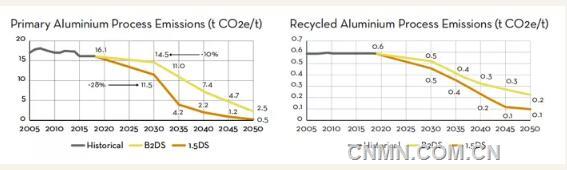
Obviously, by analyzing the above calculated data of the International Aluminum Association, no matter comparing the actual situation or the future scenario of warming below 2 degrees, the 1.5-degree plan will put forward higher requirements for the aluminum industry to deal with climate change. To achieve the above-mentioned series of goals, great changes must take place in the whole industry, including great changes in the energy structure and industrial layout structure, and major advances and revolutionary breakthroughs in smelting, processing and recycling technology. Aluminum products and consumption patterns also need to make important changes to better meet the requirements of sustainability.
The International Aluminum Association launched this calculation scheme during the 26th United Nations Climate change Conference, which is bound to arouse great attention from aluminum industry participants and stakeholders in the industry chain, indicating the major challenges facing the industry in the future. The relevant parties need to anticipate the development prospects and strategic tasks of the industry, take the initiative to assume the responsibility and fulfill the obligations of emission reduction, and strengthen cooperation and joint response in the process of this action, so as to demonstrate the industry's capacity on the road to achieving the sustainable development goals. make industry contributions.