A few days ago, the bus Federation released the production and sales data of passenger cars in October. The data showed that narrow-sense passenger car production fell 4.1% year-on-year to 1.96 million in October, down 4.1% from a year earlier. Retail sales of narrow-sense passenger cars fell 13.9% to 1.717 million, while wholesale sales of narrow-sense passenger cars in October were 1.978 million, down 4.8% from a year earlier. Although the passenger car market is still sliding below the main tone in October, due to the gradual improvement in chip supply at the end of September and the relatively stable domestic epidemic from the end of September to the middle of October, these factors have contributed to the stabilization of the automobile production and sales structure in October.
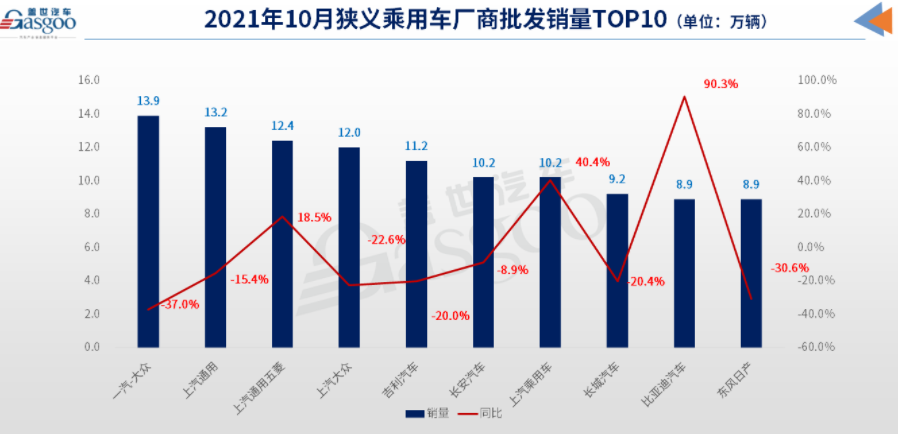
In terms of the wholesale sales of passenger car manufacturers in the narrow sense in October, the top 10 car companies did not increase or decrease compared with September, but the major car companies changed slightly in the internal order. The specific performance is as follows: first, FAW-Volkswagen replaced SAIC-Volkswagen to become the champion, which is also two months later, FAW-Volkswagen returned to the top of the list again; second, Great Wall Automobile and BYD moved forward, while Dongfeng Nissan retreated to the bottom. In addition, SAIC's October sales remained strong, with four subsidiaries shortlisted.
The sales volume of German system has gradually improved, and the performance of Shanghai Automobile system is outstanding.
FAW-Volkswagen sold 139000 vehicles wholesale in October, a 37 per cent year-on-year decline, but still leads in volume. Meanwhile, SAIC-Volkswagen sold 120000 vehicles in October, ranking fourth among narrow passenger car manufacturers in wholesale sales in October. The bus Association pointed out that with the improvement of Volkswagen sales, the market share of German cars in the mainstream joint venture brands is gradually increasing, and the supply situation continues to improve.
In October, SAIC still had four subsidiaries on the list of narrow passenger car manufacturers in wholesale sales, namely SAIC GM, SAIC GM Wuling, SAIC Volkswagen and SAIC passenger cars. The four subsidiaries contributed 95 per cent of SAIC's sales in October, helping SAIC reach 580000 vehicles in October. On November 4, SAIC announced its October sales results. Due to the excellent performance of the above four subsidiaries, SAIC shares rose by the daily limit of only half an hour after A shares opened on November 5, the first limit of SAIC shares this year.
Although the rise and fall of the stock price is caused by multiple factors, it is undeniable that SAIC's market performance in the past two months is indeed relatively strong. In particular, new energy and overseas market sales have achieved substantial growth. Data show that SAIC sold 556000 new energy vehicles from January to October this year, an increase of 187.6 per cent over the same period last year. Among them, Hongguang MINIEV, which is owned by SAIC GM Wuling, has played an absolute main role. In addition, ID. under SAIC Volkswagen Series sales are gradually climbing in recent months, with the arrival of ID.3, its overall market share continues to expand.
In the first 10 months of this year, SAIC sold 529000 vehicles in overseas markets, up 99.4 per cent from a year earlier. Among them, SAIC GM, SAIC GM Wuling, SAIC passenger cars and SAIC Chase are the main contributors to SAIC's exports and overseas market sales. At the end of October this year, 1500 Unkewei S produced by SAIC GM Dongyue factory were exported to the North American market. It is understood that SAIC GM Dongyue Motor Co., Ltd. exported 66000 vehicles from January to September this year, an increase of 224.1% over the same period last year. In addition, SAIC GM Wuling has factories in Indonesia and SAIC Mingjue in India. At present, the monthly sales of the two companies in overseas factories are stable at more than 2000 units. At the same time, SAIC passenger car MG brand and SAIC Chase have achieved good market performance in Europe, Australia and other places. Industry analysts commented that the strong performance of Chinese car companies, led by SAIC, in exports and overseas markets further highlights the fact that made in China and Chinese supply chains have withstood the test in the context of frequent global outbreaks, and also provides an opportunity for Chinese brands to "go out to sea".
The independent lineup continued to grow, and the ranking of Great Wall and BYD moved forward.
In October, the performance of the independent brand market is still commendable. According to data provided by the Carriage Association, self-brand terminal sales in October were 770000, up 4 per cent from a year earlier and 11 per cent month-on-month, up 9 per cent from October 2019. This is even more difficult in a situation where sales of both luxury brands and mainstream joint venture brands have declined affected by the shortage of chips.
As the leader of its own brand, Geely achieved sales of 112000 vehicles in October, down 20% from a year earlier, and still ranks first in terms of volume. Geely said in official news that Geely Xingyue L sold only 4092 cars in October due to a shortage of chips in the 7nm Qualcomm Snapdragon 8155, with cumulative orders for the model now exceeding 75000. If tens of thousands of orders affected by chip shortages are released over the next two months, Geely is on track to meet its annual sales target of 1.53 million vehicles set at the beginning of the year. Geely has sold 1.033 million vehicles in the first 10 months, reaching 68 per cent of its annual sales target, according to figures released by Geely.
Changan sold 102000 vehicles in October, down 8.9 per cent from a year earlier. Industry insiders pointed out that at this stage, Changan automobile CS75 series, CS55 series, Yi series is the foundation of its solid sales, as long as the above models remain hot, Changan automobile sales will be guaranteed. However, in the Changan UNI series, the performance of UNI-K needs to be improved.
In addition to Geely and Changan becoming more and more stable in the independent head camp, the sales rankings of SAIC passenger cars, Great Wall cars and BYD cars are also rising rapidly. Of these, Great Wall sold 92000 passenger cars in October, with Harvard and Euler contributing 63000 and 13000 respectively, while the tank brand sold nearly 10,000 vehicles in October, far surpassing the WEY brand. However, the WEY brand is now in the adjustment stage, and with the launch of the WEY coffee series, it has embarked on a new round of product renovations. In the future, the WEY brand will also have car products to join, which also means that Great Wall Motors restart the car business after many years.
Under the background of the lack of core and the epidemic restricting the development of the automobile industry, BYD took off rapidly in the east wind of new energy vehicles and became one of the few Chinese brand car companies in the highlight moment this year. In October, BYD sold 89000 new cars, but fuel vehicles accounted for less than 10%, which is a further indication that new energy vehicles have become the absolute sales pillar of BYD. Of course, the sharp increase in BYD's new energy vehicle sales is inseparable from its technical layout in the field of pure electricity and plug-in. At present, many models based on DM-i super hybrid technology platform have become popular, while dolphin, the first model based on e-platform 3.0, has entered the market. In the future, the pure electric models under this platform, together with Han EV, are expected to form a strong product lineup of BYD in the field of pure electric vehicles.
Dongfeng Nissan is "lagging behind", and the market share of the Japanese system continues to decline.
Although the darkest moment of the lack of cores in the auto industry has come to an end in the third quarter, the market performance of the Japanese system has not improved. According to the data, the market share of Japanese brands was 22.6% in October, down 1.4 percentage points from the same period last year. Sales of joint ventures of Japanese leading car companies such as Nissan, Honda and Toyota in China have all declined to varying degrees.
Dongfeng Nissan is the only Japanese carmaker left on the list of narrow wholesale passenger car sales in October, a situation that has been going on for months. In October, Dongfeng's daily production and sales volume was 89000, down 30.6% from a year earlier, ranking last in the rankings.
The reason for the sharp decline in Dongfeng's daily production and sales is that, in addition to the limitation of production and marketing caused by lack of core, there is also a major reason that the sales of the new generation of Qijun do not meet expectations. On July 30 this year, the new generation Qijun officially launched. This model took five years, with a total investment of 19 billion yuan, which can be called the largest and most complex project in Nissan's history. However, because the new generation Qijun is equipped with a three-cylinder engine, this makes many people worry about its sales after its listing. Now, judging from its post-IPO sales in August and September, the performance is not satisfactory. Qijun sold 9304 vehicles in August and 3355 in September, according to statistics from the car Federation. Dongfeng Nissan did not mention Qijun's sales in its official October sales figures, leading the industry to speculate that its October sales were still lower than expected.
Japanese joint ventures in China have not been on the list in recent months, reflecting that they have not returned to normal supply due to chip shortages. According to data provided by Honda, its terminal sales in China in October were 148000, down 17.87 per cent from a year earlier. Among them, Guangzhou Auto Honda and Dongfeng Honda sold 78000 and 71000 vehicles respectively in October.
Although Toyota is not listed in the sales list, it is not short of attention. With the launch of Crown Lu Fang, Ling Fang, Sena, Weisa VENZA and other products, Toyota's product lineup in China is becoming more and more abundant. Of course, while the lack of core leads to the restriction of production and marketing, the market price of the car market terminal is also tightening. Recently, the news that Toyota racing is listed on the market with a price increase of 70,000 yuan to pick up the car has sparked a heated discussion on the Internet. From this point of view, although the lack of core suppresses sales, it also aggravates the scarcity of best-selling models.
![The Most-Traded BC Copper Contract Closed Up 1.68%, Easing Conflict Boosted Copper Prices [SMM BC Copper Commentary]](https://imgqn.smm.cn/usercenter/kvwSZ20251217171710.jpg)
![The SHFE/LME Price Ratio Continued to Weaken Intraday, and the Center of Transaction Prices Moved Lower [SMM Yangshan Spot Copper]](https://imgqn.smm.cn/usercenter/CaDcj20251217171711.jpg)