Silicon Metal Social Inventory Up 3,000 Mt on Week

Published: Oct 15, 2021 16:52
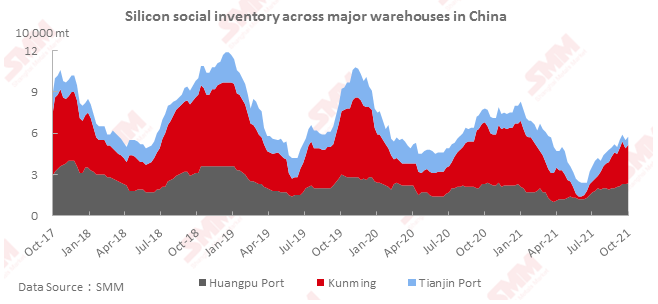
The social inventories of silicon metal across Huangpu port, Kunming city and Tianjin port increased 3,000 mt from the previous week to 58,000 mt as of Friday October 15.

SHANGHAI, Oct 15 (SMM) – The social inventories of silicon metal across Huangpu port, Kunming city and Tianjin port increased 3,000 mt from the previous week to 58,000 mt as of Friday October 15.

The warehousing and shipment activities of the warehouse in Huangpu port in south China has been more active than those in Tianjin port. The shipment of 4-series silicon metal in Huangpu port has been much better than other specifications.

Generally speaking, the transaction of silicon has been slack amid a weak market. The inventory of silicon metal increased slightly again in the raining season.

Data Source Statement: Except for publicly available information, all other data are processed by SMM based on publicly available information, market communication, and relying on SMM's internal database model. They are for reference only and do not constitute decision-making recommendations.

For any inquiries or for more information, please contact: lemonzhao@smm.cn
For more information on how to access our research reports, please contact:service.en@smm.cn
Related News
Zimbabwe Earmarks Chrome-Producing Regions for Dedicated Ferrochrome Hubs as H1 Mining Revenue Nears US$5.8 Billion
5 hours ago
Zimbabwe Earmarks Chrome-Producing Regions for Dedicated Ferrochrome Hubs as H1 Mining Revenue Nears US$5.8 Billion
Read More
Zimbabwe Earmarks Chrome-Producing Regions for Dedicated Ferrochrome Hubs as H1 Mining Revenue Nears US$5.8 Billion
[SMM Express] Zimbabwe's Ministry of Mines and Mining Development used its three-day Mid-Term Strategic Planning Review Workshop in Kadoma this week to confirm that the country's mining sector generated approximately US$5.73 billion in export earnings during H1 2026 — gold contributing US$3.2 billion and other minerals a further US$2.53 billion through the Minerals Marketing Corporation of Zimbabwe — putting the sector on track to exceed 2025's record US$8.6 billion full-year total. Mines Minister Dr Polite Kambamura used the occasion to announce that government will establish regional beneficiation hubs aligned to each area's mineral endowment, with chrome-producing districts specifically earmarked to specialize in ferrochrome and chromium alloy production, while iron ore regions are directed toward steel. The announcement reinforces the trajectory already visible in Zimbabwe's chrome sector this year: a February 2026 ban on exporting unbeneficiated minerals, combined with policy requiring chrome mining titles above 100 hectares to be tied to ferrochrome furnace development, has been steadily pushing production and investment toward smelting rather than raw ore shipment. Formalizing that push into designated regional hubs — rather than leaving beneficiation to individual operator discretion — signals Harare intends to treat chrome-specific value addition as a structural, geography-based policy rather than a company-by-company negotiation. With the Chamber of Mines projecting 10% sector growth for 2026 and full-year export earnings potentially reaching US$7.5–11 billion, the coming months should show whether the hub concept translates into concrete furnace investment in Zimbabwe's chrome belt or remains, for now, a stated policy direction.
5 hours ago
Glencore's Quarterly Data Reveals Ferrochrome Production Already Rebounding at the Lion Smelter
7 hours ago
Glencore's Quarterly Data Reveals Ferrochrome Production Already Rebounding at the Lion Smelter
Read More
Glencore's Quarterly Data Reveals Ferrochrome Production Already Rebounding at the Lion Smelter
Glencore's H1 2026 Half-Year Production Report shows attributable ferrochrome production — its 79.5% share of the Glencore-Merafe Chrome Venture — at just 110,000 tonnes, down 75% (323,000 tonnes) from 433,000 tonnes in H1 2025, with the company noting that chrome smelting "remained largely on care and maintenance during H1 2026." Taken alone, that headline figure reads as a continuation of the collapse already documented at Merafe Resources. But Glencore's quarterly breakdown adds a detail not visible in the half-year number alone: production fell from 156kt in Q2 2025 to just 3kt in Q3 2025 and effectively nil in Q4 2025, before climbing back to 13kt in Q1 2026 and then jumping to 97kt in Q2 2026 — a roughly sevenfold quarter-on-quarter increase. Glencore explicitly ties this rebound to "a phased restart of operations commencing at the Lion smelter," confirming that output bottomed out around late 2025 and was already recovering well before the half-year closed. Read alongside Merafe's own report — which cited continued suspensions at Wonderkop and Boshoek but only a partial suspension at Lion — Glencore's figures confirm Lion as the first of the Venture's smelters to begin ramping back up. The scale of the H1 year-on-year decline therefore somewhat understates the improving trajectory within the period itself, positioning H2 2026 as the more meaningful test of whether the recovery extends to Wonderkop and Boshoek as well.
7 hours ago
Glencore's Attributable Chrome Ore Output Holds Near 1.65 Million Tonnes in H1 2026 Despite Ferroalloys Strain
14 hours ago
Glencore's Attributable Chrome Ore Output Holds Near 1.65 Million Tonnes in H1 2026 Despite Ferroalloys Strain
Read More
Glencore's Attributable Chrome Ore Output Holds Near 1.65 Million Tonnes in H1 2026 Despite Ferroalloys Strain
[SMM Express] Glencore's Half-Year Production Report 2026 shows attributable chrome ore production — the group's 79.5% share of the Glencore-Merafe Chrome Venture — at 1,647,000 tonnes for H1 2026, down just 4% (70,000 tonnes) from 1,717,000 tonnes in H1 2025. Glencore attributed the modest decline simply to "operating conditions over the period," a notably milder explanation than the smelter-specific language it used for ferrochrome. Quarterly data confirms this was a gradual easing rather than a sharp drop: 910kt in Q2 2025, rising to 1,037kt in Q3, before stepping down to 859kt in Q4 2025, 830kt in Q1 2026 and 817kt in Q2 2026 — a 10% year-on-year decline at the Q2-to-Q2 level. This resilience mirrors what SMM has already tracked at Merafe Resources, Glencore's 20.5% partner in the same Venture. Merafe's own H1 2026 disclosure showed chrome ore production of 425,000 tonnes, down 4% from 443,000 tonnes — an almost identical percentage decline to Glencore's figure. With both Venture partners independently reporting the same modest ore-side softening even as ferrochrome production collapsed on their respective books, the pattern is now confirmed at the Venture level rather than being an artifact of one company's reporting: chrome ore extraction has held up far better than downstream smelting through the first half of 2026.
14 hours ago
Silicon Metal Social Inventory Up 3,000 Mt on Week - Shanghai Metals Market (SMM)