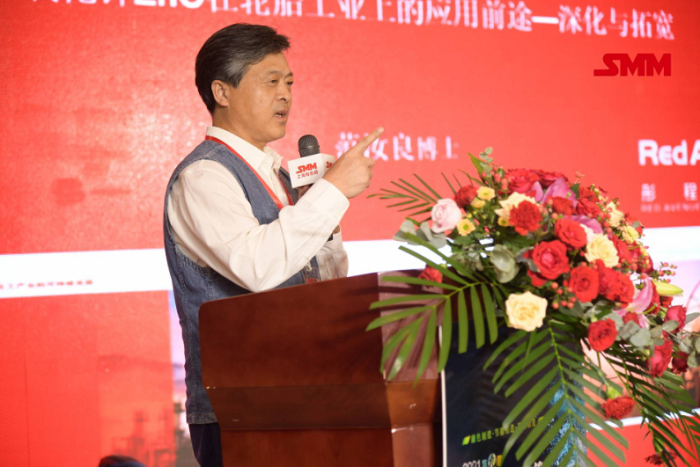
SMM: at the ninth Green Zinc Salt and Zinc oxide Industry Summit Forum 2021 held by SMM, Fan Ruliang, doctor and applied technical director of Tongcheng New Materials Group Co., Ltd., introduced the functions, advantages and disadvantages of zinc oxide in tires and broadened the application of zinc oxide. He says zinc oxide is almost one of the most expensive raw materials in the tire rubber formula. When zinc oxide combines with fatty acid derivatives of plant and animal fatty acids such as oleic acid, palmitic acid and stearic acid to form zinc soap processing aids, adding to the tire manufacturing process can improve the dispersion of fillers, reduce Mooney viscosity, shorten mixing time, improve production efficiency, easy demoulding, reduce scrap rate, save energy, and reduce costs.
In addition, he also pointed out that the synthesized organic zinc has some advantages and problems, such as reducing the content of zinc ion in the compound, decreasing the density of cross-linking bond, increasing the tensile strength, hardness, rigidity, heat resistance, decreased thermal conductivity and so on. It is not recommended that these organic zinc replace traditional zinc oxide.
The role of Zinc oxide in Tire
In the process of tire operation, the internal temperature is 30 to 100 ℃, and the temperature is as high as ≥ 100 ℃ in the areas with insufficient thermal conductivity, such as the center and shoulder of the tire, and the temperature of the tire ring reaches 70 ~ 80 ℃. The temperature is mainly caused by the shear force in the process of driving.
The cause of internal accelerated damage: oxygen diffusion and reaction activity in pneumatic tires.
The increase of the amount of zinc oxide will improve the thermal conductivity and heat resistance of the compound, which is beneficial to reduce the increase of temperature during tire operation.
The function, advantages and disadvantages of Zinc oxide in Tire Rubber products
Zinc oxide is an active agent of sulfur / accelerant vulcanization in tire rubber formula.
Promote vulcanization, accelerate the speed of vulcanization and improve the degree of vulcanization
The heat resistance, reversion resistance and thermal conductivity of the compound can be improved by increasing the dosage.
Zinc oxide is the sulfur agent of neoprene, which is used in neoprene products such as flame retardant conveyor belts.
Zinc oxide is the raw material of soap processing aids, which is used to improve the processability of tire rubber.
Zinc oxide is the raw material of some accelerators, which is used in tire rubber to improve sulfur activity and tire performance.
Organic zinc salt is a method to reduce zinc under the requirement of ecological environment.
Shortcoming
Zinc oxide contains trace heavy metals, such as lead oxide and cadmium oxide: zinc ingots themselves contain zinc, lead and cadmium "triplets"
Zinc oxide "zinc ion" will catalyze the aging of tire rubber.
Pollution of water and soil: tread debris worn off during tire driving and discarded
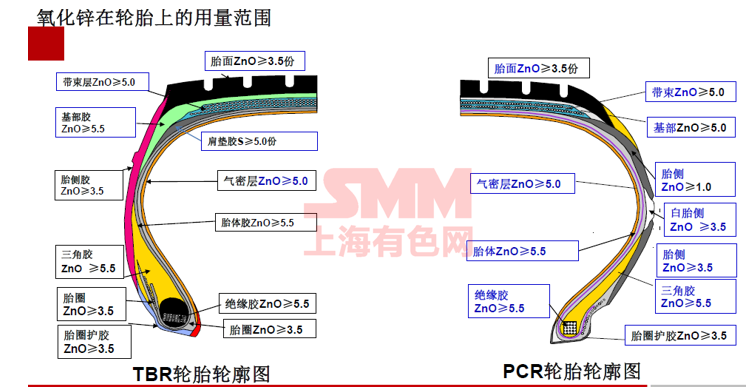
And it is worth mentioning that zinc oxide is almost one of the most expensive raw materials in tire rubber formula.
Broaden the application of zinc oxide
Zinc soap processing aids are used in tire rubber products
When zinc oxide combines with derivatives of plant and animal fatty acids, such as oleic acid, palmitic acid and stearic acid, to form zinc soap processing aids, the addition to the tire manufacturing process has the following effects:
Improve filler dispersion, reduce Mooney viscosity, shorten mixing time, improve production efficiency, easy demoulding, improve appearance, reduce scrap rate, save energy and reduce cost.
Zinc alkyl thiophosphate is used in tires and rubber products
When zinc oxide reacts with P2S5 P2S5, or CH3 (CH2) 3OH, isooctyl or NaOH solution to form zinc alkyl thiophosphate, it may have the following effects:
For tires to improve performance; for car seals to reduce odor; for car hoses to improve performance; for rubber shoes to reduce odor and improve appearance.
Focus on hot spots
Organic zinc instead of traditional zinc oxide
The EU environmental regulation EC 1272Compact 2008 requires the reduction of zinc ions in the compound by a maximum of 70% and 90%. However, the synthesized organic zinc has some advantages and problems, such as reducing the content of zinc ion in the compound, decreasing the density of cross-linking bond, improving the tensile strength, hardness, rigidity, heat resistance, thermal conductivity and so on. Overall, it is not recommended that these organic zinc replace traditional zinc oxide.
Summary
Zinc oxide is important for tires and rubber products: zinc oxide is one of the "time-tested and indispensable" raw materials with the development of industry and is so far strongly dependent on cost-effective vulcanizing agents.
In terms of "comprehensive performance / price ratio", there is no complete substitute for zinc oxide (so far), but the technical index of zinc oxide, especially the particle size distribution is very important, rice resistance is favored.
Zinc oxide classification: micron 99.7% 99.7% priority, micron 99.9%, micron active ZnO, nanometer ZnO (future)
Micron 99.7% zinc oxide 3 phr, the comprehensive performance reached the balance point, adding more to improve the heat resistance, the nanometer grade was reduced to 1 phr and 2 phr.
Zinc oxide has "the highest volume cost" in tire formula.
Zinc oxide has a catalytic effect on tire rubber.
EU environmental regulation EC 1272 Compact 2008: pollution of zinc oxide to the environment, especially water and soil.
Zinc oxide derivatives, soaps to improve the processability of tire rubber, the future may be reduced.
Goal: to continue to reduce dependence on zinc oxide (dosage and substitution) with the goal of environmental protection.