China Rare Earth Exports Fell in July and Prices Rose, What is the Driving Force?

Published: Aug 10, 2021 14:59
China rare earth exports in July stood at 3955 mt, down 1.4% month on month but surged 144.2% year on year according to the General Administration of Customs. The average export prices was $16460/mt, up 23% month on month and 5% year on year. The export volume totalled 1620 mt in the same period of last year.
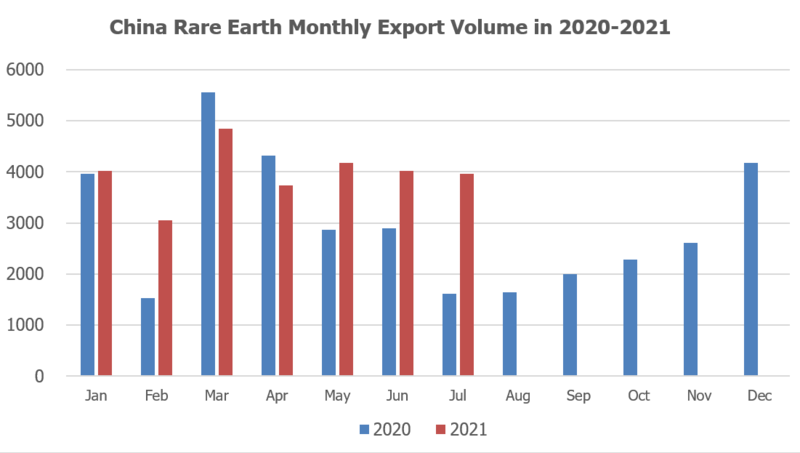
SHANGHAI, Aug 10 (SMM) - China rare earth exports in July stood at 3955 mt, down 1.4% month on month but surged 144.2% year on year according to the General Administration of Customs. The average export prices was $16460/mt, up 23% month on month and 5% year on year. The export volume totalled 1620 mt in the same period of last year.

The fall of export volume in July on a monthly basis was mainly due to the tight domestic supply in the month as cargo holders were unwilling to sell, combined with summer break in overseas market.

On the other hand, prices of domestic mainstream rare earth products surged, leading to MoM increases in export prices as the overseas market was also impacted by the high quotation. For example, Pr-Nd oxide averaged at 557000 yuan/mt in the month, up 18% on a month basis; Pr-Nd metal averaged at 694000 yuan/mt, rising by 19% from the previous month.

In addition, the YoY growth rate of rare earth exports in July surged to 144.2%, because the overall exports were comparatively low last year due to the pandemic. However, export prices in July only added 5% on the year in spite of the board increases of prices among mainstream products. Why is that?

SMM thinks that the comparatively mild volatility in prices of lanthanum and cerium products, which made up the majority of the total exports, was the leading cause. For example, the prices of lanthanum oxide and cerium oxide in July declined 19% and 15% respectively year on year; while Pr-Nd oxide surged nearly 90%, indicating a much weaker price pattern of lanthanum and cerium.

The tightened domestic supply is likely to sustain in the short term in light of the resurged pandemic across the globe and China, continued challenges on the prevention of imported COVID cases, hindered imports of ionic ore from Myanmar, and disrupted production among some companies because of environmental protection measures.

China rare earth export volume is expected to trend down further in August.

Data Source Statement: Except for publicly available information, all other data are processed by SMM based on publicly available information, market communication, and relying on SMM's internal database model. They are for reference only and do not constitute decision-making recommendations.

For any inquiries or for more information, please contact: lemonzhao@smm.cn
For more information on how to access our research reports, please contact:service.en@smm.cn
Related News
[SMM Rare Earth Morning Briefing] Ore prices followed the increase in oxides, and trading activity in the magnetic material market was moderate.
5 mins ago
[SMM Rare Earth Morning Briefing] Ore prices followed the increase in oxides, and trading activity in the magnetic material market was moderate.
Read More
[SMM Rare Earth Morning Briefing] Ore prices followed the increase in oxides, and trading activity in the magnetic material market was moderate.
[SMM Rare Earth Morning Briefing] Ore prices followed the increase in oxides, and trading activity in the magnetic material market was moderate.
[Ore Prices Follow Oxide Gains, Magnetic Material Market Sees Average Trading] Yesterday, Pr-Nd oxide market prices pulled back slightly following futures, but most suppliers held offer prices firm and low-priced supply remained hard to find. In the medium-heavy rare earth segment, dysprosium and terbium market prices continued to mainly hold up well, with some buyers making small purchases.
5 mins ago
[SMM Rare Earth Morning Briefing] Oxide prices diverge, metal trading is stagnant, and magnetic material demand slows down in the off-season
13 mins ago
[SMM Rare Earth Morning Briefing] Oxide prices diverge, metal trading is stagnant, and magnetic material demand slows down in the off-season
Read More
[SMM Rare Earth Morning Briefing] Oxide prices diverge, metal trading is stagnant, and magnetic material demand slows down in the off-season
[SMM Rare Earth Morning Briefing] Oxide prices diverge, metal trading is stagnant, and magnetic material demand slows down in the off-season
[Oxide Prices Diverge, Metal Trading Stalemate, Off-Season Magnetic Material Demand Slows] Yesterday, NdFeB blank quotations edged down slightly, mainly because lower raw material prices dragged down blank prices. In terms of trading, as the off-season set in, the production pace of end-users and motor factories gradually slowed, rigid demand orders were released moderately, while large-scale restocking orders have not yet been effectively released. Overall trading volume in the NdFeB market was modest.
13 mins ago
Hastings Tech Metals Updates DFS for Yangibana Rare Earth Project, Confirms Strong Economics
1 hour ago
Hastings Tech Metals Updates DFS for Yangibana Rare Earth Project, Confirms Strong Economics
Read More
Hastings Tech Metals Updates DFS for Yangibana Rare Earth Project, Confirms Strong Economics
[SMM Rare Earth Flash] ASX-listed Hastings Technology Metals has released the results of the updated definitive feasibility study (DFS) for Stage 1 of the Yangibana rare earth and niobium project in Western Australia. The project is held by a joint venture, with Wyloo Gascoyne holding a 60% interest and Hastings holding 40%. The updated DFS confirms a pre-tax net present value (NPV) of AUD 649 million, an internal rate of return (IRR) of 34%, and a payback period of 2.4 years. Initial capital investment is AUD 333 million, with a mine life of 19 years and average annual concentrates production of 37,000 mt. The project is based on ore reserves of 20.93 million mt at a total rare earth oxide (TREO) grade of 0.90%. Neodymium-praseodymium (NdPr) accounts for 37% of TREO and is expected to contribute over 90% of project revenue. All environmental approvals have been obtained, and infrastructure and long-lead equipment have already been delivered to site.
1 hour ago