Aug. 5 (Xinhua) as the global decarbonization process accelerates, most of the discussion about lithium-ion batteries is limited to how they can help the world become "greener", while little attention has been paid to the disadvantages of large-scale use and storage. With the recent fire at Tesla's lithium energy storage facility in Australia, which lasted for many days, it finally aroused public concern about the safety of energy storage.
The fire first broke out on Friday morning local time, when a 13-ton lithium battery caught fire and then spread to a nearby battery pack. It took the local fire department three days to put out the fire.
You know, lithium reacts violently when it meets water at room temperature, and reacts with CO2 when ignited, so once the lithium battery ignites spontaneously, it is impossible to extinguish it with water and fire-fighting equipment.
As a result, the local fire department adopted the strategy of waiting for the battery to burn out, saying, "Lithium battery fires last much longer than ordinary fires, because lithium batteries produce oxygen to reignite as they decompose. Firefighters can only eliminate the heat inside them as much as possible."
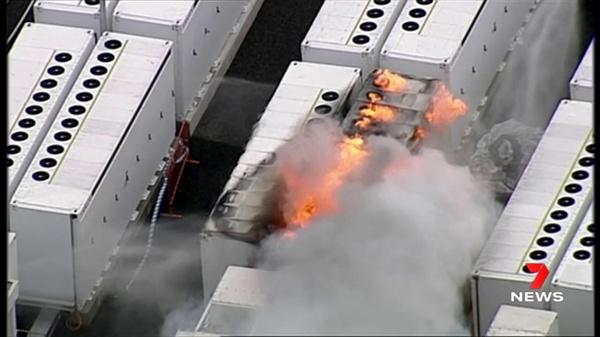
The Victorian Big Battery (Victorian Big Battery) project is the country's largest energy storage project, jointly developed by French power producer and renewable energy giant Neoen SA and Tesla. The project, which has 210 battery packs that can store up to 450MW of energy for Electroweb, aims to achieve 50 per cent of renewable energy for Victoria by 2030.
In fact, with the rise of clean energy, global lithium battery energy storage devices are being rolled out at an unprecedented scale. According to Wood Mackenzie, a research and consulting firm, the total number of energy storage facilities deployed worldwide increased by 62 per cent throughout 2020. The agency expects the market as a whole to grow another 27 times over the next decade.
In this process, lithium battery fires are actually not uncommon. Data show that since 2018, there have been a total of 38 large-scale lithium-ion battery fires around the world.
For example, in September 2020, a lithium-ion battery in Liverpool caught fire. An Electroweb-sized lithium-ion battery fire threw a firefighter "more than 20 meters" in Arizona in 2019, causing brain injuries and broken ribs.
Paul Christensen, a professor at Newcastle University, said: "Lithium-ion batteries are crucial to the decarbonization of the planet, but lithium-ion energy storage projects permeate society far beyond people's understanding of the risks and hazards associated with them. As individuals and households increasingly install lithium-ion batteries to store the energy of solar panels, such risks will only continue to increase. "
But for now, the "advantages" of lithium-ion batteries still seem to outweigh the "disadvantages".
Gavin Harper, a (University of Birmingham) researcher at the University of Birmingham, concluded: "it is critical that we not stifle new innovation because we have to decarbonize quickly, but at the same time, we also need to take precautions when deploying new technologies on a large scale."
![[SMM Revue hebdomadaire du marché des cellules de batteries de stockage d'énergie 9.3] L'offre restreinte de feuilles de cuivre limite les calendriers de production de septembre, les prix des cellules de batteries de stockage d'énergie restent fermes](https://imgqn.smm.cn/usercenter/tKgKv20251217171725.png)
![Revue hebdomadaire du marché du carbonate de lithium : du 31/08 au 03/09, les prix au comptant du carbonate de lithium ont d'abord augmenté puis baissé, tendance globale à la baisse [Revue hebdomadaire SMM]](https://imgqn.smm.cn/usercenter/PPLUj20251217171727.jpg)