Sodium-ion batteries released by CATL, potentially threats to Li-ion batteries

Published: Aug 3, 2021 11:16
CATL recently released sodium-ion batteries, whose relatively higher energy density, fast charging rate, better high and low temperature performance, sufficient resources and low prices have attracted great attention from the lithium battery industry.

Background: In recent years, new energy vehicles have developed rapidly, especially since the second half of last year, the demand has increased significantly, which result in the shortage of raw materials. Among that, cobalt, nickel and lithium resources are insufficient, and prices have risen sharply. In the long run, the cobalt, lithium, nickel raw materials will be in a tight balance in the next 5 years. For lithium batteries, which account for a relatively large material cost (occupies 85%), it will be difficult to reduce the cost in the next 5 years, which will put greater pressure on batteries and car companies.

In this case, CATL recently released sodium-ion batteries, whose relatively higher energy density, fast charging rate, better high and low temperature performance, sufficient resources and low prices have attracted great attention from the lithium battery industry.

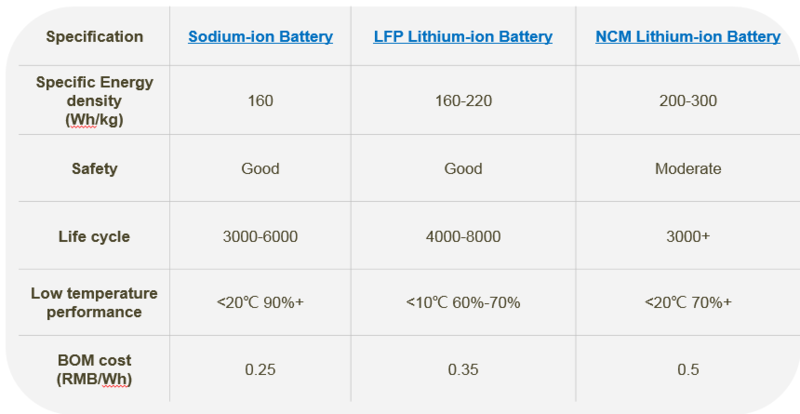
Sodium-ion battery specification

  1. Relatively higher specific energy density

The energy density of the battery cell has reached 160Wh/kg, which is higher of 120-130 Wh/kg, and is close to energy density of LFP&LMO battery cell ( Wh/kg).

  1. Good safety

The of sodium-ion battery is stable, although sodium-ion battery is easy to , its safety test performance is better than that of lithium-ion battery.

  1. Long Life cycle

The battery cell can achieve 3000-6000 , which is significantly higher than that of LCO and NCM battery cell. The life cycle is different in different scenarios, and the cycle will be longer with water cooling systems. It is expected to be more than 8,000 times in the future which is to LFP battery life cycle.

  1. Better low temperature performance

Discharge rate of Sodium-ion battery is 0.3c at -30 degrees, with a capacity retention rate of 80%. And at -20 degrees, capacity retention rate of Sodium-ion battery is above 90%, which is higher than that of Lithium-ion battery.

  1. Lower battery BOM cost

The Sodium-ion battery BOM cost is 0.25 RMB/Wh, which is lower than that of LFP battery (0.35 RMB/Wh). , the BOM cost of sodium-ion battery is 30% lower than that of LFP battery, but the current manufacturing costs of sodium-ion battery are still relatively high. BOM cost plus production costs of Sodium-ion battery are currently higher than that of LFP batteries, because Sodium-ion battery . But it is expected to reach to or lower than LFP battery around 2025.

  1. Sufficient raw material resources

The of sodium-ion battery are higher than lithium-ion battery, and the is lower. The global reserves of sodium are about 2.5% to 3%, which is about 1,000 times than that of lithium resources. In addition, sodium-ion battery almost use no rare metals, but mainly use metals such as iron, aluminum and manganese. These elements are relatively inexpensive compared to cobalt, nickel, lithium that used in lithium-ion battery and the huge market demand in the future.
Sodium-ion battery future application area

  1. Energy storage area

At present, the batteries energy storage market mainly use LFP battery and lead-acid battery. Lithium-ion battery are gradually replacing lead-acid batteries because of their high cycle life, safety and cost performance. From the perspective of cycle life, sodium-ion battery with more than 3,000 times can be used in 5G base stations, and their price may be lower than LFP batteries in 2025, or gradually replace LFP battery in 2025. Large energy storage (such as wind power photovoltaics, etc.) has higher requirements for life cycle, which is basically about 8,000 times, and its , or it is more inclined to use LFP battery with higher cycle life.

  1. Light electric vehiclesarea

Light electric vehicles require moderate life cycle (around 2000 times), lower battery cost and . Sodium-ion battery meet the requirement and its battery cost will be lower than LFP battery, so it may in light electric vehicles in 2025.

In conclusion, Sodium-ion battery will be applied to scenarios that do not require high energy density, but require cost-efficient and higher life cycle, such as energy storage,light electric vehicles, low-to-medium level new energy vehicles and construction machinery. It will not be able to replace the lithium-ion battery for a considerable period of time in the future, and it will be complementary to the lithium-ion battery.

Data Source Statement: Except for publicly available information, all other data are processed by SMM based on publicly available information, market communication, and relying on SMM's internal database model. They are for reference only and do not constitute decision-making recommendations.

For any inquiries or for more information, please contact: lemonzhao@smm.cn
For more information on how to access our research reports, please contact:service.en@smm.cn
Related News
[Sodium Battery: 100,000-Ton Sodium-Ion Battery Cathode Material Project Planned For Zhijin, Guizhou]
Aug 11, 2026 11:59
[Sodium Battery: 100,000-Ton Sodium-Ion Battery Cathode Material Project Planned For Zhijin, Guizhou]
Read More
[Sodium Battery: 100,000-Ton Sodium-Ion Battery Cathode Material Project Planned For Zhijin, Guizhou]
[Sodium Battery: 100,000-Ton Sodium-Ion Battery Cathode Material Project Planned For Zhijin, Guizhou]
On August 10, the Zhijin Branch of the Bijie Ecological Environment Bureau in Guizhou Province released the first public notice for the environmental impact assessment of the "100,000 Tons/Year Sodium-Ion Battery Cathode Material Production Base Project (Phase I, Stage 1)." The project is located in the Zhijin Economic Development Zone (Anle Community, Chadian Township), Bijie City, Guizhou Province, with the construction entity being Guizhou Nabang New Energy Co., Ltd. The total investment for Phase I, Stage 1, is 108.3844 million yuan. The construction involves renting a factory building to build a new sodium battery plant (including a finished goods warehouse), along with supporting facilities for electrical systems, instrumentation, water supply and drainage, fire protection, and information technology. Upon completion, the project will have an annual production capacity of 5,500 tons of sodium-ion battery cathode materials (of the polyanionic type).
Aug 11, 2026 11:59
[SMM Cobalt Morning Briefing] Off-Season Demand Remains Under Pressure; Prices Weaken Across Multiple Segments, Intensifying Market Tug-of-War
Aug 11, 2026 09:54
[SMM Cobalt Morning Briefing] Off-Season Demand Remains Under Pressure; Prices Weaken Across Multiple Segments, Intensifying Market Tug-of-War
Read More
[SMM Cobalt Morning Briefing] Off-Season Demand Remains Under Pressure; Prices Weaken Across Multiple Segments, Intensifying Market Tug-of-War
[SMM Cobalt Morning Briefing] Off-Season Demand Remains Under Pressure; Prices Weaken Across Multiple Segments, Intensifying Market Tug-of-War
This week, the industry chain as a whole remained in the doldrums. In the traditional consumption off-season, end-use demand recovery was limited, and market transactions were generally sluggish. Electrolytic products continued to grind lower, affected by loosening overseas quotes and weakening domestic salts and intermediate product prices, leading to rising bearish sentiment. The divergence between miners holding intermediate product prices firm and downstream pushing for lower prices widened, hindering actual transactions. The sulphate, chloride, tetroxide, and powder markets all faced insufficient demand and inventory pressure, with some low-priced supply increasing, keeping short-term prices under pressure. Ternary cathode precursor prices were temporarily stable; top-tier player production load recovered somewhat, and export orders performed well. Ternary cathode material prices rebounded slightly, with EV market orders in August stable and growing, but the consumer market improvement remained insignificant. LCO supply and demand remained mediocre, with prices still likely to decline. On the policy front, multiple regions continued to optimize auto consumption subsidies, the catalogue of vehicle models eligible for vehicle and vessel tax exemptions expanded, and end-use consumption stimulus policies continued to advance.
Aug 11, 2026 09:54
[SMM Cobalt-Lithium Morning Briefing] Lithium and Cobalt Prices Under Pressure and Diverging, Tug-of-War Between Sellers and Buyers Intensifies Material Market Consolidation
Aug 7, 2026 14:45
[SMM Cobalt-Lithium Morning Briefing] Lithium and Cobalt Prices Under Pressure and Diverging, Tug-of-War Between Sellers and Buyers Intensifies Material Market Consolidation
Read More
[SMM Cobalt-Lithium Morning Briefing] Lithium and Cobalt Prices Under Pressure and Diverging, Tug-of-War Between Sellers and Buyers Intensifies Material Market Consolidation
[SMM Cobalt-Lithium Morning Briefing] Lithium and Cobalt Prices Under Pressure and Diverging, Tug-of-War Between Sellers and Buyers Intensifies Material Market Consolidation
This week, industry chain prices diverged. Lithium ore edged down alongside lithium carbonate, but mines continued to hold prices firm, making profit distribution across the industry chain a market focus. Supported by maintenance and tight spot order supply, lithium carbonate prices consolidated on a subdued note, while lithium hydroxide prices initially fell before rebounding. The cobalt industry chain remained generally under pressure—with weakening overseas quotations and sluggish off-season demand, refined cobalt, intermediate products, and cobalt salt prices continued to weaken, and the price spread between buyers and sellers widened. Nickel sulphate edged down, with the market still primarily focused on destocking; ternary cathode precursor prices declined due to weaker nickel and cobalt salt prices, while ternary cathode material prices remained basically stable. LFP prices proved resilient, supported by rising processing fees, with August production schedules continuing to grow and high-quality capacity remaining tight. Artificial graphite prices rose, the supply-demand balance for separators stayed in tight balance, and electrolyte prices were pushed up by raw material cost transmission. Supply of key materials for sodium-ion batteries remained tight, while recycling-side transactions were subdued. On the terminal side, EV and ESS demand maintained resilience, though the consumer market recovery remained limited. Looking ahead, the focus will be on peak season stockpiling and demand realization.
Aug 7, 2026 14:45