Analysis of China's rare earth import and export data in May

Published: Jun 30, 2021 14:42
China imported 235.534 mt of rare earth permanent magnet materials in May, an increase of 60.2% year-on-year. China exported 4,218.624 mt of rare earth permanent magnets in May, an increase of 39.6% year-on-year, according to data released by the General Administration of Customs.
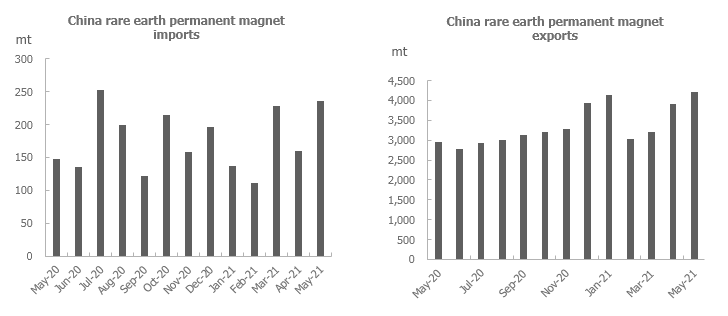
SHANGHAI, Jun 30 (SMM) - China imported 235.534 mt of rare earth permanent magnet materials in May, an increase of 60.2% year-on-year. China exported 4,218.624 mt of rare earth permanent magnets in May, an increase of 39.6% year-on-year, according to data released by the General Administration of Customs.

The top five import countries of Chinese rare earth permanent magnets in May were the United States (657.983 mt), Germany (613.218 mt), South Korea (513.189 mt), Vietnam (316.705 mt) and Italy (223.442 mt).

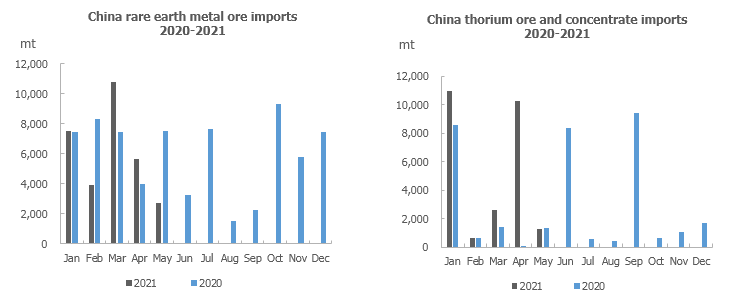
In terms of rare earth metal ore, China imported 2,742.5 mt of rare earth metal ore in May, all of which came from the United States, a YoY decrease of 63.5%. The value of China's imports of rare earth metal ore was $12.41 million in May, an increase of 13.4% on the year. The import volume of thorium ore and concentrate was relatively stable on a year-on-year basis in May , but fell sharply from the previous month.
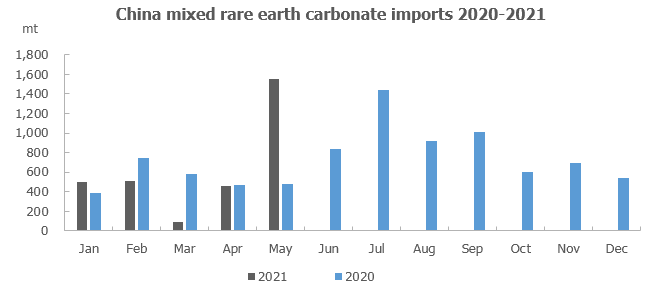
China's imports of mixed rare earth carbonate  totalled 1,551.099 mt in May, an increase of 224% on the year and 237.6% on the month. Imports of mixed rare earth carbonate came mainly from Malaysia (1,059 mt), Russia (90.099 mt) and Myanmar (362 mt), followed by India (21 mt) and Estonia (22 mt).
China imported 2,993.565 mt of unlisted rare earth oxides in May, an increase of 68.1% year-on-year. The import value of unlisted rare earth oxides was $94.42 million, a year-on-year increase of 205.3%. abcde China exported 559.975 mt of unlisted rare earth oxides in May, an increase of 33.4% year-on-year. The export value of unlisted rare earth oxides was $12.381 million, an increase of 182.9% year-on-year.

Japan remained the top buyer of Chinese unlisted rare earth oxides, importing 400.002 mt from China in May.

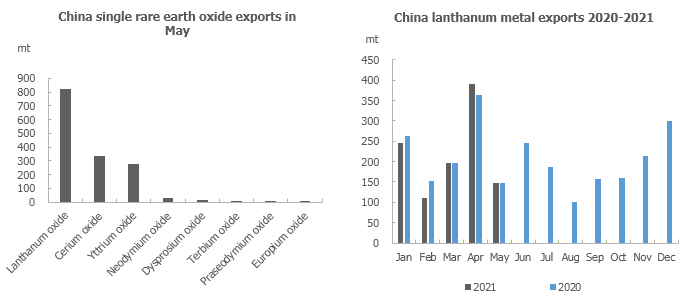
In terms of single rare earth oxides, lanthanum oxide (825.804 mt) recorded the largest export volume in May, followed by cerium oxide, yttrium oxide, neodymium oxide, dysprosium oxide, terbium oxide, praseodymium oxide, and europium oxide.

In terms of single rare earth metals, lanthanum metal (147.015 mt) recorded the largest export volume in May, followed by cerium metal, neodymium metal, praseodymium metal, terbium metal, dysprosium metal and yttrium metal.
Data Source Statement: Except for publicly available information, all other data are processed by SMM based on publicly available information, market communication, and relying on SMM's internal database model. They are for reference only and do not constitute decision-making recommendations.

For any inquiries or for more information, please contact: lemonzhao@smm.cn
For more information on how to access our research reports, please contact:service.en@smm.cn
Related News
Ex-China Rare Earth Scrap Recycling: From "Technology Verification" to "Locking in Materials and Customers" [SMM Analysis]
4 hours ago
Ex-China Rare Earth Scrap Recycling: From "Technology Verification" to "Locking in Materials and Customers" [SMM Analysis]
Read More
Ex-China Rare Earth Scrap Recycling: From "Technology Verification" to "Locking in Materials and Customers" [SMM Analysis]
While the global rare earth recycling rate remains below 1%, Europe and the United States accelerated support for domestic recycling capacity in 2025—the EU Critical Raw Materials Act requires that at least 25% of strategic raw material consumption come from recycling by 2030, and China’s series of export controls in 2025 has also turned “urban mining” from an ESG slogan into a supply-chain necessity. But what is truly driving the industry’s inflection point is not policy documents, but the intensive build-out on the recycling side by top-tier players such as MP Materials, Noveon, Cyclic Materials, HyProMag, and Carester. They have all shifted the competitive focus from “laboratory recovery rates” to “who can reliably secure scrap magnets and who can turn recycled powder into material that magnet manufacturers are willing to sign long-term supply agreements for.”
4 hours ago
[SMM Rare Earth Morning Meeting Summary] Pr-Nd Pulled Back, Transactions Stagnant; Medium-Heavy Rare Earth Stable; Magnetic Materials Followed Gains but Demand Recovery Uneven
5 hours ago
[SMM Rare Earth Morning Meeting Summary] Pr-Nd Pulled Back, Transactions Stagnant; Medium-Heavy Rare Earth Stable; Magnetic Materials Followed Gains but Demand Recovery Uneven
Read More
[SMM Rare Earth Morning Meeting Summary] Pr-Nd Pulled Back, Transactions Stagnant; Medium-Heavy Rare Earth Stable; Magnetic Materials Followed Gains but Demand Recovery Uneven
[SMM Rare Earth Morning Meeting Summary] Pr-Nd Pulled Back, Transactions Stagnant; Medium-Heavy Rare Earth Stable; Magnetic Materials Followed Gains but Demand Recovery Uneven
[Pr-Nd Pulls Back amid Transaction Stalemate; Medium-Heavy Rare Earths Stable; Magnetic Materials Follow Gains but Demand Recovery Uneven] Last week, affected by the pullback in futures prices, spot suppliers’ offers for Pr-Nd oxide softened somewhat, with market trading sentiment relatively sluggish and prices revised down slightly; dysprosium oxide prices were stable overall, with no notable adjustments; terbium oxide prices held steady amid sluggish market inquiries and trading activity, with limited follow-through in actual transactions.
5 hours ago
Global Rare Earth Recycling Surges as US, EU, and Leading Companies Boost Capacity【SMM Analysis】
6 hours ago
Global Rare Earth Recycling Surges as US, EU, and Leading Companies Boost Capacity【SMM Analysis】
Read More
Global Rare Earth Recycling Surges as US, EU, and Leading Companies Boost Capacity【SMM Analysis】
Global rare earth recycling rates remain below 1% to date. In 2025, the US and Europe accelerated support for domestic recycling capacity—the EU’s Critical Raw Materials Act (CRMA) mandates that at least 25% of strategic raw material consumption come from recycling by 2030, while China’s series of export controls in 2025 turned the “urban mine” from an ESG slogan into a supply chain imperative.
6 hours ago