Deteriorating COVID-19 pandemic outbreak in India hit export orders for lithium battery products

Published: Jun 8, 2021 10:52
The COVID-19 outbreak has led to a precipitous decline in factory operating rates, with operating rates of pharmaceutical intermediate and active pharmaceutical ingredient (API) companies only at around 30%. India is also known as the "World's Pharmaceutical Factory" and produces nearly 20% of the world's generic drugs.

SHANGHAI, Jun 8 (SMM) – Many pillar industries in India are facing severe shock. The COVID-19 outbreak has led to a precipitous decline in factory operating rates, with operating rates of pharmaceutical intermediate and active pharmaceutical ingredient (API) companies only at around 30%. India is also known as the "World's Pharmaceutical Factory" and produces nearly 20% of the world's generic drugs. Its API is an important link in the pharmaceutical industry chain that is closely connected with upstream and downstream. Pharmaceutical companies in India have basically shut down due to large-scale lockdowns, and the supply chain of India's drug exports is currently collapsing.

Lithium metal export orders affected

Metal lithium can be divided into industrial grade and battery grade in application. Industrial-grade lithium metal is used in the pharmaceutical industry, while battery-grade lithium metal is used in the cathode of disposable lithium batteries. The mainstream downstream application of lithium metal is the pharmaceutical intermediate industry. The Covid outbreak India led to decline in Chinese export orders of lithium metal, but the impact may be relatively lagging. However, the impact on mainstream lithium metal importing countries, such as the United States, Japan and France (which are also affected by COVID-19) was relatively small.

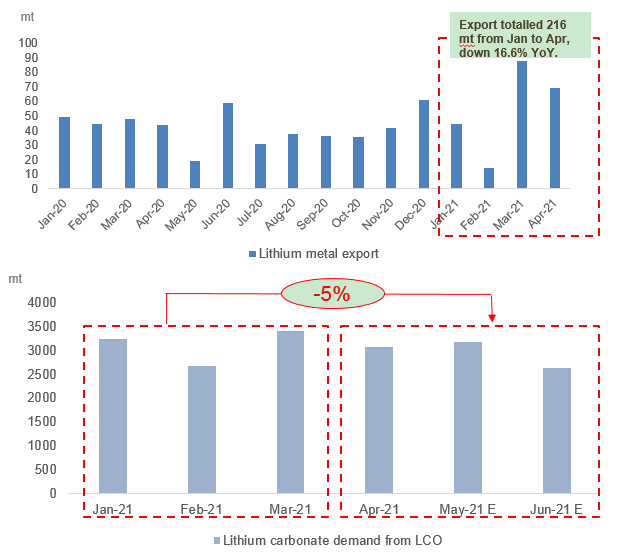
China is the largest metal lithium smelting country. Major metal lithium manufacturers in China are concentrated in Jiangxi, Sichuan, and Qinghai. Chinese export of lithium metal stood at 506 mt in 2020, and 216 mt from January to April 2021, a year-on-year increase of 16.6%. Export is expected to decrease slightly in May and June.
Exports of 3C lithium battery products fell, softening demand for raw materials

As one of the largest consumers of smart phones, India imports about 77% of smart phones from China. The current Covid situation in India will greatly affect China's export volume of 3C products, which will send ripple effects to demand for batteries and lithium carbonate. SMM estimates that LCO output will fall 5% quarter on quarter in Q2 as a result of the off-season for 3C sector and Covid outbreaks. Major LCO producers reduced output and raw material purchase.
Data Source Statement: Except for publicly available information, all other data are processed by SMM based on publicly available information, market communication, and relying on SMM's internal database model. They are for reference only and do not constitute decision-making recommendations.

For any inquiries or for more information, please contact: lemonzhao@smm.cn
For more information on how to access our research reports, please contact:service.en@smm.cn
Related News
LFP Market Weekly: Processing Fees Rise, Supply Tightness Continues Amid Strong Demand
9 hours ago
LFP Market Weekly: Processing Fees Rise, Supply Tightness Continues Amid Strong Demand
Read More
LFP Market Weekly: Processing Fees Rise, Supply Tightness Continues Amid Strong Demand
9 hours ago
Hyundai Motor Group Says AI Cuts Production Line Downtime by 86%
9 hours ago
Hyundai Motor Group Says AI Cuts Production Line Downtime by 86%
Read More
Hyundai Motor Group Says AI Cuts Production Line Downtime by 86%
Hyundai Motor Group held its AX (AI Transformation) Performance Presentation at its Yangjae headquarters in Seocho District, Seoul, on August 12, unveiling its AI application results and future strategy. The group said it is fully applying artificial intelligence across its business operations, from R&D to production, maintenance and customer response. By using AI, Hyundai Motor Group reduced the time required to analyze crash test-related data by 90% and cut production line downtime by 86%. The company also achieved annual cost savings of more than KRW 5.2 billion at production sites.
9 hours ago
South Korea to Allow Secondary Battery Recycling Firms Into Gumi and Pohang Industrial Complexes
9 hours ago
South Korea to Allow Secondary Battery Recycling Firms Into Gumi and Pohang Industrial Complexes
Read More
South Korea to Allow Secondary Battery Recycling Firms Into Gumi and Pohang Industrial Complexes
The South Korean government announced the first round of its “field-oriented corporate investment and innovation support measures” on August 13 during an Emergency Economic Headquarters meeting and economic ministers’ meeting. Secondary battery recycling businesses had previously been classified as a waste-related industry, limiting their ability to move into national industrial complexes. Going forward, however, they will be allowed to enter such complexes on the same basis as manufacturing businesses.
9 hours ago