Deteriorating COVID-19 pandemic outbreak in India hit export orders for lithium battery products

Published: Jun 08, 2021 10:52 (GMT+8)
The COVID-19 outbreak has led to a precipitous decline in factory operating rates, with operating rates of pharmaceutical intermediate and active pharmaceutical ingredient (API) companies only at around 30%. India is also known as the "World's Pharmaceutical Factory" and produces nearly 20% of the world's generic drugs.

SHANGHAI, Jun 8 (SMM) – Many pillar industries in India are facing severe shock. The COVID-19 outbreak has led to a precipitous decline in factory operating rates, with operating rates of pharmaceutical intermediate and active pharmaceutical ingredient (API) companies only at around 30%. India is also known as the "World's Pharmaceutical Factory" and produces nearly 20% of the world's generic drugs. Its API is an important link in the pharmaceutical industry chain that is closely connected with upstream and downstream. Pharmaceutical companies in India have basically shut down due to large-scale lockdowns, and the supply chain of India's drug exports is currently collapsing.

Lithium metal export orders affected

Metal lithium can be divided into industrial grade and battery grade in application. Industrial-grade lithium metal is used in the pharmaceutical industry, while battery-grade lithium metal is used in the cathode of disposable lithium batteries. The mainstream downstream application of lithium metal is the pharmaceutical intermediate industry. The Covid outbreak India led to decline in Chinese export orders of lithium metal, but the impact may be relatively lagging. However, the impact on mainstream lithium metal importing countries, such as the United States, Japan and France (which are also affected by COVID-19) was relatively small.

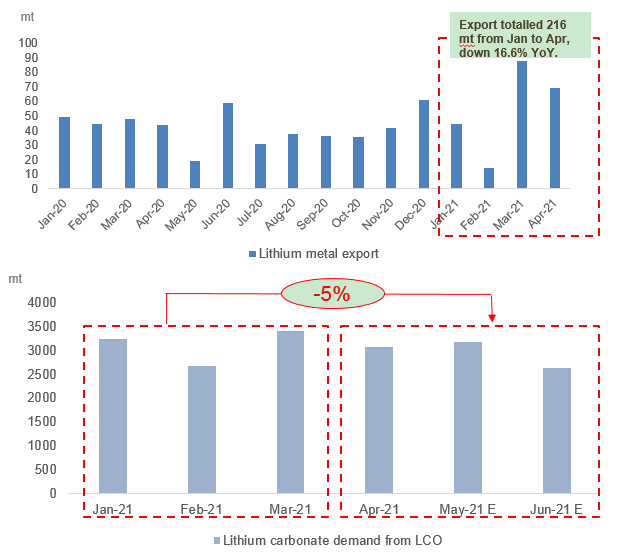
China is the largest metal lithium smelting country. Major metal lithium manufacturers in China are concentrated in Jiangxi, Sichuan, and Qinghai. Chinese export of lithium metal stood at 506 mt in 2020, and 216 mt from January to April 2021, a year-on-year increase of 16.6%. Export is expected to decrease slightly in May and June.
Exports of 3C lithium battery products fell, softening demand for raw materials

As one of the largest consumers of smart phones, India imports about 77% of smart phones from China. The current Covid situation in India will greatly affect China's export volume of 3C products, which will send ripple effects to demand for batteries and lithium carbonate. SMM estimates that LCO output will fall 5% quarter on quarter in Q2 as a result of the off-season for 3C sector and Covid outbreaks. Major LCO producers reduced output and raw material purchase.
Data Source Statement: Except for publicly available information, all other data are processed by SMM based on publicly available information, market communication, and relying on SMM's internal database model. They are for reference only and do not constitute decision-making recommendations.

For any inquiries or for more information, please contact: lemonzhao@smm.cn
For more information on how to access our research reports, please contact:service.en@smm.cn
Related News
Capchem: Forecast Net Profit Growth of 104.53%-111.22% YoY for First Three Quarters
22 hours ago
Capchem: Forecast Net Profit Growth of 104.53%-111.22% YoY for First Three Quarters
Read More
Capchem: Forecast Net Profit Growth of 104.53%-111.22% YoY for First Three Quarters
Capchem disclosed its earnings forecast for the first three quarters. The company expects net profit attributable to shareholders of the publicly listed firm for the first three quarters of 2026 to be 1.53 billion to 1.58 billion yuan, up 104.53%-111.22% from the same period last year.
22 hours ago
Lopal: Subsidiary Signs Long-Term Sales Agreement for LFP Cathode Materials
22 hours ago
Lopal: Subsidiary Signs Long-Term Sales Agreement for LFP Cathode Materials
Read More
Lopal: Subsidiary Signs Long-Term Sales Agreement for LFP Cathode Materials
Lopal announced in an evening filing that its second-tier holding subsidiary Nanjing Lithium Source and Jiyao Tongxing signed a Strategic Cooperation Framework Agreement. Under the agreement, provided that product settlement prices are competitive and delivery cycles, quality, and technology meet requirements, Nanjing Lithium Source and its affiliated producers will sell a combined 378,600-567,800 mt of LFP cathode materials to Jiyao Tongxing from 2026 to 2030, with specific sales volumes determined by orders. The specific unit price is subject to fluctuations in major raw material prices and will be determined monthly by both parties in accordance with the agreement terms.
22 hours ago
[SMM Cobalt-Lithium Morning Meeting Summary] Raw material price trends diverge; supply-demand support for battery materials varies in strength
Oct 13, 2026 10:06 (GMT+8)
[SMM Cobalt-Lithium Morning Meeting Summary] Raw material price trends diverge; supply-demand support for battery materials varies in strength
Read More
[SMM Cobalt-Lithium Morning Meeting Summary] Raw material price trends diverge; supply-demand support for battery materials varies in strength
[SMM Cobalt-Lithium Morning Meeting Summary] Raw material price trends diverge; supply-demand support for battery materials varies in strength
This week, the battery industry chain showed divergent trends. Spot lithium ore was tight, but expectations of future supply growth weighed on prices. On October 12, the average spot price of lithium carbonate fell to 115,400 yuan/mt, down 6,950 yuan/mt in a single day. Futures declined with rising open interest, while social inventory continued to destock. Lithium hydroxide, cobalt salt, and nickel sulphate were under pressure, with cautious purchasing. Ternary cathode precursor, ternary cathode material, and LCO weakened along with raw materials. LFP orders were relatively strong, with high-quality production lines running near full capacity and finished product inventories declining. Iron phosphate operating rates were high, but resistance to price increases grew. Artificial graphite edged up, supported by costs and demand, while natural graphite operated at low levels. Separator was supported by NEV, energy storage, and export rush demand, with supply-demand conditions tight. Electrolyte rose due to lagged cost pass-through. Sodium-ion battery production and delivery were stable, while recycling-side inquiries recovered but transactions did not increase in volume. In news, CATL deepened cooperation with Seres. In the first three quarters, NEV production and sales both exceeded 12 million units. Export tax rebate policy adjustments and China-EU automotive trade consultations drew attention.
Oct 13, 2026 10:06 (GMT+8)