SMM survey on the impact on primary aluminium alloy industry from automaker shutdowns caused by chip shortage

Published: Apr 19, 2021 14:31
Volkswagen announced in March that it had cut production by more than 100,000 vehicles in January and February due to the lack of chips. Honda Motor announced that its Mexican plant would cease production from March 18. General Motors announced the temporary closure of its plant in Lansing, Michigan, and it was expected that it would not restart operations before April this year.

SHANGHAI, Apr 19 (SMM)—Volkswagen announced in March that it had cut production by more than 100,000 vehicles in January and February due to the lack of chips. Honda Motor announced that its Mexican plant would cease production from March 18. General Motors announced the temporary closure of its plant in Lansing, Michigan, and it was expected that it would not restart operations before April this year.

NIO announced on March 26 that it has decided to suspend production at its Hefei Jianghuai Automobile Plant for 5 days starting from March 29 amid chips shortage. On April 12, senior White House officials held a meeting with executives from nearly 20 companies to discuss the global semiconductor shortage that has caused turmoil in the automotive industry and technology companies.

The problem of chip shortages has been exacerbated by the earthquake in Japan, the fire in the Renesas electronics factory, and the cold wave in North America, which has affected the supply of other auto parts suppliers. Wheel hubs are important parts of automobiles. At present, about 90% of A356.2 primary aluminium alloy in China is used to make aluminium alloy wheel hubs.

SMM has conducted surveys with a number of primary aluminium alloy companies.
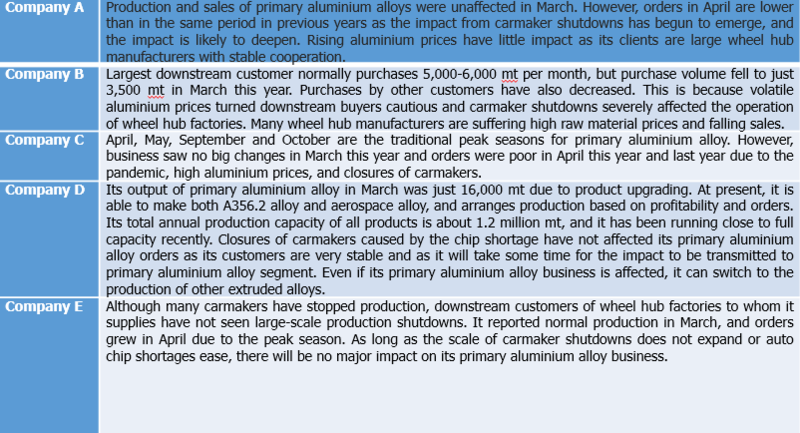
In summary, wheel hub manufacturers restocked as needed amid high aluminium prices in March. The wave of production shutdowns among carmakers triggered by chip shortages has begun to have an impact on the A356.2 alloy industry. Some small and medium-sized primary aluminium alloy companies indicated that their orders in March were not as good as in the same period in previous years, and the purchases from downstream customers generally decreased.

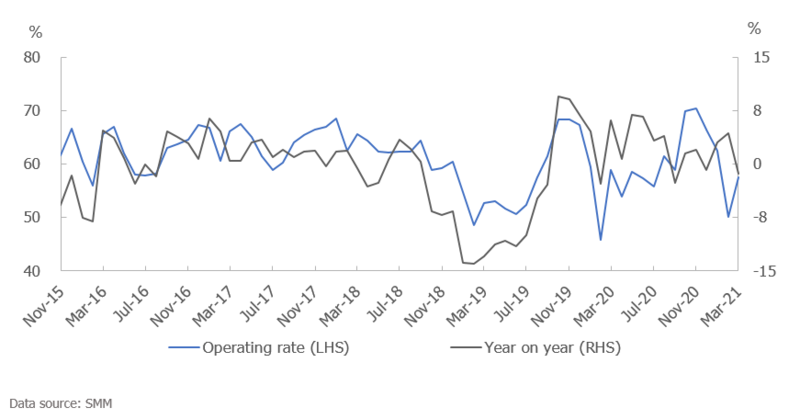
Large primary aluminium alloy companies reported normal output and sales in March. First-class product quality, stable customer resources, and ample cash flow have enable large companies to be little affected by high aluminium prices and carmaker shutdowns. However, some companies have indicated that orders did not improve in the peak season of April and are concerned that carmaker shutdowns will continue to suppress orders for primary aluminium alloys. Some companies have transformed their business and begun to produce a variety of alloy products according to market demand and profitability of each product. Operating rates at A356.2 primary aluminium alloy producers stood at 57.56% in March, up 7.48 percentage points month on month, but down 1.31 percentage points year on year, SMM survey showed.

The chip shortage is not a short-term phenomenon, and it remains to be seen how this problem will evolve in the future. If the worsening of the chip shortage leads to further shutdowns among carmakers, operating rates at primary aluminium alloy producers are likely to fall to about 50% in April, and production and sales in Q2 may drop sharply compared with the same period in previous years.

Operating rates at A356 aluminium alloy producers
Data Source Statement: Except for publicly available information, all other data are processed by SMM based on publicly available information, market communication, and relying on SMM‘s internal database model. They are for reference only and do not constitute decision-making recommendations.

For any inquiries or to learn more information, please contact: lemonzhao@smm.cn
For more information on how to access our research reports, please contact:service.en@smm.cn
Related News
Middle East Trade Chain for Aluminum Foil Disrupted by Geopolitical Conflicts, Down 0.74% YoY in Jan-Feb [SMM Analysis]
1 hour ago
Middle East Trade Chain for Aluminum Foil Disrupted by Geopolitical Conflicts, Down 0.74% YoY in Jan-Feb [SMM Analysis]
Read More
Middle East Trade Chain for Aluminum Foil Disrupted by Geopolitical Conflicts, Down 0.74% YoY in Jan-Feb [SMM Analysis]
[SMM Analysis: China’s Aluminum Foil Exports Edged Down 0.74% YoY in January-February, Geopolitical Conflicts Disrupted the Middle East Trade Chain] According to customs data, China’s total aluminum foil exports in January-February 2026 (tariff codes 76071110, 76071120, 76071190, 76071900, 76072000) reached 214,800 mt, down 0.74% YoY from 2025, of which exports were 121,100 mt in January, up 2% YoY, and 93,700 mt in February, down 4% YoY.
1 hour ago
Aluminum Plate/Sheet and Strip Exports Face Dual Pressure Despite 16.6% YoY Growth in Jan-Feb [SMM Analysis]
2 hours ago
Aluminum Plate/Sheet and Strip Exports Face Dual Pressure Despite 16.6% YoY Growth in Jan-Feb [SMM Analysis]
Read More
Aluminum Plate/Sheet and Strip Exports Face Dual Pressure Despite 16.6% YoY Growth in Jan-Feb [SMM Analysis]
[SMM Analysis: Aluminum Plate/Sheet and Strip Exports up 16.6% YoY in January-February, to Face Dual Pressure] According to customs data, China’s total exports of aluminum plate/sheet and strip reached 509,300 mt in January-February 2026, up 16.65% YoY from 2025. Of this, exports were 278,500 mt in January, up 16% YoY, and 230,800 mt in February, up 17% YoY.
2 hours ago
Middle East Conflict Boosts Oil Prices, Raises Concerns of Inflation and Potential Fed Rate Hikes
3 hours ago
Middle East Conflict Boosts Oil Prices, Raises Concerns of Inflation and Potential Fed Rate Hikes
Read More
Middle East Conflict Boosts Oil Prices, Raises Concerns of Inflation and Potential Fed Rate Hikes
The escalating conflict in the Middle East has driven international oil prices sharply higher, a trend that has deeply unsettled Wall Street. Wall Street is concerned that US inflation could reaccelerate as a result, forcing the US Fed to delay interest rate cuts and even shift its policy direction toward rate hikes. Bank of America revealed that "whether the Fed will raise interest rates this year" has become a key question its clients have frequently asked in recent days. BofA noted that although the possibility of a rate hike cannot be entirely ruled out, three conditions would need to be met for one to occur: the labour market remains stable, inflation worsens further, and Powell continues to serve as Fed Chairman.
3 hours ago
SMM survey on the impact on primary aluminium alloy industry from automaker shutdowns caused by chip shortage - Shanghai Metals Market (SMM)