Copper downstream consumption rebounded seasonally in March

Published: Apr 15, 2021 13:31
According to SMM statistics, copper semis output in March stood at 1.84 million mt. The cumulative output from January to March was 4.49 million mt, an increase of 2.48% year-on-year due to a low base in the same period last year. Operating rates at copper semis producers stood at 73.03% in March, an increase of 20.73 percentage points from the previous month, compared to an expected rise of 3.65 percentage points, and an increase of 8.82 percentage points year on year.
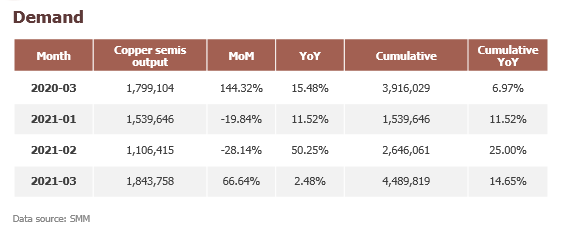
SHANGHAI, Apr 15 (SMM)—According to SMM statistics, copper semis output in March stood at 1.84 million mt. The cumulative output from January to March was 4.49 million mt, an increase of 2.48% year-on-year due to a low base in the same period last year. Operating rates at copper semis producers stood at 73.03% in March, an increase of 20.73 percentage points from the previous month, compared to an expected rise of 3.65 percentage points, and an increase of 8.82 percentage points year on year.

The seasonal factor drove the big month-on-month increase in operating rates, while the year-on-year increase was attributable to the slow resumption of production at downstream companies against the COVID-19 pandemic post-CNY last year.

Operating rates: copper tube industry (87.81%)> the copper plate, strip and foil industry (79.56%)> copper rod industry using copper cathode as raw materials (68.22%)

Brisk domestic sales and exports led to strong orders in home appliance industry, ensuring high operating rates across copper tube plants. Some enterprises operated at full capacity and have scheduled production to end-May. Operating rates in the copper plate, strip and foil industry in March also increased year-on-year, mainly due to the continuous increase in production and sales of new energy vehicles and semiconductor electronics.

The performance of copper rod industry using copper cathode was the weakest. Operating rates in the wire and cable industry increased slowly in March, and the delivery-taking speed was much lower than normal; meanwhile, a big price difference between copper cathode and copper scrap drove wire and cable producers to purchase copper rod produced with secondary copper. The good performance of the enamelled wire industry since the start of the year failed to bolster operating rates at the copper rod industry using copper cathode as raw material due to its small market share.
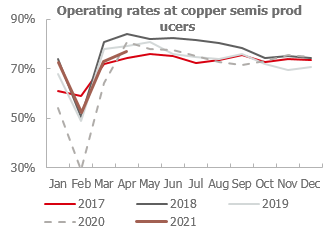
Operating rates in April: copper tube industry (89.23%)> copper plate and strip industry (80.55%)> copper rod industry using copper cathode (73.43%).

Operating rates at copper semis producers are expected to stand at 76.94%, an increase of 3.91 percentage points from the previous month and a decrease of 3.7 percentage points from the same period last year. The operating rate of the copper tube and copper plate and strip industry will remain at a high level.

Operating rate of the copper rod industry using copper cathode will also rise, but the substitution of copper cathode by copper scrap will limit the increase.
Data Source Statement: Except for publicly available information, all other data are processed by SMM based on publicly available information, market communication, and relying on SMM‘s internal database model. They are for reference only and do not constitute decision-making recommendations.

For any inquiries or to learn more information, please contact: lemonzhao@smm.cn
For more information on how to access our research reports, please contact:service.en@smm.cn
Related News
Gulf disruption squeezes Indonesia nickel makers' sulphur supply
6 hours ago
Gulf disruption squeezes Indonesia nickel makers' sulphur supply
Read More
Gulf disruption squeezes Indonesia nickel makers' sulphur supply
Due to the conflict in the Middle East, shipping through the Strait of Hormuz has been disrupted, raising the risk of tighter global sulphur supplies. Indonesia relies on the Middle East for around 75% of its sulphur imports, and sulphur is a key raw material for producing sulphuric acid, which is essential for leaching metals in nickel and copper processing. Analysts note that sulphur inventories at Indonesia’s HPAL nickel plants typically cover only one to two months of consumption. If transport disruptions persist, some plants may be forced to cut production as early as next month. Overall, if shipping disruptions in the Middle East continue for more than a few weeks, production and demand for related metals may need to slow.
6 hours ago
SHFE Copper Warrants Up by 11,856 MT, Total Reaches 315,488 MT
11 hours ago
SHFE Copper Warrants Up by 11,856 MT, Total Reaches 315,488 MT
Read More
SHFE Copper Warrants Up by 11,856 MT, Total Reaches 315,488 MT
[SMM Shanghai Spot Copper] Intraday SHFE copper futures warrants increased by 11,856 mt, bringing the total to 315,488 mt. Of this, the Shanghai area increased by 8,871 mt, Guangdong decreased by 125 mt, and Jiangsu decreased by 3,110 mt.
11 hours ago
Geopolitical Risks Intensified; the Most-Traded BC Copper Contract Closed Down 0.41% [SMM BC Copper Commentary]
12 hours ago
Geopolitical Risks Intensified; the Most-Traded BC Copper Contract Closed Down 0.41% [SMM BC Copper Commentary]
Read More
Geopolitical Risks Intensified; the Most-Traded BC Copper Contract Closed Down 0.41% [SMM BC Copper Commentary]
12 hours ago
Copper downstream consumption rebounded seasonally in March - Shanghai Metals Market (SMM)