Copper downstream consumption rebounded seasonally in March

Published: Apr 15, 2021 13:31 (GMT+8)
According to SMM statistics, copper semis output in March stood at 1.84 million mt. The cumulative output from January to March was 4.49 million mt, an increase of 2.48% year-on-year due to a low base in the same period last year. Operating rates at copper semis producers stood at 73.03% in March, an increase of 20.73 percentage points from the previous month, compared to an expected rise of 3.65 percentage points, and an increase of 8.82 percentage points year on year.
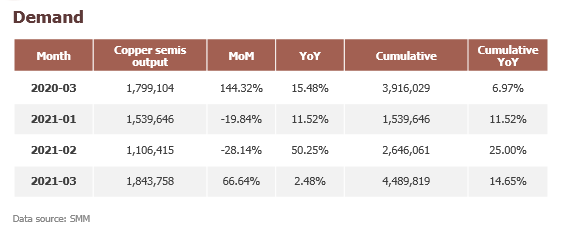
SHANGHAI, Apr 15 (SMM)—According to SMM statistics, copper semis output in March stood at 1.84 million mt. The cumulative output from January to March was 4.49 million mt, an increase of 2.48% year-on-year due to a low base in the same period last year. Operating rates at copper semis producers stood at 73.03% in March, an increase of 20.73 percentage points from the previous month, compared to an expected rise of 3.65 percentage points, and an increase of 8.82 percentage points year on year.

The seasonal factor drove the big month-on-month increase in operating rates, while the year-on-year increase was attributable to the slow resumption of production at downstream companies against the COVID-19 pandemic post-CNY last year.

Operating rates: copper tube industry (87.81%)> the copper plate, strip and foil industry (79.56%)> copper rod industry using copper cathode as raw materials (68.22%)

Brisk domestic sales and exports led to strong orders in home appliance industry, ensuring high operating rates across copper tube plants. Some enterprises operated at full capacity and have scheduled production to end-May. Operating rates in the copper plate, strip and foil industry in March also increased year-on-year, mainly due to the continuous increase in production and sales of new energy vehicles and semiconductor electronics.

The performance of copper rod industry using copper cathode was the weakest. Operating rates in the wire and cable industry increased slowly in March, and the delivery-taking speed was much lower than normal; meanwhile, a big price difference between copper cathode and copper scrap drove wire and cable producers to purchase copper rod produced with secondary copper. The good performance of the enamelled wire industry since the start of the year failed to bolster operating rates at the copper rod industry using copper cathode as raw material due to its small market share.
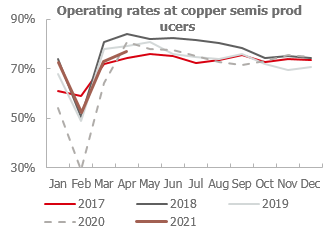
Operating rates in April: copper tube industry (89.23%)> copper plate and strip industry (80.55%)> copper rod industry using copper cathode (73.43%).

Operating rates at copper semis producers are expected to stand at 76.94%, an increase of 3.91 percentage points from the previous month and a decrease of 3.7 percentage points from the same period last year. The operating rate of the copper tube and copper plate and strip industry will remain at a high level.

Operating rate of the copper rod industry using copper cathode will also rise, but the substitution of copper cathode by copper scrap will limit the increase.
Data Source Statement: Except for publicly available information, all other data are processed by SMM based on publicly available information, market communication, and relying on SMM's internal database model. They are for reference only and do not constitute decision-making recommendations.

For any inquiries or for more information, please contact: lemonzhao@smm.cn
For more information on how to access our research reports, please contact:service.en@smm.cn
Related News
KGHM and South32 launch US$725m Sierra Gorda expansion, lifting copper capacity 26%
22 hours ago
KGHM and South32 launch US$725m Sierra Gorda expansion, lifting copper capacity 26%
Read More
KGHM and South32 launch US$725m Sierra Gorda expansion, lifting copper capacity 26%
KGHM and South32 have broken ground on a fourth grinding line at the Sierra Gorda copper-molybdenum mine in Chile's Atacama region. The US$725 million expansion runs for three years from January 2027, with completion by late 2029 and full output in H2 2030. Ore processing capacity rises 26%, from 131,000 tonnes per day to 165,000 tpd. Annual copper output is projected to climb from 165,000 tonnes in 2025 to 195,000 tonnes, with 6,000 tonnes of molybdenum, 58,000 ounces of gold and 1.7 million ounces of silver as by-products. The project creates over 900 direct jobs and is funded from operating cash flow and debt. Unit operating costs are expected to fall about 10%.
22 hours ago
Emerita Extends Final Review of Iberian Belt West PFS, Release Expected in Coming Weeks
23 hours ago
Emerita Extends Final Review of Iberian Belt West PFS, Release Expected in Coming Weeks
Read More
Emerita Extends Final Review of Iberian Belt West PFS, Release Expected in Coming Weeks
Emerita Resources has provided an update on the Preliminary Feasibility Study (PFS) for its Iberian Belt West polymetallic project in Spain, saying the study is well advanced but remains under final technical review.​ The company said the review process has been expanded to include additional technical and quality-assurance oversight before publication. As a result, Emerita now expects the PFS to be released in the coming weeks rather than within the previously indicated timeframe.​ Iberian Belt West hosts copper, zinc, lead, gold and silver mineralization and is one of Emerita’s principal development-stage assets in Spain. The PFS is expected to provide updated detail on the proposed mine plan, processing configuration, capital requirements, operating costs and project economics.​ Emerita said the additional review work is intended to ensure consistency and completeness across the technical disciplines contributing to the study before it is finalized.​ The company did not announce a revised specific publication date, and no new production, capital or economic figures were disclosed in the latest update.​ The extended review delays the next major technical milestone for Iberian Belt West, but the company continues to indicate that the PFS is nearing completion. For the copper market, the significance of the study will depend on the production profile and project economics ultimately disclosed, particularly the contribution of copper relative to the project’s other payable metals. Attention will therefore remain on the timing of the PFS release and whether the final study materially changes the project’s development outlook.
23 hours ago
Cascadia Intersects 75.55 m at 1.19% Cu at Carmacks Copper-Gold Project
23 hours ago
Cascadia Intersects 75.55 m at 1.19% Cu at Carmacks Copper-Gold Project
Read More
Cascadia Intersects 75.55 m at 1.19% Cu at Carmacks Copper-Gold Project
Cascadia Minerals has reported additional drill results from its 2026 exploration programme at the Carmacks copper-gold project in Yukon, Canada, with new step-out drilling extending mineralization at Zone 2000S beyond the boundaries of the existing Mineral Resource.​ Drill hole CD-26-058 returned 75.55 metres grading 1.19% copper, 0.97 g/t gold, 10.4 g/t silver and 335 ppm molybdenum, equivalent to 2.18% copper-equivalent. The interval included 48.66 metres grading 1.61% copper, 1.39 g/t gold, 15.1 g/t silver and 475 ppm molybdenum, equivalent to 3.03% CuEq.​ Within the same hole, a higher-grade interval of 14.50 metres returned 2.30% copper, 2.68 g/t gold, 29.5 g/t silver and 1,015 ppm molybdenum, equivalent to 5.08% CuEq.​ A second hole, CD-26-059, intersected 93.99 metres grading 0.96% copper, 0.70 g/t gold, 4.6 g/t silver and 919 ppm molybdenum, equivalent to 1.94% CuEq. This included 63.97 metres at 1.26% copper, 0.96 g/t gold, 6.3 g/t silver and 1,049 ppm molybdenum, equivalent to 2.52% CuEq.​ Cascadia said the latest results continue to expand mineralization at Zone 2000S beyond the limits of the current Mineral Resource and highlight the higher-grade nature of the extension. The reported drill intervals represent drilled thicknesses, with true widths estimated at approximately 60–70%.​ The latest step-out results indicate that copper-gold mineralization at Zone 2000S extends beyond the boundaries of the current Carmacks Mineral Resource. The broad intervals and higher-grade internal zones could support future resource expansion if additional drilling confirms continuity. However, the new intersections have not yet been incorporated into an updated Mineral Resource Estimate, meaning their ultimate impact on project scale and mine planning remains to be determined.
23 hours ago