Resurgence of COVID-19 and early closures of downstream producers and logistics firms affected copper scrap consumption

Published: Feb 3, 2021 10:23
The resurgence of COVID-19 in Hebei and three provinces in north-east China forced factories in some regions to suspend production for a period of time in early 2021.

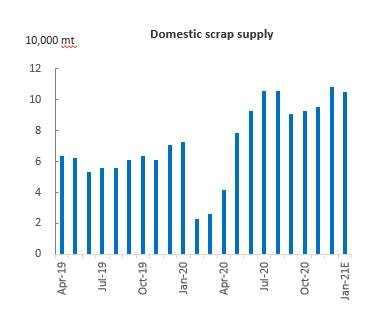
SHANGHAI, Feb 3 (SMM)—The resurgence of COVID-19 in Hebei and three provinces in north-east China forced factories in some regions to suspend production for a period of time in early 2021. The impact on logistics was even bigger. Transport disruptions in Hebei, which is the largest wire and cable production base in the north, left many scrap copper rod manufacturers unable to deliver orders and pushed up their inventories significantly. Due to difficulties in sending out finished goods and purchasing raw materials, the off-peak season before CNY came earlier than last year across many industries and end-user sectors, causing consumption of copper scrap to decline rapidly.
CNY affected copper scrap imports, arrivals to increase significantly after CNY

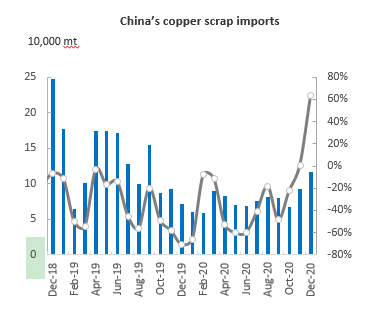
In December 2020, the import of copper scrap stood at 116,700 mt, up 25.18% from the previous month. Increased import volumes caused inventories at some traders to double from the same period of previous years. With copper prices around a record high, traders rushed to clear inventories before workers returned home for CNY at the end of January, leaving copper scrap supply abundant. However, copper scrap supply tightened in late January as there were few supplier. , The overall supply of copper scrap in January remained plentiful.

Shipping companies in Hong Kong-south China will close from January 20 to February 20 for CNY, which will severely hamper copper scrap imports in south China. Most import companies will schedule arrivals to post-CNY date as employees are off work during CNY. Therefore, copper scrap imports are expected to decrease in early February. Imports will gradually pick up after CNY, and concentrated arrivals are expected in March.

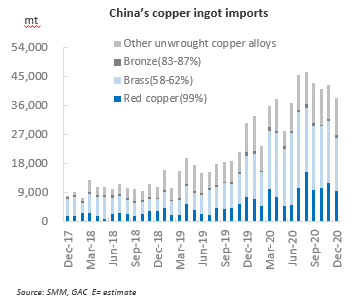
According to customs data, the import volume of copper ingots in December 2020 stood at 38,100 mt, a decrease of 10.04% from the previous month. Following the implementation of the renewable copper material import standard, enterprises without copper scrap import approvals will no longer need to melt and cast part of the copper scrap into ingots for imports in the form of copper ingots. Their import enthusiasm faded as expected. In 2020, imports totalled 450,900 mt, a year-on-year increase of 109.07%.
Data Source Statement: Except for publicly available information, all other data are processed by SMM based on publicly available information, market communication, and relying on SMM‘s internal database model. They are for reference only and do not constitute decision-making recommendations.

For any inquiries or to learn more information, please contact: lemonzhao@smm.cn
For more information on how to access our research reports, please contact:service.en@smm.cn
Related News
China's Copper Ore Imports Down 11.97% MoM, Up 5.84% YoY in February 2026
2 hours ago
China's Copper Ore Imports Down 11.97% MoM, Up 5.84% YoY in February 2026
Read More
China's Copper Ore Imports Down 11.97% MoM, Up 5.84% YoY in February 2026
General Administration of Customs: In February 2026, China imported 2.31 million dmt of copper ore and concentrate, a decrease of 11.97% month-on-month and an increase of 5.84% year-on-year. The cumulative imports in January-February increased by 4.9%.
2 hours ago
China's Jan 2026 Copper Ore Imports Down 2.96% MoM, Up 3.72% YoY
2 hours ago
China's Jan 2026 Copper Ore Imports Down 2.96% MoM, Up 3.72% YoY
Read More
China's Jan 2026 Copper Ore Imports Down 2.96% MoM, Up 3.72% YoY
General Administration of Customs: In January 2026, China imported 2.624 million dmt of copper ores and concentrates, a decrease of 2.96% month-on-month and an increase of 3.72% year-on-year.
2 hours ago
As Delivery Approaches, the Price Spread Between Futures Contracts Widens; SHFE Copper Spot Premiums Shift from a Discount to Flat [SMM Shanghai Spot Copper]
2 hours ago
As Delivery Approaches, the Price Spread Between Futures Contracts Widens; SHFE Copper Spot Premiums Shift from a Discount to Flat [SMM Shanghai Spot Copper]
Read More
As Delivery Approaches, the Price Spread Between Futures Contracts Widens; SHFE Copper Spot Premiums Shift from a Discount to Flat [SMM Shanghai Spot Copper]
[SMM Shanghai Spot Copper] As the delivery period approaches, spot discounts for SHFE copper are expected to continue narrowing steadily. From the perspective of market structure, the inter-month contango price spread between futures contracts has widened, significantly strengthening suppliers’ willingness to ship to delivery warehouses. In particular, inventory in Jiangsu is mainly in the form of warrants, and suppliers tend to opt for delivery rather than spot sales, resulting in persistently tight availability of deliverable spot cargo. In addition, spot premiums quotes in Jiangsu are slightly higher than those in Shanghai. Against this backdrop, suppliers showed a strong willingness to hold prices firm intraday, and quotes in the second session were raised slightly, making procurement more difficult for some downstream enterprises. Looking ahead to tomorrow, under delivery-driven dynamics, spot premiums in Shanghai are expected to remain at current levels.
2 hours ago
Resurgence of COVID-19 and early closures of downstream producers and logistics firms affected copper scrap consumption - Shanghai Metals Market (SMM)