SMM1 March 27: the entire new energy market in 2020 is relatively tortuous. In the first half of the year, due to the impact of the global epidemic, private consumer demand weakened, coupled with a 50-70% drop in the daily active users of online car-hailing, the previous major B-end market orders dropped sharply, with production and sales of less than 400000 vehicles in the first half of the year. The new energy market rebounded rapidly in the second half of the year, especially since the fourth quarter, the production and sales of new energy vehicles have increased significantly compared with the previous quarter, with annual sales of nearly 1.37 million vehicles, an increase of 10.9 percent over the same period last year. The power battery market is also in a state of "low in front and high in later". The battery cost reduction target continues to be implemented after the subsidy declines, in consideration of cost, safety and battery technology breakthrough, the installed capacity of iron-lithium batteries in passenger cars increased significantly in the second half of the year.
Source: SMM
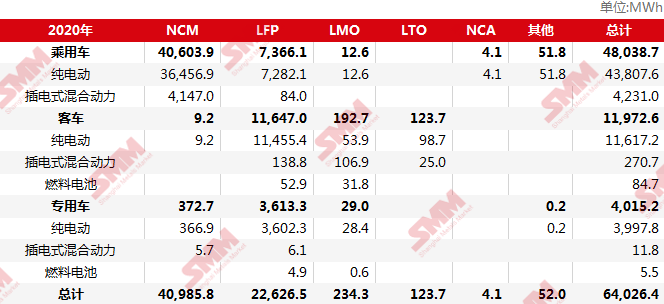
According to the SMM new energy database, the total installed capacity of power batteries in China in 2020 was 64GWH, an increase of 2.9% over the same period last year. In terms of battery types, ternary batteries are mainly used in the field of passenger vehicles, with a total installed capacity of 41GWhs, accounting for 64%; lithium iron phosphate batteries are mainly used in commercial vehicles and pure electric passenger vehicles, with a total installed capacity of 22.6GWhs, accounting for 35.3%.
Looking at the data of new energy vehicles and power batteries installed in 2020, the downstream market this year mainly has the following characteristics:
First, the market concentration has increased, and overseas battery companies have entered the list.
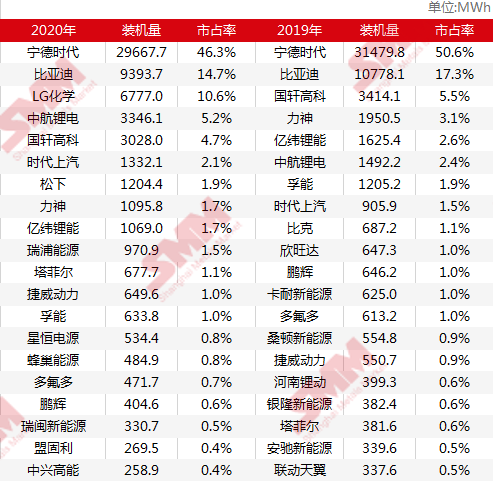
Comparison of TOP20 Enterprises with installed capacity in 2020 and 2019
Source: SMM
In 2020, many domestic and foreign battery companies have come to the fore, such as LG Chemical, Panasonic, Ruipu Energy, Honeycomb Energy, ZTE High Energy and so on. " The cancellation of the "whitelist" marks the official entry of foreign battery companies into the Chinese market, ranking among the top through supporting Tesla, LG Chemical and Panasonic. However, the overall number of power battery enterprises has decreased (76 in 2020 and 83 in 2019). After the decline of subsidies, some established power battery enterprises are forced to stop production or transform the areas of small power and consumption due to technology, cost, cash flow and other reasons.
In 2020, the CR10 of the power battery market was 90.4%, an increase of 6.8% over the same period last year, an increase of 81.5%, a year-on-year increase of 6%, an increase of 71.6%, and a year-on-year increase of 0.4%. In terms of various models, power battery enterprises are the most competitive in passenger cars; the concentration of TOP5 in the bus market has reached 95%; in addition, due to the improvement of lithium iron phosphate battery technology in 2020, coupled with cost and safety advantages, the proportion of installed capacity in passenger cars has increased significantly.
In 2020, Tesla's annual output increased steadily, supporting battery enterprises LG Chemical and Panasonic installed capacity were not affected by the epidemic, and the demand was relatively stable. In the Ningde era, there were more car companies, and new energy vehicles were seriously affected by the epidemic in the first half of the year, and the demand for batteries dropped sharply. Although the output of new car-making companies such as Xiaopeng, Weilai and ideal increased significantly in the second half of the year, and new customers Tesla were added, due to the sharp decline in production in the past 20 years by major customers such as BAIC, SAIC, Geely and other car companies, and after changes in some customer suppliers, the annual Ningde era installed capacity fell 5.8% compared with the same period last year.
In addition, through deep cooperation with Guangzhou Automobile and Changan Automobile, especially after becoming the main supplier of the best-selling model Guangzhou Automobile AION S, AVIC Lithium has greatly improved its ranking of installed capacity, with an increase of 124.2% compared with the same period last year. Ruipu Energy ranks in the top 10 by assembling SAIC GM Wuling popular model Hongguang MINI and Yundu New Energy. Due to the weakening demand in the operating market throughout the year and the late launch of new models, BYD's annual installed capacity declined compared with the same period last year.
Second, the advantages of iron-lithium batteries have emerged, and the proportion of installed capacity of passenger cars has increased.
Source: SMM
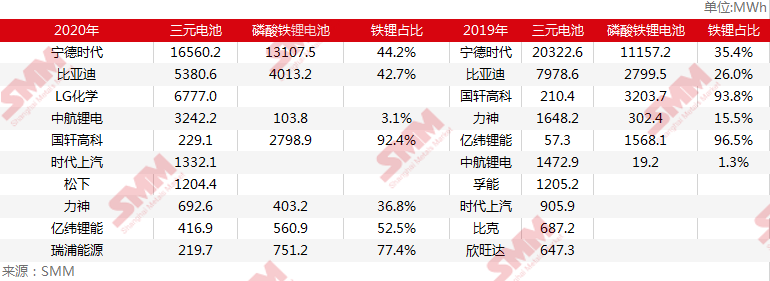
In 2020, the installed capacity of ternary batteries was 41 GWH, an increase of 1.3% over the same period last year, and the installed capacity of lithium iron phosphate batteries was 22.6 GWH, an increase of 12.7% over the same period last year. The growth rate of iron-lithium batteries was more than three yuan, of which the installed capacity of iron-lithium batteries in passenger cars was 7.4GWh, an increase of 298.9 percent over the same period last year, while the installed capacity of ternary batteries in passenger cars increased by only 2.8 percent over the same period last year.
From the installed capacity data of head battery enterprises, it can also be found that the proportion of iron-lithium battery installed in Ningde era has increased from 35.4% to 44.2%. The iron-lithium increment mainly comes from supporting iron-lithium version Tesla Model 3, Hongguang MINI, Chery eQ1 and other models. The proportion of iron and lithium in BYD increased from 26% to 42.7%, mainly because BYD "Han", which is equipped with blade batteries, was widely praised after it went public in the second half of the year. In addition, the installed proportion of iron lithium batteries in Lishen and Ruipu energy sources has also increased.
The proportion of iron-lithium batteries in new energy passenger vehicles increased in the second half of 2020, mainly due to the introduction of CTP technology and BYD blade battery technology in Ningde era at the beginning of the year, which increased the energy density of iron-lithium battery packages through structural optimization, increased the mileage of cars, and reduced consumers' mileage anxiety. in addition, it has certain advantages over ternary batteries in terms of safety and price. After a long period of testing, In the second half of the year, it was officially used in new models, including Hongguang MINI, Model 3, Han and other models after the launch of a big increase in sales, but also greatly boost the demand for iron lithium batteries.
In 2021, the Ministry of Finance, the Ministry of Industry and Information Technology and other four departments jointly issued the Circular on further improving the Financial subsidy Policy for the Promotion and Application of New Energy vehicles. In the field of pure electric vehicles, the subsidy standard for new energy vehicles in 2021 will decline by 20% on the basis of 2020. The Plan proposes that the sales volume of new energy vehicles will reach about 20% of the total sales of new vehicles, and the overall new energy penetration rate has been lower than before. After the epidemic in 2020, the overall market sales of new energy vehicles still increased by 10%.
For the development of new energy vehicles and power batteries in 2021, there are three main directions:
First, from policy-led to market-led. After two years of subsidy decline, the new energy car market no longer relies on state subsidies, but also improves car performance from the perspective of consumer demand, and some car companies are gradually withdrawing from the stage. After the weakening of operating market demand last year, private consumer demand began to rise sharply, and the market focus gradually shifted from the B-end market to the C-end market. This year, there will be more best-selling models on the market, such as BYD Blade Battery Series, Tesla Model Y, Volkswagen ID.4, New Power of carmaking and other new models, starting from consumer demand, from appearance to interior decoration, car mileage, safety, etc., to improve car performance, in addition, the state and automobile companies will increase the construction of charging piles to better promote the future development of new energy vehicles.
Second, foreign capital and joint venture car enterprises continue to attack the Chinese market. After Tesla entered the Chinese market in early 2020, its brand effect and the temptation of price reduction not only led to a monthly increase in sales, but also boosted domestic private consumer demand. Tesla Model Y was listed in China at the beginning of 2021, with a price drop of 148000 yuan and a reservation of more than 100000 units, seizing the domestic SUV market. Recently, the Volkswagen ID.4 has also been listed in China, with a minimum price of less than 200000 yuan. Due to Volkswagen's friendly price, stable performance and good sales in the European market, it is expected to become a best-selling model in China. In addition, Audi e-tron, BMW i4, Mercedes-Benz EQA and other new models are also expected to be listed in China this year, brand advantages plus performance or further impact on the Chinese market.
Third, the cost of the battery has increased, and the demand for iron-lithium batteries continues to rise. The decline of subsidies still has a lot of impact on the prices of car companies. Due to the fierce competition in the new energy market, taking into account the price sensitivity of end consumers, and the price reduction of various models by foreign car company Tesla to occupy the Chinese market share, most car companies will not consider raising their prices. Batteries account for a large proportion of the cost of electric vehicles, and car companies propose plans to reduce battery costs by 5% by 10% every year. However, since the beginning of this year, raw material prices have risen sharply, and due to tight supply and demand support, the average price for the whole year is expected to rise from 2020, resulting in an increase in battery costs. Considering that the price of raw materials is difficult to control, many car companies have plans to list iron-lithium models or existing iron-lithium versions. It is expected that the proportion of installed iron-lithium batteries will continue to increase in 2021, and the demand for iron-lithium batteries may increase by nearly 90%.
Taking into account the continued implementation of new energy activities to the countryside this year, driving low-end market demand, coupled with local policy subsidies and charging pile construction, and the listing of new models at home and abroad, SMM estimates that the total production of new energy vehicles in China will be 1.93 million in 2021, an increase of 42.9 percent over the same period last year, and the total production of new energy vehicles in China is expected to exceed 6 million in 2025.
SMM battery materials research team
Mei Wangqin 021-51666759
Huo Yuan 021-51666898
Liu Xiaoyi 021-51666716
Yuan Ye 021-51595792