Weaker-than-expected substitution of copper cathode with copper scrap despite wide price spread

Published: Jan 25, 2021 13:32
As of January 21, 2021, the price spread between copper cathode and copper spread stood at a four-year high 3,202 yuan/mt, a gain of 249 yuan/mt from the previous day. However, premiums in the domestic spot market remained high amid continued declines in domestic copper cathode inventories, as the substitution of copper cathode with copper scrap weakened.

SHANGHAI, Jan 25 (SMM)—As of January 21, 2021, the price spread between copper cathode and copper scrap stood at a four-year high 3,202 yuan/mt, a gain of 249 yuan/mt from the previous day. However, premiums in the domestic spot market remained high amid continued declines in domestic copper cathode inventories, as the substitution of copper cathode with copper scrap weakened.

Market focus on copper scrap has increased in recent years amid strict environmental requirements. Which peaked in July 2020 due to the enact of the new solid waste law and the implementation of secondary copper resource standard in November. The price advantage of copper scrap is noticeable when the price spread between copper cathode and copper scrap exceeds 1,200 yuan/mt.
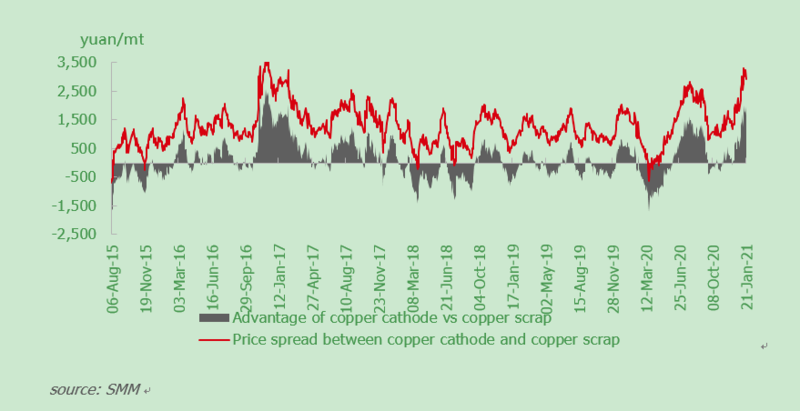
With enhanced environmental protection requirements in Henan and intensified COVID-19 situations in Hebei, consumption of copper scrap in the north has been severely reduced. Copper rod plants using copper scrap as feedstock refrained from restocking copper scrap against low copper rod prices and ample raw material inventory. This combined with plans to shut ahead of CNY has kept available copper scrap ample, prompting downstream buyers to push for lower procurement prices. As such, the price spread between copper cathode and copper scrap widened to 3,300 yuan/mt, and the price spread between copper rod produced with copper cathode and with copper scrap exceeded 2,200 yuan/mt. Strong price advantage ensured brisk trades of copper scrap, despite high SHFE copper prices.

Copper cathode output in January should fall nearly 9% on the month due to maintenance at several big smelters and the absence of a production rush at most smelters at the beginning of the year. Meanwhile, the influx of imported copper should be limited amid a closed import window. Social inventory of copper cathode in China's mainstream markets should continue to fall. Inventory declines in the week ended January 15 stood at 10,800 mt, with the decline in Shanghai and Guangdong most significant. Spot premiums in Shanghai and Guangdong also reflected the strong spot copper market. Spot premiums in Shanghai surged to 180 yuan/mt at one point even as SHFE copper prices fluctuated between 58,500-59,500 yuan/mt. In addition to transactions among trader under long-term contracts, downstream buyers stocked up on cargoes.

The high price spread between copper cathode and copper scrap did not boost the substitution of copper cathode with copper scrap to result in weaker copper consumption and significant stock accumulation.
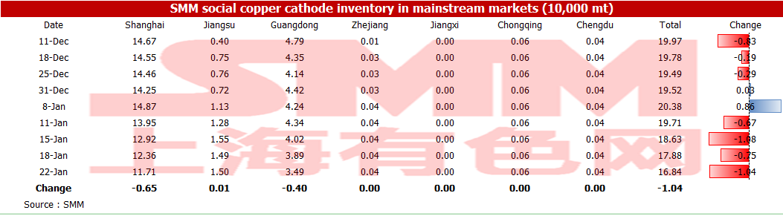
SMM understood that weaker substitution of copper cathode with copper scrap amid weaker consumption since December, coupled with disruptions to copper supply, accounted for copper inventory declines, even as operating rates fell across copper semis producers. In addition, the influx of non-standard and non-registered copper into the domestic market since 2020 has also substituted copper cathode, weakening demand for copper scrap.

Annual domestic capacity of copper rods produced with copper cathode stands at around 16 million mt, and annual capacity of copper rods produced with copper scrap stands at 5 million mt. Copper rod produced with copper scrap drove the recent decline in consumption across copper rods processing enterprises. Orders of electric wire and cable decreased in January, weakening the substitution demand of copper cathode with copper scrap significantly. Photovoltaics and motors sectors with brisk domestic and export orders in 2021 mainly use enamelled wire, and the substitution effect of copper scrap is relatively weak due to process issues. Copper tubes, strips and foils mainly use copper cathode, also limiting copper scrap consumption. 

The approach of CNY combined with COVID-19 should weaken copper scrap. But trades of copper scrap are likely to improve if the price spread stabilises above 3,000 yuan/mt. The price spread between copper cathode and copper scrap should stabilise at the current high level in the near term.

For more information on the Chinese domestic copper markets, please subscribe to China Copper Weekly.

Data Source Statement: Except for publicly available information, all other data are processed by SMM based on publicly available information, market communication, and relying on SMM's internal database model. They are for reference only and do not constitute decision-making recommendations.

For any inquiries or for more information, please contact: lemonzhao@smm.cn
For more information on how to access our research reports, please contact:service.en@smm.cn
Related News
Alchemy Resources Starts Drilling Copper-Gold Targets at Yellow Mountain
2 mins ago
Alchemy Resources Starts Drilling Copper-Gold Targets at Yellow Mountain
Read More
Alchemy Resources Starts Drilling Copper-Gold Targets at Yellow Mountain
Alchemy Resources announced on September 11 that reverse-circulation drilling has commenced across its Yellow Mountain and Overflow projects in New South Wales, Australia, with up to 15 holes planned during the latest exploration campaign.​ At the 80%-owned Yellow Mountain project, drilling will test extensions to previously identified copper-gold and polymetallic mineralisation, as well as two previously undrilled geophysical targets.​ Previous drilling at Yellow Mountain returned an intersection of 113 metres grading 1.17% copper equivalent, comprising 0.33% copper, 0.37 g/t gold, 24.3 g/t silver, 0.86% lead and 1.23% zinc. The latest drilling campaign is designed to test whether the known mineralised system extends into newly identified target areas.​ The program will also include drilling at the Overflow project, where Alchemy is targeting extensions to existing mineralisation along strike and at depth. Overflow currently hosts an inferred mineral resource of approximately 342,000 ounces of gold equivalent and contains gold, silver, copper, lead and zinc mineralisation.​ The commencement of drilling provides a near-term test of the scale and continuity of mineralisation at Yellow Mountain. The previously reported broad copper-gold-polymetallic intersection indicates potential for a sizeable mineralised system, while the newly defined geophysical targets provide additional exploration upside. Drilling results will be important in determining whether the mineralised footprint can be materially expanded.
2 mins ago
Freeport CEO Signals Likely Go-Ahead for $4.5 Billion Bagdad Copper Expansion
4 mins ago
Freeport CEO Signals Likely Go-Ahead for $4.5 Billion Bagdad Copper Expansion
Read More
Freeport CEO Signals Likely Go-Ahead for $4.5 Billion Bagdad Copper Expansion
Freeport-McMoRan Chief Executive Officer Kathleen Quirk has indicated that the company expects to move forward with the proposed expansion of its Bagdad copper mine in Arizona, marking a stronger commitment to the project ahead of a formal investment decision. Speaking at the Jefferies Global Industrials Conference on September 10, Quirk said the project still requires input from Freeport's board but that she expects the company will proceed. She described the expansion as a roughly three-year construction project and noted that no major permitting hurdles are expected. Freeport's latest project estimates put capital expenditure for the Bagdad expansion at approximately US$4.5 billion, around 30% above the previous US$3.5 billion estimate, reflecting cost escalation, scope changes and additional engineering. The project would more than double concentrator capacity at Bagdad and is expected to add approximately 200–250 million lb, or around 91,000–113,000 tonnes, of copper production annually, alongside an additional 10–12 million lb of molybdenum. Bagdad currently has a reserve life exceeding 80 years. Freeport's Q2 2026 regulatory filing had described the project as being prepared for a potential investment decision during the second half of 2026. The latest comments therefore represent a more positive signal from management on the likelihood of development, although formal board approval has not yet been announced. A decision to proceed with Bagdad would represent one of Freeport's most significant near-term copper growth investments in the US. The potential addition of more than 90,000 tonnes per year of copper would materially increase Freeport's US output, although first production would remain several years away given the expected construction period. Attention will now turn to formal board approval and a final investment decision.
4 mins ago
Chile July Copper Output Falls 9.4% YoY; Escondida Slumps 22.1%
12 mins ago
Chile July Copper Output Falls 9.4% YoY; Escondida Slumps 22.1%
Read More
Chile July Copper Output Falls 9.4% YoY; Escondida Slumps 22.1%
According to foreign media reports citing data from the Chilean Copper Commission (Cochilco), Chile's copper production fell 9.4% year on year in July 2026, as output declined sharply at several major operations in the world's largest copper-producing country. Copper production at state-owned Codelco fell 5% year on year to 112,800 tonnes in July, extending a period of weaker output for the company amid operational challenges at key mines. Production at BHP-controlled Escondida, the world's largest copper mine, dropped more sharply, falling 22.1% year on year to 89,400 tonnes. In contrast, output at Collahuasi, jointly owned by Anglo American and Glencore, increased 12.3% year on year to 38,400 tonnes. Chile's National Statistics Institute (INE) separately reported mine copper production of 403,424 tonnes in July. The country's Mining Production Index fell 7.2% year on year, while metallic mining activity declined 10.7%, mainly due to lower copper extraction and processing. Foreign media reports also cited severe weather in northern Chile and maintenance at major operations as factors weighing on July production. Cochilco currently forecasts Chilean copper production at approximately 5.27 million tonnes in 2026, down 2.6% year on year, before recovering 5.2% to around 5.55 million tonnes in 2027. The sharp July decline highlights continued pressure on Chilean mine supply. The 22.1% year-on-year drop at Escondida is particularly significant given the mine's scale, while lower Codelco production further weighs on national output. Although Collahuasi recorded higher production, the increase was insufficient to offset weakness elsewhere. A recovery in major operations during the remainder of the year will be important if Chile is to limit the full-year decline projected by Cochilco.
12 mins ago
Weaker-than-expected substitution of copper cathode with copper scrap despite wide price spread - Shanghai Metals Market (SMM)