China steel rebar inventory continued to post faster increase on week amid shrinking demand

Published: Jan 15, 2021 11:00 (GMT+8)
China steel rebar inventories continued to accelerate increases this week amid pandemic and cold weather.

SHANGHAI, Jan 15 (SMM) – China steel rebar inventories continued to accelerate increases this week amid pandemic and cold weather.

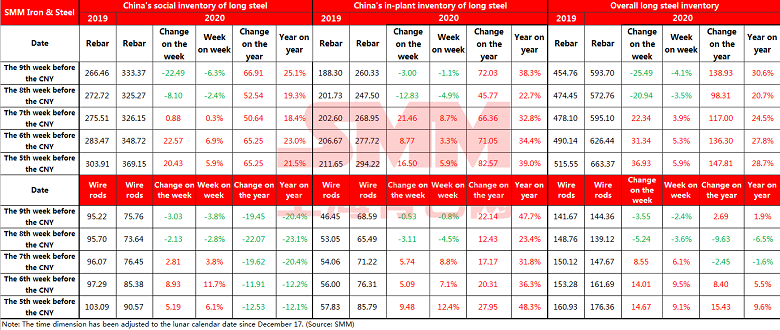
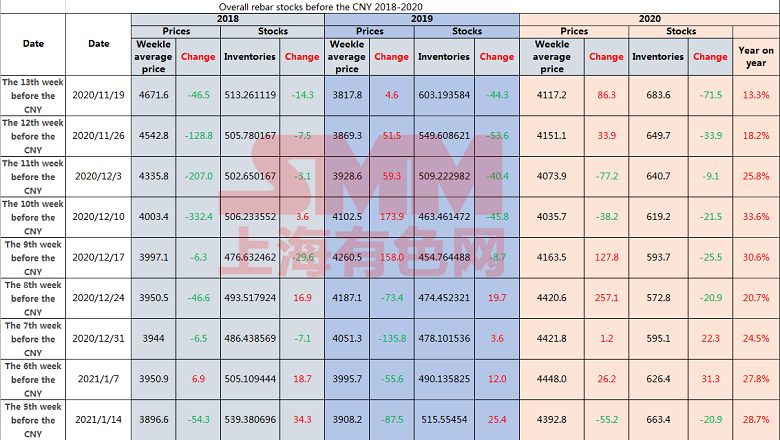
Inventories of rebar across Chinese steelmakers and social warehouses stood at 6.63 million mt as of January 14, up 5.9% from a week ago. From the time dimension of the lunar calendar, stocks are up 28.7% from a year earlier.

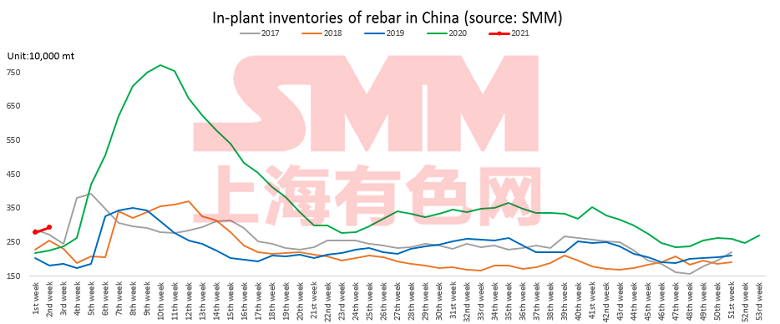
According to SMM data, inventories at Chinese steelmakers rose 165,000 mt on the week and stood at 2.94 million mt. From the time dimension of the lunar calendar, stocks are up 5.94% from a week ago and up 39% from a year earlier.

In-plant stocks posted faster increase on week. On the one hand, steel mill output continued to decline. According to an SMM survey, as of January 14, the affected volume of long steel caused by the steel plant maintenance stood at 1.2 million tons, up 79,800 mt from December. Meanwhile, operating rates of billet plants and electric furnace plants continued to decline due to electricity restrictions and profits (SMM data showed that operating rates of electric furnaces fell 1.21 percentage points on week, and operating rates of billet plants fell 6.4 percentage points from the previous month). On the other hand, end-user demand continues to weaken, and with the approaching winter storage, the absolute market prices are still high, and merchants are less willing to restock, which drags down the decline in in-plant stocks.

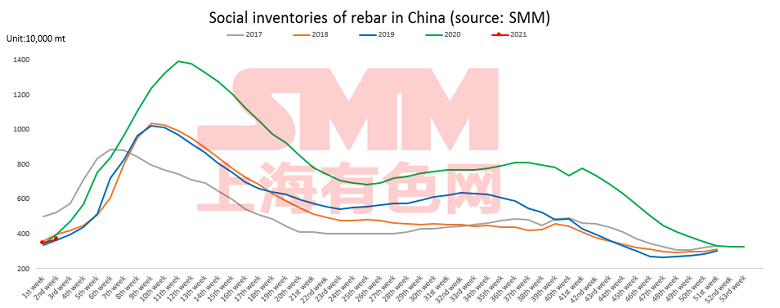
Inventories at social warehouses rose 204,300 mt on the week and stood at 3.69 million mt, up 5.86% from a week ago and 21.5% higher from a year ago.

Social stocks are still accumulating despite the shrinking demand, but the accumulation speed has slowed down. The main reason is that the transfer efficiency of in-plant stocks to social stocks has decreased. The willingness to ship the goods and reduce the stocks is strong due to the cautious sentiment about the later prices before the Chinese New Year.

The current outbreak area of the pandemic is expanding slightly. Although the pandemic in Hebei has been slowly controlled, it has still aroused the attention and concerns of all sectors of the market. Shandong Jining and other places have successively announced the shutdown of construction sites in mid-January.

Demand is shrinking at an accelerating rate under the dual impact of the pandemic and cold weather. Rebar inventories will continue to accelerate increases, and the downward trend of rebar prices has not yet ended. However, it is understood that under the firm raw material prices, steel mills have made little profit. Steel mills in North China and other regions have even entered a state of loss of 100-200 yuan/mt. They are very willing to support prices, so the downside space is likely to be limited.
Data Source Statement: Except for publicly available information, all other data are processed by SMM based on publicly available information, market communication, and relying on SMM's internal database model. They are for reference only and do not constitute decision-making recommendations.

For any inquiries or for more information, please contact: lemonzhao@smm.cn
For more information on how to access our research reports, please contact:service.en@smm.cn
Related News
Western Mining Subsidiary Receives 17-Year License for Qinghai Polymetallic Mine
9 hours ago
Western Mining Subsidiary Receives 17-Year License for Qinghai Polymetallic Mine
Read More
Western Mining Subsidiary Receives 17-Year License for Qinghai Polymetallic Mine
On September 22, Western Mining announced that its wholly owned subsidiary, Qinghai Ganxin Mining Development Co., Ltd. (“Ganxin Mining”), recently obtained a Mining License issued by the Department of Natural Resources of Qinghai Province. The mine, named the Geermu Tuwenchahan Iron Polymetallic Mine of Qinghai Ganxin Mining Development Co., Ltd., covers iron, copper, gold, molybdenum, zinc, lead, and silver as the permitted mining commodities. The mining license is valid from August 3, 2026, to August 30, 2043.
9 hours ago
Korea Zinc's $7.4B US Project Passes Environmental Assessment, Set for 2029 Trial Operations
Sep 21, 2026 17:02 (GMT+8)
Korea Zinc's $7.4B US Project Passes Environmental Assessment, Set for 2029 Trial Operations
Read More
Korea Zinc's $7.4B US Project Passes Environmental Assessment, Set for 2029 Trial Operations
On September 21, Korea Zinc announced that its $7.4 billion US manufacturing project had passed the environmental impact assessment. The facility is scheduled to begin trial operations in 2029 and commercial production the following year, producing 11 critical minerals, 12 non-ferrous metals and semiconductor-grade sulfuric acid. In April, Korea Zinc said it had completed the acquisition of a local zinc smelter and other related companies. The company plans to implement the project by expanding and upgrading the existing facilities.
Sep 21, 2026 17:02 (GMT+8)
Australia Reviews Anti-Dumping Duties on Galvanized Steel from India, Malaysia, Vietnam Amid Zinc Concerns
Sep 11, 2026 18:30 (GMT+8)
Australia Reviews Anti-Dumping Duties on Galvanized Steel from India, Malaysia, Vietnam Amid Zinc Concerns
Read More
Australia Reviews Anti-Dumping Duties on Galvanized Steel from India, Malaysia, Vietnam Amid Zinc Concerns
On September 9, 2026, Australia initiated its second sunset review of anti-dumping measures on galvanized steel sheet from India, Malaysia and Vietnam, and separately launched a sunset review of countervailing measures on imports from India. The review covers July 2025-June 2026, with the final report expected by February 11, 2027. As galvanized steel is the largest end-use sector for zinc, the measures directly affect export costs and competitiveness, potentially impacting Australia’s domestic zinc demand and supply chain. Maintaining the duties would provide some protection for domestic steel and coating capacity, while termination could increase low-priced imports and affect regional zinc consumption. The final outcome remains subject to the authorities’ determination.
Sep 11, 2026 18:30 (GMT+8)