SMM, Jan. 13: recent data on electric vehicle sales in Europe in December have also been released one after another. in December, sales of new energy vehicles in ten major European countries reached 251000, up 257% from the same period last year, up 70% from the previous month, and the impulse continued to exceed expectations at the end of the year. Among them, sales of electric cars in Germany, the main European country, were 83000 in December, up 636% from the same period last year, up 40% from the previous month, and the penetration rate reached 26.6%. Sales for the whole year reached 394000, an increase of 263% over the same period last year. In addition, France sold 36000 electric cars in December, up 403% from a year earlier, up 92.7% from a month earlier, and a penetration rate of 19%. Sales for the year reached 185000, up 225% from a year earlier. As can be seen from Germany, France and other major countries, the sales of the European electric car market in 2020 exceeded expectations, mainly due to the strong promotion of new energy subsidy policies in European countries, which are far stronger than before, and the superimposed listing of new European models to promote market demand. coupled with the strict carbon emission targets in Europe, we will speed up the completion of carbon emission targets by the end of the year. According to MarkLines data, sales of electric cars in Europe reached 1.05 million from January to November, and sales for the whole year are expected to be 1.28 million, an increase of nearly 200% over the same period last year!
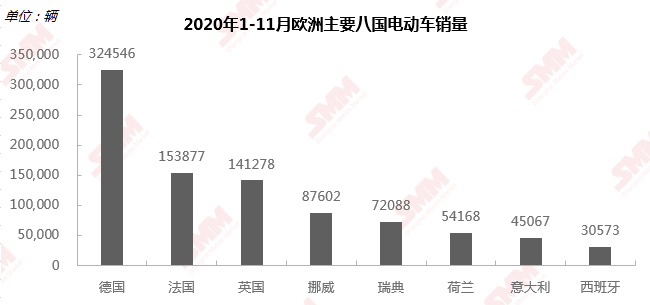
Source: MarkLines, SMM
At present, the European Union has basically raised the greenhouse gas emission reduction target by 2030 from 40% to 55% through the European Climate Target Plan 2030. In addition, countries have paid more attention to the electrification process and introduced the target time of fuel ban in advance. In addition, the high subsidy policies of various countries continue to be maintained, coupled with the number and promotion of new European models in the future, domestic car companies export Europe, and so on, to meet the needs of consumers in various countries. It is expected that the European new energy market has great potential in the future, will continue to maintain high growth in the next five years, and sales will reach 4.7 million vehicles in 2025.
When sales in the European market are growing by leaps and bounds, it also brings opportunities for domestic power battery companies. There are not many local battery enterprises in Europe, and the speed of putting into production is also slow. in recent years, many Japanese and South Korean head battery companies have taken the lead in laying out in the European market. For example, South Korean company LG Chemical has established the largest battery factory in Europe in Poland in 2018, and Samsung has also expanded its battery plant in Hungary. In addition, Chinese battery companies such as CATL, Honeycomb Energy, BYD and Funeng have all begun to speed up the battery layout in Europe. Ningde's first overseas factory in Thuringia, Germany, was started in October 2019. After the project is completed, it will become the largest lithium battery factory in Germany, and it is expected to achieve the annual battery production capacity of 14GWh in 2022. Honeycomb Energy announced plans to build a plant in Europe in July 2019. it will build a large-scale 24GWh power battery factory, a supporting cathode material factory and a battery technology center in Europe.
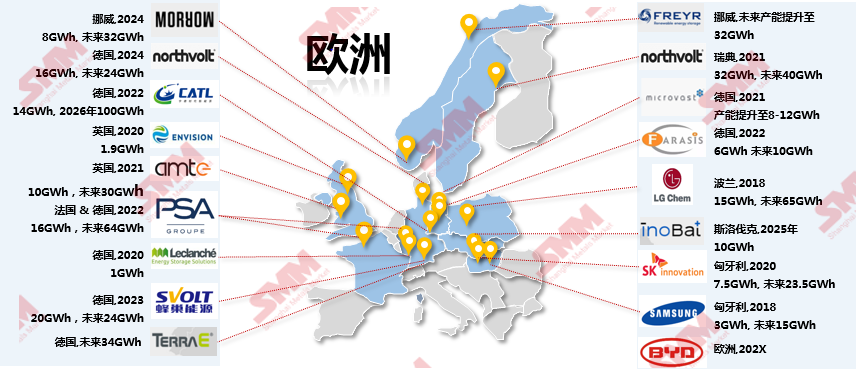
Source: SMM, company website
The main advantages of Chinese battery companies in Europe are:
1. At present, the process of electrification in Europe is accelerating, and the demand for lithium batteries in the new energy market is increasing in the future. It is expected that the demand for lithium batteries will reach 310GWH in 2025. At present, the battery capacity in the European local market is far from enough. Chinese power battery enterprises can seize the European market share as soon as possible by laying out the European market in advance.
2. European countries have attached great importance to electrification in the past two years, and have been increasing subsidies for electric vehicles since 2020. Superimposed in 2019, the Advanced Battery Technology Alliance has received 3.2 billion euros of financial support to support the research, development and innovation of battery technology. The project involves seven EU member states, namely, Germany, France, Italy, Belgium, Finland, Poland and Sweden. The support of huge subsidies is more beneficial to the future expansion of Chinese battery companies.
3. Last year, many domestic head battery companies such as Ningde Times, BYD and Funeng opened cooperation with overseas car companies such as Volkswagen, BMW and Daimler. after officially entering the European market in the future, it will be more convenient to match well-known overseas car companies. and increase international influence.
SMM battery materials research team
Mei Wangqin 021-51666759
Huo Yuan 021-51666898
Liu Xiaoyi 021-51666716
Yuan Ye 021-51595792
![MIIT Seeks Public Comments on Power Battery Recycling Standard System [SMM Analysis]](https://imgqn.smm.cn/usercenter/QGlKw20251217171730.jpg)