Blister copper produced from copper scrap is expected to be sufficient in supply

Published: Jan 11, 2021 12:20 (GMT+8)
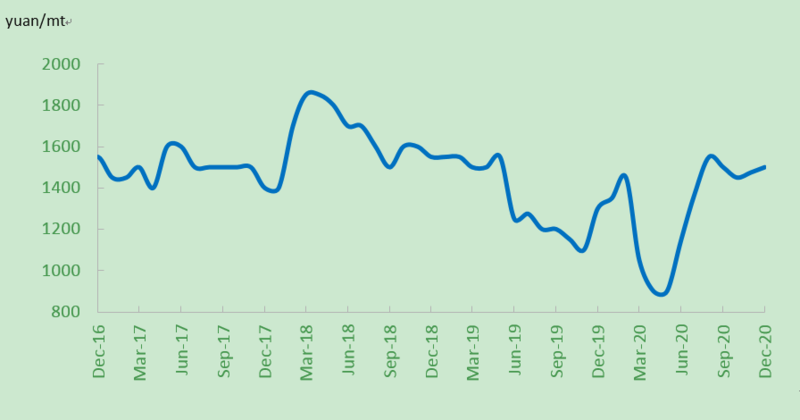
Mainstream refining charges (RCs) of domestic blister copper stood at 1,450-1,550 yuan/mt in December, delivery to factory, an average increase of 25 yuan/mt from the previous month.

SHANGHAI, Jan 11 (SMM)—Mainstream refining charges (RCs) of domestic blister copper stood at 1,450-1,550 yuan/mt in December, delivery to factory, an average increase of 25 yuan/mt from the previous month. RCs of imported blister copper CIF stood at $155-165/mt, up $2.5/mt on average. With the implementation of the secondary copper resource policy, overseas high-quality copper scrap continued to flow into China, forcing some domestic lower-quality copper scrap to the smelting end, and the production at copper scrap smelters increased. The domestic long-term order prices of RCs for blister copper will be around 1,500 yuan/mt in 2021, indicating the strong market confidence in supply. China’s imports of copper anode hit a new high at 117,700 mt in November, and the domestic blister copper inventories were abundant at refineries, so the RCs of blister copper remained high.

RCs for blister copper in China
Source: SMM 

The long-term order prices of RCs for blister copper CIF are yet to be settled. Buyers and sellers have not reached an agreement on which side to bear the cost of the gold value-added tax. The market prices are expected to rise to $140-145/mt.

For more information on the China copper raw materials sector, please subscribe to China Copper Raw Materials Market Report.
Data Source Statement: Except for publicly available information, all other data are processed by SMM based on publicly available information, market communication, and relying on SMM's internal database model. They are for reference only and do not constitute decision-making recommendations.

For any inquiries or for more information, please contact: lemonzhao@smm.cn
For more information on how to access our research reports, please contact:service.en@smm.cn
Related News
Glencore's MARA (Agua Rica–Alumbrera) copper project in Argentina secures RIGI approval
1 min ago
Glencore's MARA (Agua Rica–Alumbrera) copper project in Argentina secures RIGI approval
Read More
Glencore's MARA (Agua Rica–Alumbrera) copper project in Argentina secures RIGI approval
Glencore has announced that its Minera Agua Rica-Alumbrera (MARA) project in Catamarca, Argentina has received approval under the Incentive Regime for Large Investments (RIGI), with expected investment of about US$4 billion and long-term fiscal, customs and foreign-exchange stability including a 25% corporate income tax rate. Agua Rica hosts measured and indicated resources of about 1.2 billion tonnes at 0.47% copper, 0.20 g/t gold, 3.40 g/t silver and 0.03% molybdenum. Ore will be processed at the existing Alumbrera plant 35 km away, with potential to average more than 200,000 tpa of copper in concentrate over the first ten years. The Alumbrera restart is brought forward to H2 2027 with nearly 2,000 workers on site. The government expects construction from November 2027 and production from October 2031; the exploitation-phase EIA was submitted last month and approval is not a final construction decision.
1 min ago
South Africa Moves to Tighten Scrap-Metal Rules, Mandating Electronic Payments for Controlled Metals
1 hour ago
South Africa Moves to Tighten Scrap-Metal Rules, Mandating Electronic Payments for Controlled Metals
Read More
South Africa Moves to Tighten Scrap-Metal Rules, Mandating Electronic Payments for Controlled Metals
South Africa is advancing amendments to its Second-Hand Goods Act that would further tighten controls on scrap trading, including copper, brass, bronze, aluminium, zinc, lead, nickel, tin and cobalt. Under the proposed framework, recyclers acquiring controlled metals from individuals would be explicitly required to make electronic payments and maintain detailed transaction records, while purchases from scrap-metal waste pickers would require names and identification numbers to be recorded. Public comments on the bill remain open until November 2. The legislation targets widespread cable and infrastructure theft, with copper cable theft alone estimated to cost Eskom around R5–7 billion annually, plus roughly R2 billion in replacement costs. While South Africa has already been moving toward cashless scrap transactions, the amendment would strengthen the statutory framework around traceable electronic payments, seller identification and transaction records. If enacted, compliance requirements across South Africa's copper scrap collection, recycling and trading chain would tighten further, potentially restricting the flow of anonymous or informal material into the legitimate market.
1 hour ago
What Could a Cobre Panamá Restart Mean for Global Copper Supply? [SMM Analysis]
12 hours ago
What Could a Cobre Panamá Restart Mean for Global Copper Supply? [SMM Analysis]
Read More
What Could a Cobre Panamá Restart Mean for Global Copper Supply? [SMM Analysis]
Cobre Panamá could again become a major source of global copper supply if Panama and First Quantum agree on a new operating framework. The mine produced 330.9 kt of copper in 2023 and historically supplied around 1% of global output. While stockpile processing has resumed, fresh mining remains suspended. Any restart would likely be phased, with timing dependent on negotiations, legal conditions and operational remobilisation.
12 hours ago