Imports of cobalt raw materials decreased slightly in November, costs of cobalt products continued to increase

Published: Jan 04, 2021 16:24 (GMT+8)
South Africa has tightened its COVID-19 prevention measures imposing Level III lockdowns as the pandemic has worsened, triggering concerns about supply of cobalt raw materials.

SHANGHAI, Jan 4 (SMM)—South Africa has tightened its COVID-19 prevention measures imposing Level III lockdowns as the pandemic has worsened, triggering concerns about supply of cobalt raw materials. China’s cobalt raw materials imports in December 2020 and January 2021 are likely to decline to 7,900 mt and 6,400 mt, respectively, both on a metal basis, due to the Christmas and New Year holidays, decreased port capacity, and rising logistics prices.

At present, it is more accurate to estimate the import volume of cobalt raw materials by referring to quarterly or even semi-annual import volumes. The import volume of cobalt intermediate products was around 5,572 mt in metal content in September as COVID-19 increased logistics uncertainties and made it difficult to book ships. From September to November, the average monthly import volume of cobalt intermediate products was 7,700 mt in metal content. Higher import volumes in October and November were possibly due to arrivals of delayed shipments.
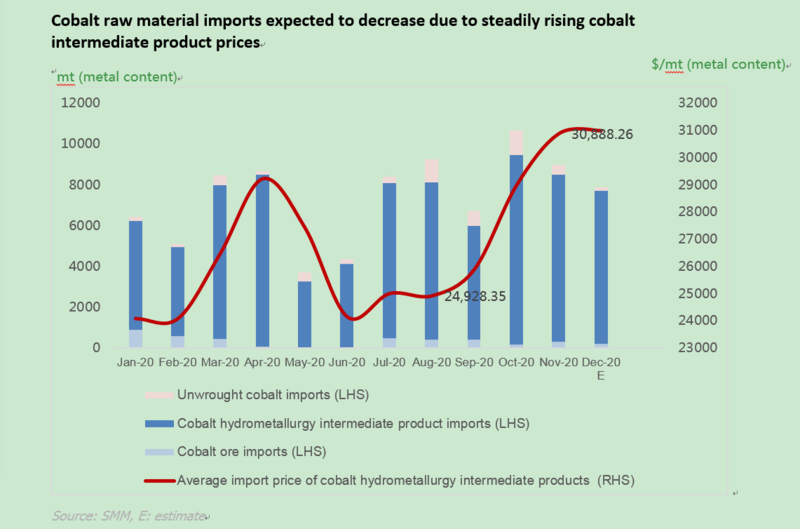
Due to the increase in logistics costs, depreciation of the US dollar, and increase in battery material prices amid strong domestic demand, the average price of cobalt intermediate products rose significantly on both yearly and monthly basis in November. At present, the cost of raw material and finished product inventory at domestic cobalt smelters has increased, supporting the rise in smelting product prices.

For more information on the China New Energy sector, please subscribe to China Cobalt & Lithium Weekly Report.
Data Source Statement: Except for publicly available information, all other data are processed by SMM based on publicly available information, market communication, and relying on SMM's internal database model. They are for reference only and do not constitute decision-making recommendations.

For any inquiries or for more information, please contact: lemonzhao@smm.cn
For more information on how to access our research reports, please contact:service.en@smm.cn
Related News
Tinci's 6-Production Line Battery Recycling Project Under Review in Jiujiang, Jiangxi
19 mins ago
Tinci's 6-Production Line Battery Recycling Project Under Review in Jiujiang, Jiangxi
Read More
Tinci's 6-Production Line Battery Recycling Project Under Review in Jiujiang, Jiangxi
【East China's Jiangxi (Jiujiang): Tinci's 6 Production Lines Battery Recycling Project】According to an environmental impact report disclosure, a waste lithium battery resource recycling project has been accepted for review. The project is located in the Jinshawan Zone, Hugao County High-tech Industrial Park, Jiujiang, Jiangxi. It is designed with six processing systems: a renovation system for waste LFP iron battery material recycling (two LFP battery pre-treatment lines, one cathode sheet pre-treatment line, and one hydrometallurgical recovery line), a new waste LFP battery pack cascade utilization system (one cascade utilization production line), a new waste battery and electrode sheet pre-treatment system (one LFP battery pre-treatment line, one ternary battery pre-treatment line, and one LFP cathode sheet pre-treatment line), a new iron phosphate hydrometallurgical recovery system, a new nickel-cobalt-manganese salt production system, and a new lithium carbonate production system (two high-purity lithium carbonate lines and one battery-grade lithium carbonate line).
19 mins ago
Hubei's Retired Battery Regeneration Project Launches, Achieving 50% Lower Carbon Footprint
19 mins ago
Hubei's Retired Battery Regeneration Project Launches, Achieving 50% Lower Carbon Footprint
Read More
Hubei's Retired Battery Regeneration Project Launches, Achieving 50% Lower Carbon Footprint
【Central China's Hubei (Dawu): Retired Battery High-Value Regeneration Project Goes into Operation】According to industry sources, an investment in a retired-battery-to-material high-value regeneration project in the Dawu County Economic Development Zone, Xiaogan, Hubei has completed construction, commissioning, and officially commenced operation. From start to product coming off the line, the project took only 90 days. Relying on the group's self-developed fully-dry direct regeneration process and intelligent equipment, the project focuses on intelligent precision dismantling of retired power batteries, precision powder sorting, and in-situ restoration regeneration of cathode materials, building a closed-loop green industrial ecosystem from "retired recycling—intelligent dismantling—material regeneration—return to the production line." The process uses no acids, no alkalis, no water, and no solid waste, with carbon footprint reduced by over 50% compared with industry levels.
19 mins ago
Hunan's Lixian Approves $30M Project for Battery and Electrode Sheet Recycling
19 mins ago
Hunan's Lixian Approves $30M Project for Battery and Electrode Sheet Recycling
Read More
Hunan's Lixian Approves $30M Project for Battery and Electrode Sheet Recycling
【Central China's Hunan (Lixian): 30,000 tpa Battery & Electrode Sheet Circular Utilization Project】According to a pre-approval disclosure by the local ecological environment bureau, a new-energy material circular utilization project has been published for approval. With a total investment of RMB 30 million and a total land area of 2,647 m², the project will build one waste lithium battery processing line, one cathode sheet processing line, and one anode sheet processing line. Upon completion, it will form an annual production capacity of 10,000 tons of waste lithium batteries (waste LFP batteries) and 20,000 tons of electrode sheets (10,000 tpa cathode sheets and 10,000 tpa anode sheets), focusing on the resource utilization of lithium electrode sheets and waste batteries.
19 mins ago