Will steel scrap import exceed expectations in 2021 when the import of secondary steel raw materials is liberalised?

Published: Jan 04, 2021 16:00 (GMT+8)
The Ministry of Ecology and Environment, the National Development and Reform Commission (NDRC), the General Administration of Customs, the Ministry of Commerce, and the Ministry of Industry and Information Technology (MIIT) jointly issued the "Announcement on Regulating the Import Administration of Secondary Materials for Steel" (hereinafter referred to as the "Announcement") on December 31, 2020, effective from January 1, 2021.

SHANGHAI, Jan 4 (SMM) — The Ministry of Ecology and Environment, the National Development and Reform Commission (NDRC), the General Administration of Customs, the Ministry of Commerce, and the Ministry of Industry and Information Technology (MIIT) jointly issued the "Announcement on Regulating the Import Administration of Secondary Materials for Steel" (hereinafter referred to as the "Announcement") on December 31, 2020, effective from January 1, 2021.

The announcement mentioned that secondary  materials for steel that meet the "Secondary Materials for Steel" (GB/T 39733-2020) standard are not solid waste and can be freely imported. At the same time, the announcement also announced the customs commodity code of secondary materials for steel. So far, the concern about the liberalisation of the import of secondary materials for steel has finally settled. So how much steel scrap imports will be brought about by the liberalisation of the import of secondary materials for steel?

Judging from the data of steel scrap imports in the past 20 years, it reached a peak of 13.69 million mt in 2009, and then the import did not exceed 7 million mt. After 2014, it stood at basically around 2 million mt, and the import in 2020 came in at only 22,000 mt. Undoubtedly, the liberalisation of imports of secondary materials for steel is expected to promote the increase in steel scrap imports. According to media reports, Euro Metallurgical has started the import of 3,000 mt of secondary materials for steel. Judong signed a single import of 2,800 mt of secondary materials for steel with Japan.      

Historical scrap imports reached a peak of 13.69 million mt in 2009
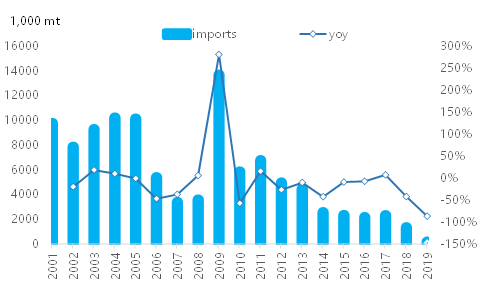
Source: China Customs

It is worth noting that whether the import can increase significantly depends on the domestic and overseas price difference. Overseas steel scrap prices have risen rapidly since late November. Take Turkish steel scrap prices as an example. They rose by 35.3% in December alone. The price difference between overseas steel scrap prices and domestic steel scrap prices has almost disappeared at present, and the import advantage has significantly weakened.

Under the regulation of the market mechanism, the volume of imported steel scrap is likely to be lower than previous expectations. It is expected that the import will remain at around 6-9 million mt in 2021, and the impact on the domestic market will be limited.

For more information on the China steel scrap  and EAF sector, please subscribe to China Steel Scrap &EAF Monthly.

Data Source Statement: Except for publicly available information, all other data are processed by SMM based on publicly available information, market communication, and relying on SMM's internal database model. They are for reference only and do not constitute decision-making recommendations.

For any inquiries or for more information, please contact: lemonzhao@smm.cn
For more information on how to access our research reports, please contact:service.en@smm.cn
Related News
Market closes steadily, the most-traded SHFE tin contract moves sideways ahead of National Day holiday [SMM Tin Midday Review]
11 mins ago
Market closes steadily, the most-traded SHFE tin contract moves sideways ahead of National Day holiday [SMM Tin Midday Review]
Read More
Market closes steadily, the most-traded SHFE tin contract moves sideways ahead of National Day holiday [SMM Tin Midday Review]
[SMM Tin Midday Review: Market Ends Stable, SHFE Tin Moves Sideways Ahead of National Day Holiday]
11 mins ago
[Indian Railways Approves INR 122 Cr for Doubling Barbil–Bolanikhadan Line in Odisha]
26 mins ago
[Indian Railways Approves INR 122 Cr for Doubling Barbil–Bolanikhadan Line in Odisha]
Read More
[Indian Railways Approves INR 122 Cr for Doubling Barbil–Bolanikhadan Line in Odisha]
[Indian Railways Approves INR 122 Cr for Doubling Barbil–Bolanikhadan Line in Odisha]
Indian Railways has approved doubling of the 6 km Barbil–Bolanikhadan section under Southeastern Railway of Odisha at a cost of INR 122 Cr. The single line stretch now carries about 9 million tonnes of freight a year, entirely high-grade iron ore and pellets moving from SAIL's Bolani mines and private sidings to steel plants and ports. Once doubled, it can handle an extra 8.9 million tonnes annually and reduce freight train delays. Part of the "Energy, Mineral and Cement Corridor," the project aims to prevent congestion ahead of SAIL's mine expansion and new port and plant capacity.
26 mins ago
Tighter China Customs Inspections Delay Copper Scrap Cargoes, Nearly 10,000 Tonnes Queuing in Hong Kong
1 hour ago
Tighter China Customs Inspections Delay Copper Scrap Cargoes, Nearly 10,000 Tonnes Queuing in Hong Kong
Read More
Tighter China Customs Inspections Delay Copper Scrap Cargoes, Nearly 10,000 Tonnes Queuing in Hong Kong
Chinese customs inspections on imported recycled copper raw materials have continued to tighten, leaving a growing volume of non-compliant copper scrap held up at ports. According to SMM market checks, nearly 10,000 tonnes of copper scrap are currently waiting in Hong Kong for entry into Guangdong. Longer customs clearance times are increasing inventory and working-capital pressure on some traders. The affected cargoes are mainly No.2 copper originating from Latin America and Southern Europe. With customs inspections remaining stringent, disruptions to scrap inflows are reducing the effective availability of imported copper scrap in the Chinese market and adding to near-term supply tightness.
1 hour ago