[SMM Outlook] the price of battery-grade lithium carbonate soared by 17% in December. Can the price continue to be strong under the overhaul of big factories in the first quarter?

Telah Terbit: Dec 31, 2020 13:32
[the price of battery-grade lithium carbonate soared by 17% in December. Can the price continue to be strong under the overhaul of big factories in the first quarter? SMM believes that the output of some lithium salt plants declined slightly in December due to power cuts, superimposed by the overhaul of large factories in the first quarter, and the supply decreased significantly in the first quarter of next year. On the demand side, under the guidance of Spring Festival stock preparation and bullish sentiment, there has been over-purchasing in some of the lower reaches, but the purchasing mood will gradually slow down in January, with only a small replenishment in the material factory, and the mainstream transaction price of lithium carbonate is expected to rise only slightly. With logistics restrictions approaching the Spring Festival and procurement demand slowing, prices are likely to remain stable from the end of January to March.

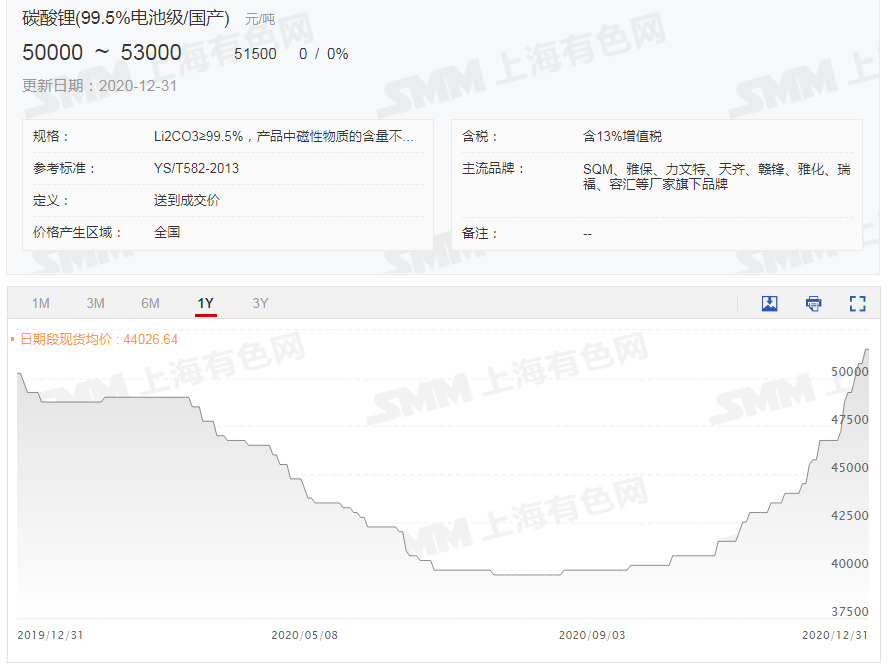
SMM12 March 31: looking back in 2020, the price of battery-grade lithium carbonate showed an overall trend of first suppressing and then rising. Since mid-late March, the price of battery-grade lithium carbonate has been falling, reaching a record low of 39750 yuan / ton. Since the end of August, prices have been rising. As of today, the average price of battery-grade lithium carbonate is 51500 yuan / ton, up 11750 yuan / ton from the lowest level since the beginning of the year, rebounding 29.6%.
"Click to view the spot historical price of SMM cobalt lithium

As the new energy vehicle industry continues to release heavy good news, driving the demand for upstream raw materials. In December, the price of battery-grade lithium carbonate continued to rise. As of today, the average price of battery-grade lithium carbonate was 51500 yuan / ton, up 7500 yuan / ton from December 1, rebounding 17%.

On the supply side, according to SMM research, since 2018, some purification enterprises have used industrial-grade lithium carbonate causticizing method to produce battery-grade lithium hydroxide. therefore, the actual lithium carbonate inventory in the market is about 50000 tons, and the current lithium salt factory inventory accounts for only about 7%. Overall, the supply is tight.

On the demand side, towards the end of the year, downstream manufacturers prepare the usual stock, and the procurement demand is relatively large, and the demand for upstream raw materials is expected to slow down. The demand for lithium carbonate is expected to be 20005 tons in December, an increase of 0.34% from the previous month, and a year-on-year increase of 107.74% to maintain a high level.

SMM believes that the output of some lithium salt plants declined slightly in December due to power cuts, superimposed by the overhaul of large factories in the first quarter, and the supply decreased significantly in the first quarter of next year.

On the demand side, under the guidance of Spring Festival stock preparation and bullish sentiment, there has been over-purchasing in some of the lower reaches, but the purchasing mood will gradually slow down in January, with only a small replenishment in the material factory, and the mainstream transaction price of lithium carbonate is expected to rise only slightly. With logistics restrictions approaching the Spring Festival and procurement demand slowing, prices are likely to remain stable from the end of January to March.

There is obvious overcapacity on the supply side of lithium carbonate in 2021, but as material factories step up their efforts to put into production and stock, it is expected that a tight balance will be formed at the end of the year as in the fourth quarter of this year, the price of lithium raw materials will continue to rise, and the price of lithium carbonate may still be bullish at the end of the year.

Pernyataan Sumber Data: Kecuali informasi yang tersedia untuk publik, semua data lainnya diproses oleh SMM berdasarkan informasi publik, komunikasi pasar, dan mengandalkan model database internal SMM. Hanya untuk referensi dan tidak menjadi rekomendasi pengambilan keputusan.

Untuk pertanyaan atau informasi lebih lanjut, silakan hubungi: lemonzhao@smm.cn
Untuk informasi lebih lanjut tentang cara mengakses laporan penelitian kami, hubungi:service.en@smm.cn
Berita Terkait
[Isu Baterai Solid-State Dibantah: Wang Fang dari CATARC Menyatakan Belum Ada Penetapan Kepatuhan untuk Perusahaan Baterai Solid-State]
14 menit yang lalu
[Isu Baterai Solid-State Dibantah: Wang Fang dari CATARC Menyatakan Belum Ada Penetapan Kepatuhan untuk Perusahaan Baterai Solid-State]
Baca Selengkapnya
[Isu Baterai Solid-State Dibantah: Wang Fang dari CATARC Menyatakan Belum Ada Penetapan Kepatuhan untuk Perusahaan Baterai Solid-State]
[Isu Baterai Solid-State Dibantah: Wang Fang dari CATARC Menyatakan Belum Ada Penetapan Kepatuhan untuk Perusahaan Baterai Solid-State]
[Bantahan Rumor Baterai Solid-State: Wang Fang dari CATARC Menyatakan Tidak Ada Penetapan Kepatuhan yang Dilakukan terhadap Perusahaan Baterai Solid-State] Pada 4 September 2026, Wang Fang, Kepala Ilmuwan di Pusat Teknologi dan Penelitian Otomotif Tiongkok (CATARC), mengklarifikasi rumor yang beredar baru-baru ini dalam "Konferensi Baterai Daya Dunia 2026": CATARC belum melakukan penetapan apa pun terhadap perusahaan baterai solid-state, dan rumor terkait adalah "informasi palsu." Baru-baru ini, terdapat laporan pasar yang mengklaim bahwa CATARC, berdasarkan standar nasional GB/T 43568-2026 "Baterai Solid-State untuk Kendaraan Listrik – Bagian 1: Terminologi dan Klasifikasi," yang mulai berlaku pada Juli tahun ini, melakukan penetapan terhadap lebih dari 320 perusahaan yang terlibat dalam baterai solid-state, dengan hanya 9 yang akhirnya lulus seluruh item kepatuhan secara lengkap.
14 menit yang lalu
[Baterai litium: Foshan Plastics merencanakan lebih dari RMB 7 miliar untuk kapasitas separator kelas atas]
14 menit yang lalu
[Baterai litium: Foshan Plastics merencanakan lebih dari RMB 7 miliar untuk kapasitas separator kelas atas]
Baca Selengkapnya
[Baterai litium: Foshan Plastics merencanakan lebih dari RMB 7 miliar untuk kapasitas separator kelas atas]
[Baterai litium: Foshan Plastics merencanakan lebih dari RMB 7 miliar untuk kapasitas separator kelas atas]
Foshan Plastics Technology mengungkapkan pada 3 September bahwa unit yang sepenuhnya dimilikinya, Gellec (Hebei Jinli), akan menginvestasikan sekitar RMB3,35 miliar untuk basis separator proses basah berkapasitas 4 miliar meter persegi per tahun di Shaoguan, Guangdong, dan sekitar RMB3,81 miliar untuk proyek separator berlapis berkapasitas 4 miliar meter persegi per tahun di Wu'an, Hebei. Perusahaan juga merencanakan penempatan saham privat hingga RMB4 miliar untuk mendanai proyek-proyek tersebut, dengan pemegang saham pengendali Guangxin Group berpartisipasi sebesar RMB400 juta hingga 1 miliar, bertujuan meningkatkan skala pasokan separator dan daya saing biaya.
14 menit yang lalu
[Solid-state: ProLogium mulai produksi massal sel solid-state penuh Gen 3.5 pada 381 Wh/kg]
15 menit yang lalu
[Solid-state: ProLogium mulai produksi massal sel solid-state penuh Gen 3.5 pada 381 Wh/kg]
Baca Selengkapnya
[Solid-state: ProLogium mulai produksi massal sel solid-state penuh Gen 3.5 pada 381 Wh/kg]
[Solid-state: ProLogium mulai produksi massal sel solid-state penuh Gen 3.5 pada 381 Wh/kg]
ProLogium mengumumkan pada 2 September bahwa baterai keramik litium generasi ketiga Gen 3.5 telah memasuki produksi massal di pabrik skala gigawatt miliknya di Taiwan, Tiongkok, membawa teknologi solid-state berdensitas energi tinggi dari tahap percontohan ke output berskala besar. Pengujian TÜV menunjukkan sel besar 185,4Ah mencapai 381 Wh/kg dan 903 Wh/L, dan pengujian UL Solutions berdasarkan standar Tiongkok GB/T 43568-2026 mengonfirmasi klasifikasi all-solid-state-nya. ProLogium telah mengirimkan lebih dari 2,4 juta sel sejak 2013 dan meraih lebih dari 175 pesanan berulang dalam penggunaan otomotif; baterai Gen 4 generasi berikutnya hanya memerlukan sekitar 10% retrofit dari lini produksi yang ada, menargetkan pusat data AI, kendaraan listrik, maritim, dan kedirgantaraan.
15 menit yang lalu