Impact on China domestic supply/demand of the new scrap law and the operational challenges of the law to primary and secondary aluminium industries

เผยแพร่แล้ว: Dec 4, 2020 16:32
Leo Yi, senior analyst at SMM, explained the challenges posed by the new solid waste law to China’s aluminium scrap supply and operations at secondary aluminium producers

SUZHOU, Dec 4 (SMM)—On today’s Shanghai Metals Market’s 2020 Nonferrous Metals Industry Chain Annual Conference held in Suzhou, Leo Yi, senior analyst at SMM, explained the challenges posed by the new solid waste law to China’s aluminium scrap supply and operations at secondary aluminium producers.  

According to Yi, the new solid waste law will lead to an increase in aluminium ash processing costs due to insufficiency of qualified processing capacity and greater difficulties in trans-provincial transport of hazardous waste.  

“But there are several measures for producers to take to tackle the problem, such as building their own aluminium ash treatment capacity, waiting for the commissioning of new technologies and new processing capacities or reducing production to lower aluminium ash output,” Yi suggested.

Yi also gave his insights on profits of imported secondary aluminum amid under the new solid waste import policy and COVID-19 pandemic. He said that the abolition of tariffs on secondary aluminium ingots is likely to expand aluminium ingots imports.
Source: SMM

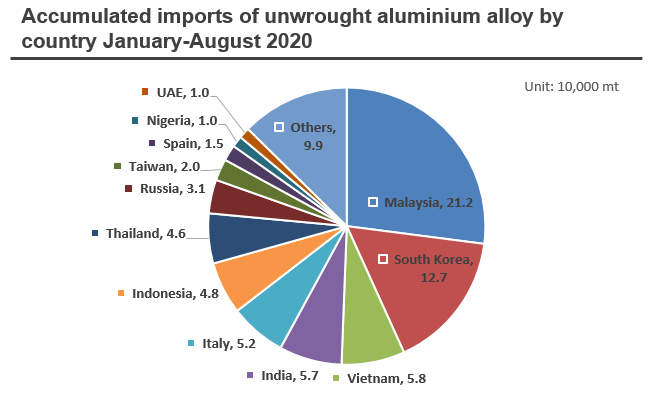
Among the countries that account for over 1% of Chinese unwrought aluminium alloy imports, agreed tariffs in Malaysia, Vietnam, Indonesia, Thailand and other ASEAN countries as well as South Korea stood at zero, with imports of 490,000 mt, accounting for 62.6%; the Asia-Pacific Trade Agreement tariff for India stood at 4.6%, with an import volume from India of 57,000 mt, accounting for 7.3%; imports from the countries with agreed tariffs stood at 547,000 mt, accounting for 69.9% of the total. Imports of aluminium alloy ingots from Italy, Russia, Taiwan, Spain, Nigeria and the United Arab Emirates, which top the list of China’s suppliers, should increase significantly if the import tariffs for secondary aluminium ingots are abolished.
Source: SMM

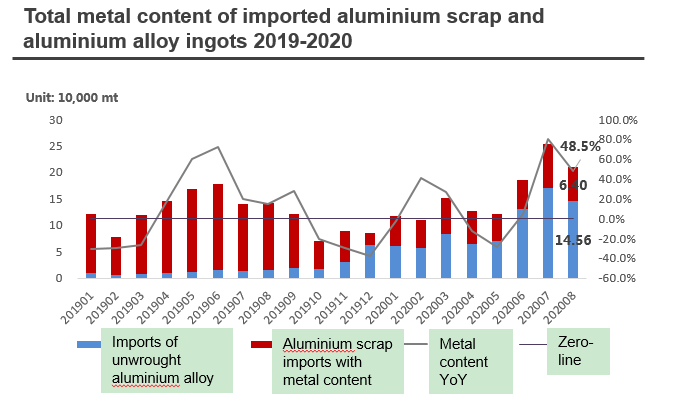
The import window for aluminium alloy ingots shrank significantly and closed at one point in August 2020, resulting in a sharp decline in new import orders of aluminium alloy ingot. This will reduce aluminium alloy ingots imports noticeably from September to November. If tariffs on imported aluminium alloy ingots are cancelled in November, the window for aluminium alloy ingots imports will expanded, increasing new import orders significantly. In this scenario, aluminium alloy ingots imports from December to January are expected to exceed 100,000 mt, giving an impact on domestic aluminium alloy ingots.

“Import opportunity for non-standard aluminium alloy and aluminium scrap increased amid weaker profits of imported ADC12,” Yi said, “Although aluminium scrap import has been freed up, requirements remain strict. At present, most of the overseas aluminium scrap cannot meet the requirements for direct import. Overseas aluminium scrap processing capacity will be insufficient in the short term. Profits are expected to drive imports of non-standard aluminium alloy due to pricing based on discounts and premiums of aluminium, ensuring profits without risk. Overseas aluminium scrap that has not been processed or is of low quality are likely to be imported in the form of non-standard ingots.”

คำชี้แจงแหล่งที่มาของข้อมูล: นอกจากข้อมูลที่เปิดเผยต่อสาธารณะแล้ว ข้อมูลอื่นๆ ทั้งหมดได้รับการประมวลผลโดย SMM จากข้อมูลสาธารณะ การสื่อสารกับตลาด และการพึ่งพาแบบจำลองฐานข้อมูลภายในของ SMMข้อมูลเหล่านี้มีไว้เพื่ออ้างอิงเท่านั้น ไม่ถือเป็นข้อเสนอแนะในการตัดสินใจ

หากมีข้อสงสัยหรือต้องการทราบข้อมูลเพิ่มเติม กรุณาติดต่อ: lemonzhao@smm.cn
หากต้องการข้อมูลเพิ่มเติมเกี่ยวกับวิธีการเข้าถึงรายงานการวิจัยของเรา โปรดติดต่อ:service.en@smm.cn
ข่าวที่เกี่ยวข้อง
การนำเข้าและส่งออกอะลูมิเนียมอัลลอยด์ยังไม่ขึ้นรูปของจีนมีแนวโน้มผสมผสานในเดือนสิงหาคม 2569
3 ชั่วโมงที่แล้ว
การนำเข้าและส่งออกอะลูมิเนียมอัลลอยด์ยังไม่ขึ้นรูปของจีนมีแนวโน้มผสมผสานในเดือนสิงหาคม 2569
อ่านเพิ่มเติม
การนำเข้าและส่งออกอะลูมิเนียมอัลลอยด์ยังไม่ขึ้นรูปของจีนมีแนวโน้มผสมผสานในเดือนสิงหาคม 2569
[SMM อลูมิเนียมด่วน] ตามข้อมูลศุลกากร การนำเข้าโลหะผสมอลูมิเนียมยังไม่ขึ้นรูปในเดือนสิงหาคม 2569 อยู่ที่ 71,500 ตัน เพิ่มขึ้น 0.2% เมื่อเทียบปีต่อปี และเพิ่มขึ้น 19.5% เมื่อเทียบเดือนต่อเดือน ยอดนำเข้าสะสมตั้งแต่เดือนมกราคมถึงสิงหาคม 2569 อยู่ที่ 564,900 ตัน ลดลง 17.4% เมื่อเทียบปีต่อปี การส่งออกโลหะผสมอลูมิเนียมยังไม่ขึ้นรูปในเดือนสิงหาคม 2569 อยู่ที่ 51,600 ตัน เพิ่มขึ้น 77.6% เมื่อเทียบปีต่อปี แต่ลดลง 11.9% เมื่อเทียบเดือนต่อเดือน ยอดส่งออกสะสมตั้งแต่เดือนมกราคมถึงสิงหาคม 2569 อยู่ที่ 348,700 ตัน เพิ่มขึ้น 100.1% เมื่อเทียบปีต่อปี
3 ชั่วโมงที่แล้ว
ผลผลิตแบตเตอรี่ลิเธียมของจีนจะพุ่งขึ้น 9% ในเดือนกันยายน ขานรับความต้องการกักเก็บพลังงานทั่วโลก
19 ชั่วโมงที่แล้ว
ผลผลิตแบตเตอรี่ลิเธียมของจีนจะพุ่งขึ้น 9% ในเดือนกันยายน ขานรับความต้องการกักเก็บพลังงานทั่วโลก
อ่านเพิ่มเติม
ผลผลิตแบตเตอรี่ลิเธียมของจีนจะพุ่งขึ้น 9% ในเดือนกันยายน ขานรับความต้องการกักเก็บพลังงานทั่วโลก
ตามข้อมูลสำรวจรายเดือนจากหลายห่วงโซ่อุตสาหกรรม คาดว่าตารางการผลิตแบตเตอรี่ลิเธียมของจีนในเดือนกันยายนจะเกิน 330 กิกะวัตต์ชั่วโมง เพิ่มขึ้นประมาณ 9% เมื่อเทียบรายเดือน โดยเซลล์กักเก็บพลังงานคิดเป็นประมาณ 130 กิกะวัตต์ชั่วโมง หรือเกือบ 40% ของทั้งหมด การเติบโตของระบบกักเก็บพลังงานส่วนใหญ่มาจากโครงการขนาดใหญ่ในต่างประเทศ โดยสถานีกักเก็บพลังงานหลายแห่งในตะวันออกกลาง ยุโรป และสหรัฐฯ ต่างเร่งเชื่อมต่อโครงข่ายก่อนสิ้นปี ลูกค้าต่างประเทศกำลังจัดซื้อเซลล์กักเก็บพลังงานความจุสูงขนาด 314Ah ขึ้นไปอย่างหนาแน่น สายการผลิตเดิมของผู้ผลิตแบตเตอรี่ชั้นนำถูกจองเต็มจนถึงกลางเดือนตุลาคม
19 ชั่วโมงที่แล้ว
ยอดขายรถยนต์พลังงานใหม่เดือนกันยายน 2026 พุ่งขึ้น 45.6% เมื่อเทียบรายปี ส่วนแบ่งตลาดใกล้แตะ 50%
19 ชั่วโมงที่แล้ว
ยอดขายรถยนต์พลังงานใหม่เดือนกันยายน 2026 พุ่งขึ้น 45.6% เมื่อเทียบรายปี ส่วนแบ่งตลาดใกล้แตะ 50%
อ่านเพิ่มเติม
ยอดขายรถยนต์พลังงานใหม่เดือนกันยายน 2026 พุ่งขึ้น 45.6% เมื่อเทียบรายปี ส่วนแบ่งตลาดใกล้แตะ 50%
ข้อมูลจาก CAAM ระบุว่าการผลิตและยอดขายรถยนต์พลังงานใหม่ (NEV) เดือนกันยายน 2569 อยู่ที่ 1.617 ล้านคัน และ 1.604 ล้านคัน ตามลำดับ เพิ่มขึ้น 42.7% และ 45.6% เมื่อเทียบกับปีก่อน สัดส่วน NEV ต่อยอดขายรถยนต์ใหม่ทั้งหมดอยู่ที่ 49.7% ยอดผลิต/ยอดขาย NEV สะสมเดือนมกราคม-กันยายนอยู่ที่ประมาณ 12.6 ล้านคัน โดยส่วนแบ่งตลาดเข้าใกล้ครึ่งหนึ่ง การส่งออก NEV เดือนกันยายนอยู่ที่ 222,000 คัน เพิ่มขึ้นมากกว่าสองเท่าเมื่อเทียบกับปีก่อน ข้อมูลจาก CPCA ระบุว่ายอดขายปลีกรถยนต์นั่ง NEV ในประเทศเดือนกันยายนอยู่ที่ประมาณ 1.296 ล้านคัน เพิ่มขึ้น 15.5% เมื่อเทียบกับปีก่อน โดยอัตราการเจาะตลาดรายเดือนสูงถึง 57.8% ซึ่งเป็นสถิติสูงสุดใหม่
19 ชั่วโมงที่แล้ว