Andy Home: Metals demand to remain strong amidst Covid-19 crisis

Published: Dec 3, 2020 17:50
Despite the ongoing COVID-19 pandemic and the possible impact of de-globalization, the metals market is likely to face new challenges, especially in the scrap sector, according to commodities veteran Andy Homes.

SUZHOU, Dec 3 (SMM)—Despite the ongoing COVID-19 pandemic and the possible impact of de-globalization, the metals market is likely to face new challenges, especially in the scrap sector, according to commodities veteran Andy Homes.

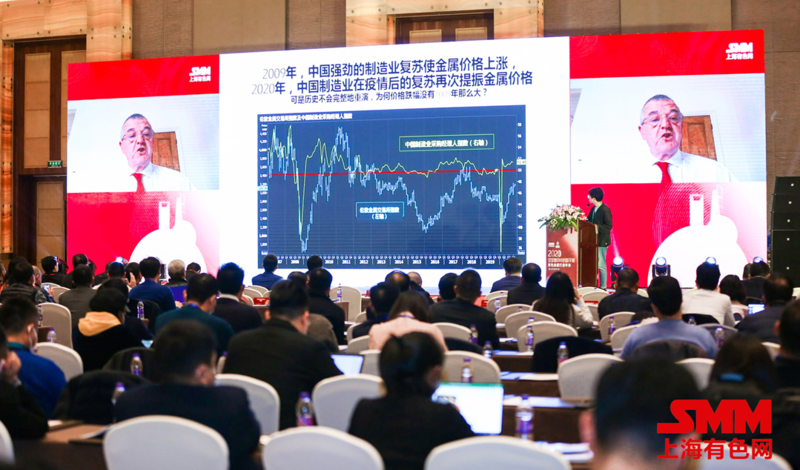
The senior metals columnist was speaking remotely to the China delegates as well as international participants in Suzhou on Thursday at the Shanghai Metals Market’s 2020 Nonferrous Metals Industry Chain Annual Conference held in Kempinski Hotel Suzhou.

In his keynote address entitled “A Tale of Two Crises”,Home was giving his insights on the trending topics such as the COVID-19 crisis and the environmental crisis.

“The ongoing COVID-19 crisis has strong echoes of the Global Financial Crisis. China is once again recovering faster than the rest of the world, importing large amounts of aluminium and copper and lifting metal prices,” Home said.

China is the first country to be struck by the coronavirus pandemic and is also the first to bring it under control with aggressive measures, and it is now taking the lead in the world's economic recovery.

“Recovery from the Global Financial Crisis was fast in China but slow and painful in the rest of the world. Similarly, recovery from the COVID-19 Crisis will also be fast in China but slow in the rest of the world,” he added.


Home also noted that 2020 has been a crisis for both metals demand and supply, particularly in the recyclable metals chain. Popular anger has powered society’s call for the post COVID-19 recovery to be a “green recovery”, and this may in turn benefit the metals industry, as “going green is going to take a lot of metal”.

According to the World Bank, the global shift to carbon neutrality will need 3 billion mt from 17 key minerals. The World’s “Big Three” (China, US and the EU) are now increasingly aligned in their climate action targets, and will all be committed to carbon neutrality.

This will translate to higher demand for nonferrous metals such as copper, aluminium and cobalt. According to a recent report from the World Bank, production of graphite, lithium, and cobalt will need to increase by more than 450% by 2050, while cumulative copper demand growth will be 30 million mt through 2050, and aluminium production will rise from 60 million mt per year to 105 million mt per year by 2050.

As for the scrap industry, Home is seeing great potential in this sector, calling it “the world’s largest metals mine”.

 “China has historically been the world’s largest scrap metals buyer and processor Imports fell in 2018 and 2019 as purity thresholds were tightened. However delayed implementation of new regulations has compounded global supply chain pressures,” Home said.

Copper imports fell 46% year-on-year during January to September 2020. “Offset from higher content is now marginal, and implied purity levels were already above 80% in H2 2019. This is one of the drivers of China’s high 2020 imports of refined metals.”

COVID-19 has accelerated green transport investments

Home also  gave his insights on the ongoing green movement in the metals industry. He said that countries like Germany and France are providing subsidies on electric vehicles, with France setting to be Europe’s top producer of clean vehicles by bringing output to more than one million electric and hybrid cars per year over the next five years. In China, President Xi Jinping has told the UN General Assembly that China will hit peak emissions by 2030 and be carbon neutral by 2060. “And COVID-19 is accelerating both national and regional investment in green transport.”

Also, Home mentioned in his keynote that de-globalization is a global trend. “ The World’s ‘Big Three’ are now shaping similar long-term strategies to prioritise self-sufficiency and reduce exposure to global trade, particularly in metals-intensive sectors such as defence, electric vehicle batteries and new technology. As a result, the metal markets may become more regionalized, as  de-globalization means redrawing the metals map with global trade flows changing. Also,  the price risk will become more localised and more politicised.”
Data Source Statement: Except for publicly available information, all other data are processed by SMM based on publicly available information, market communication, and relying on SMM's internal database model. They are for reference only and do not constitute decision-making recommendations.

For any inquiries or for more information, please contact: lemonzhao@smm.cn
For more information on how to access our research reports, please contact:service.en@smm.cn
Related News
Platinum Seen Outperforming Palladium as Supply Deficits and Industrial Demand Support Outlook
6 hours ago
Platinum Seen Outperforming Palladium as Supply Deficits and Industrial Demand Support Outlook
Read More
Platinum Seen Outperforming Palladium as Supply Deficits and Industrial Demand Support Outlook
[SMM Flash] Platinum could continue to outperform palladium over the longer term despite near-term pressure from a stronger US dollar and elevated Treasury yields, according to a September 2 analysis by FX Empire. Platinum had fallen towards $1,725/oz while palladium traded near $1,290/oz, with the analyst identifying $1,650–1,700/oz as an important platinum support zone and around $1,200/oz as key support for palladium. The analysis attributed near-term pressure on both metals partly to higher interest-rate expectations. FX Empire argued that platinum retains stronger medium-to-long-term fundamentals because of constrained supply and potential new industrial demand. The analysis cited expectations for continued platinum and palladium market deficits alongside potential platinum demand from hydrogen-truck adoption. Palladium's longer-term outlook was described as more dependent on petrol and hybrid vehicle demand as battery-electric vehicle penetration increases. These price levels and relative-performance expectations represent analyst technical analysis and commentary rather than confirmed market forecasts.
6 hours ago
India’s KABIL Eyes Colombian Critical-Minerals Opportunities as Supply Diversification Expands
6 hours ago
India’s KABIL Eyes Colombian Critical-Minerals Opportunities as Supply Diversification Expands
Read More
India’s KABIL Eyes Colombian Critical-Minerals Opportunities as Supply Diversification Expands
[SMM Flash] India is preparing to expand its critical-minerals engagement with Colombia, with state-owned Khanij Bidesh India Ltd (KABIL) expected to assess mining and exploration opportunities in the country. Diplomatic sources cited by StratNews Global said India is seeking a stronger foothold in Colombian mineral resources as part of a wider strategy to diversify overseas raw-material supply chains. Colombia has prospective resources that include coltan alongside copper and other critical minerals. The initiative remains early-stage strategic engagement, with no specific Colombian tantalum mine, investment amount, acquisition or offtake agreement announced. For the tantalum market, KABIL participation could eventually create an additional source of exploration financing and downstream demand for Colombian coltan resources, but any commercial supply impact remains prospective and dependent on project identification, licensing and development.
6 hours ago
Sibanye-Stillwater Starts Restructuring Consultations at Kwezi PGM Shaft, 1,114 Workers Potentially Affected
6 hours ago
Sibanye-Stillwater Starts Restructuring Consultations at Kwezi PGM Shaft, 1,114 Workers Potentially Affected
Read More
Sibanye-Stillwater Starts Restructuring Consultations at Kwezi PGM Shaft, 1,114 Workers Potentially Affected
[SMM Flash] Sibanye-Stillwater has commenced formal consultations over the proposed restructuring of the Kwezi shaft at its Rustenburg PGM operations in South Africa, as the underground operation approaches the end of its economic life. The company said mining has reached the limits of the shaft’s approved mining-right area and economically mineable reserves are being depleted. The Section 189A process could potentially affect 781 employees and 333 contractor employees, representing 1,114 people in total. The consultation does not yet constitute a confirmed shaft closure or final retrenchment decision. However, the development highlights the depletion pressure facing mature South African PGM operations despite the recent recovery in platinum-group-metal prices. If restructuring ultimately results in closure or materially reduced activity at Kwezi, the shaft’s future contribution to Sibanye-Stillwater’s Rustenburg PGM production would decline, although the company has not yet disclosed a specific production-loss estimate.
6 hours ago