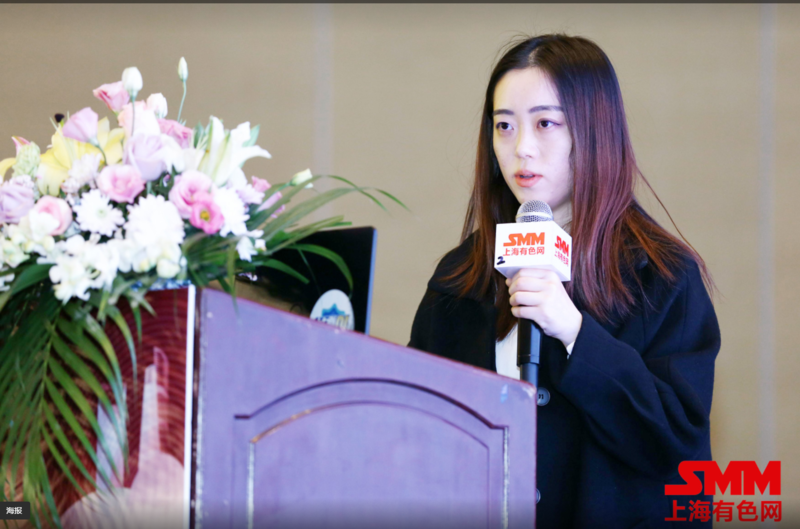
SUZHOU, Dec 4 (SMM) – Consumption in the automotive sector remains optimistic in 2021, but may see limited growth in the construction sector, said Man Xu, Senior Analyst, SMM.
Speaking at the Shanghai Metals Market's 2020 Nonferrous Metals Industry Chain Annual Conference held in Suzhou on December 4, Xu was giving her insights on automotive and construction market-driven comparison of aluminum strip consumption.
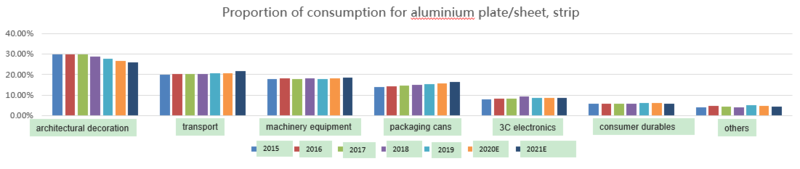
“Consumption for aluminium plate/sheet and strip from architectural decoration, transport, machinery equipment and packaging cans has the biggest market share. On the other hand, consumption from architectural decoration trended lower while from transport, mechanical equipment and packaging cans trended higher. Other sectors were stable, “ Xu said.
It is estimated that consumption for aluminium plate/sheet and strip from architectural decoration sector will account for 26.04% in 2020, 20.81% in transport sector, 18.53% in machinery equipment, and 16.39% in packaging cans.
source: SMM
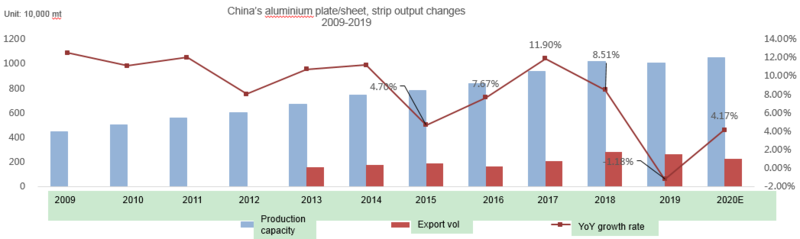
Aluminium plate/sheet, strip output rose gradually mainly supported by domestic consumption. Aluminium plate/sheet, strip output rose from gradually from 4.5 million mt in 2009 to 10.8 million mt in 2019.
Nearly 80% of China’s output were consumed in domestic market from 2009 to 2018. With the implement of anti-dumping measures in the European Union and India, exports have declined over the past two years.
“The year-on-year growth rate has declined in recent years, but 2020 may saw increase. Output in 2020 is expected to be 10.5 million mt, up 4.17% from last year, which indicated that the industry is becoming mature,” Xu added.
source: SMM
Aluminium plate/sheet used in auto outer coverings thinned, but there is room for further growth. “Traditional models are generally updated once every 7 years. Given that the models remain unchanged, the aluminisation rate will not increase much. Aluminium plate/sheet is used in the doors and two covers of a car, which are divided into outer and inner plate/sheet.” Xu said.
The cost pressure from using aluminium body is also relatively high. The price of all-aluminium body is settled at over 600,000 to 700,000 yuan so that they could have profits. Mid-to-high-end models generally adopt four-door and two-cover design. Domestic carmakers like BYD and Xiaopeng Motors have made trials in NEVs over the last two years.
Compared with cast aluminium and aluminium extrusion plants, aluminium plate/sheet are not used much in passenger cars, but the amount of castings is relatively saturated, and there is more room for growth of body panels.
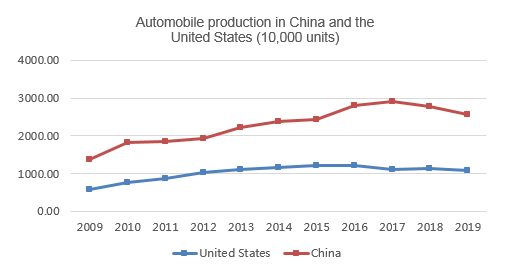
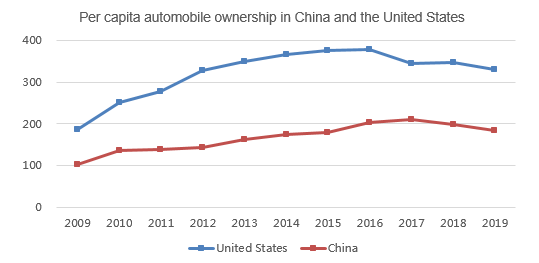
China's auto production is nearly twice that of the United States, and its growth rate is clearly ahead of the United States. Taking the year 2019 as an example. China’s auto production was 25.7 million units in 2019, while auto production in the U.S. was 10.88 million units.
However, on a per capita basis, China is at a relative disadvantage. The number of cars owned per 10,000 people in the U.S. in 2019 was 331.18 units, while the number in China was only 183.87 units.
“The market demand for automotive ABS aluminium alloy sheet and strip in China has a large room for growth in the future,” Xu said.
source: SMM
source: SMM
There is great growth potential for automotive ABS aluminium alloy sheet demand in China.
Advantages: Per capita car ownership in China has greater room for growth than in Europe and the United States; China's automotive ABS aluminium alloy production capacity continues to expand, accounting for close to 1/3 of the global capacity, and has scale advantages; domestic companies actively promote automotive ABS aluminium sheet and strip products and upgrade technologies; the Chinese government supports and encourages the applications of lightweight cars its 13th and 14th Five-Year Plans.
Disadvantages: China's automotive ABS aluminium sheet and strip industry starts later than that abroad, and technology lags behind; automotive ABS aluminium alloy sheets are mostly used in high-end cars, and the global high-end automotive production is concentrated in developed countries such as Europe and the United States; the process of national certification and car factory certification of automotive ABS aluminium alloy sheet in China is slow and complicated and has high requirements on manufacturers.
The future growth of architectural decoration aluminium plate and strip may encounter bottlenecks.
Advantages: China's land area is large, and the building area is large and expanding; the Chinese people have the tradition of buying and speculating in houses; the construction industry has a large demand for aluminium plate and strip, and future growth may be driven by all-aluminium homes.
Disadvantages: The real estate policy is tightened, housing prices are strictly controlled, real estate speculation is strictly controlled, and the expansion of newly started houses will be restricted in the future; the proportion of demand for aluminium plate and strip in housing construction is close to saturation.