SMM11 March 18: lithium iron phosphate battery, which has experienced peaks and troughs, is showing the momentum of making a comeback. According to the data, the total loading of lithium iron phosphate batteries increased by 127.5% in October compared with the same period last year, up 3.5% from the previous month. The limelight overshadowed the ternary lithium battery.
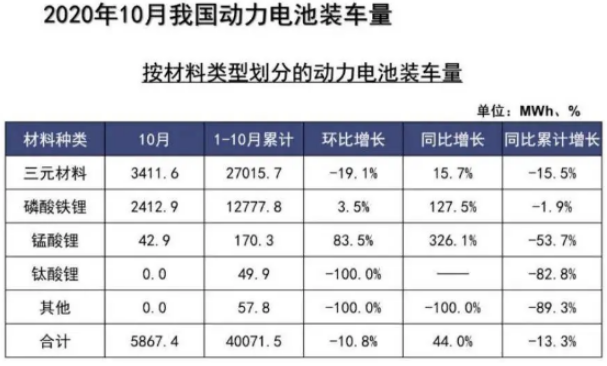
Data source: China Automotive Power Battery Industry Innovation Alliance
The installed capacity of iron and lithium accounted for more than 40% in October, and the demand in the passenger car market has increased significantly. Since the second half of this year, the listing of Hongguang MINI and BYD "Han" has driven the market share of iron lithium batteries in passenger cars. With the launch of iron lithium version Model 3 in October, the demand for iron lithium has increased rapidly. In addition, BAIC EU5 and Roewe EI5 are also equipped with lithium iron phosphate batteries in the second half of the year. At present, lithium iron batteries are mostly used in A00 and B, C-class vehicles, mainly suitable for the middle and low-end market of new energy. Iron-lithium technology has also improved significantly this year, such as BYD's "blade battery" and Ningde's CTP technology, which optimize the structure of the battery pack to improve the energy density of the battery, while still maintaining safety and low prices. Therefore, the high performance-to-price ratio and safety of iron lithium also make more and more automobile companies consider supporting iron lithium batteries.
The price of lithium iron phosphate in large factories or a slight increase in prices in small factories is weak.
Since 2020, according to SMM research, the price of lithium iron phosphate shows a downward trend as a whole. Recently, the price of lithium iron phosphate rose slightly. As of November 18, the daily price of lithium iron phosphate was 34500 yuan / ton, up from the lowest level since the beginning of the year.
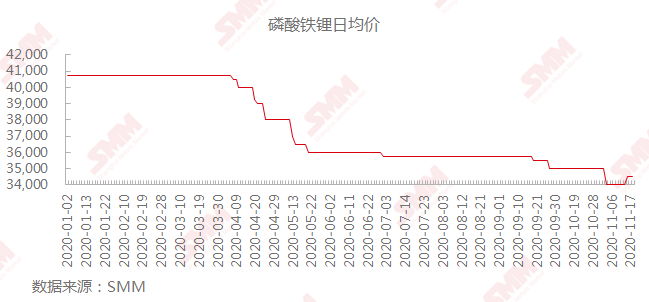
"Click to view the historical price of SMM cobalt lithium
The price of lithium iron phosphate has been in a downward trend for a long time in recent years, mainly due to overcapacity in the iron-lithium market, fierce competition among iron-lithium manufacturers, the cost reduction target of downstream battery enterprises and the technical optimization of iron-lithium. In the past two weeks, the price of lithium carbonate has increased rapidly, the price of industrial carbon has risen by nearly 5000 yuan / ton, and the prices of phosphates and auxiliary materials have also increased. As the price of iron and lithium has been near the cost line for a long time, the rising price of raw materials has greatly increased the cost pressure of iron and lithium enterprises. The demand for iron-lithium materials in the lower reaches has increased significantly since August, and the head iron-lithium plant has basically reached full production in October. Due to the single supply chain in the power market, large iron-lithium factories are in tight supply, making it difficult to meet the growing demand downstream. Therefore, iron lithium large factories raised prices last week, the price increase in 1000-3000 yuan / ton, has now been transmitted to small and medium-sized battery enterprises. However, other iron and lithium plants are still highly competitive, with an operating rate of less than 50%, and it is difficult for prices to rise. Overall, the price of lithium iron phosphate in large factories is likely to rise slightly in the short term, while the rise in small factories is weak.
Lithium iron phosphate technology is mature
At present, lithium iron phosphate technology is very mature, longer life, safer, more cost-effective.
For example, BYD's blade battery is an improved version of lithium iron phosphate battery. Through structural innovation, it can skip the "module" in the group, greatly improve the volume utilization, and finally achieve the design goal of installing more cells in the same space. Compared with the traditional battery pack, the volume utilization of the "blade battery" has increased by more than 50%, that is, the mileage can be increased by more than 50%, reaching the same level as the high energy density ternary lithium battery.
The power battery CTP is the cell inside the battery that is directly integrated into the battery package. Power battery integration is higher, through this technology also saves a certain link of battery assembly, it can be said that the cost is also greatly saved.
Take the power battery CTP of the Ningde era as an example, the power battery CTP technology of the Ningde era is to directly connect a large number of cells in series and parallel together by omitting the module, and this technology can play a role in reducing the use of parts and components to optimize space utilization, while also reducing the total weight of the battery pack, and achieving the effect of improving battery energy density. At the same time, CTP technology still has an advantage for the power battery module, directly through the fixture through the sleeve or using the installation beam directly installed in the whole vehicle.
Enterprises step up the layout of lithium iron phosphate projects
Recently, the performance of iron-lithium battery is excellent, and its overall demand is driven by the increase in the proportion of iron-lithium in the passenger car market. Many enterprises are stepping up the layout of lithium iron phosphate projects.
The 50,000-ton lithium iron phosphate project invested by Hebei Annezhe New Energy Company is stepping up trial production, and the high-pressure solid nano-lithium iron phosphate cathode materials are being loaded and shipped to all parts of the country. It is understood that the 50,000-ton lithium iron phosphate project is a project of attracting investment in Hequ County in 2019, and it is also the first large-scale new material industry project introduced into Hequ County. With the commissioning of this project, not only lithium iron phosphate batteries can be produced, but also due to the growth of battery demand in the future, projects such as iron phosphate, anode materials, battery diaphragms, battery shells, batteries and battery packs, battery management systems, etc., have been settled in Hequ County, creating a lithium-ion battery industry chain in the county and pulling the economic structure of Hequ County from "relying on coal to eat coal" in the past. It has turned to a new development model of green, economic, safe and efficient.
Recently, the Office of the leading Group for the Construction and Promotion of Major projects in Guangxi Zhuang Autonomous region issued the fourth batch of plans for promoting major projects at the autonomous region level in 2020. There are 11 preparatory projects, mainly related to new energy, new materials, trade and logistics, food industry, municipal foundation and other fields, with a total investment of about 27.904 billion yuan, including an annual production of 50, 000 tons of iron phosphate precursors for power batteries and a co-production of 60, 000 tons of phosphoric acid. a 50, 000-ton iron phosphate construction project with an annual capacity of 50, 000 tons of lithium iron phosphate for power batteries
On October 19th, Tesla announced that Model 3 from the Shanghai super factory will be shipped to Europe by sea. It is reported that the export model is the standard battery life upgrade version of Model 3 made in China. The model is equipped with Ningde era lithium iron phosphate battery with a total capacity of 55kWhh and a range of 468 km. It is also the first time that lithium iron phosphate battery has been used in the European market.
On October 9th, the project of 60, 000 tons of high-performance lithium iron phosphate cathode material and 200000 tons of engine tail gas treatment liquid of Jiangsu Longyi Science and Technology Co., Ltd. formally signed a contract with the people's Government of Pengxi County. It is understood that the project, with a total investment of 800 million yuan, is located in Jinqiao District, Pengxi Economic Development District, with a planned area of 300 mu, and mainly produces high-performance lithium iron phosphate battery materials, ternary cathode materials, negative electrode materials and engine exhaust treatment solution. After all the projects are completed, the annual output value is expected to be not less than 2.2 billion yuan, and the annual tax revenue is not less than 110 million yuan.
BYD's lithium iron phosphate battery factory in Manaus, Brazil, was officially put into production a few days ago, with an annual production capacity of 18000 battery modules. This is BYD's third factory in Brazil and the first lithium iron phosphate battery factory in Brazil, with an investment of about 15 million reais (US $2.7 million).
At present, Yuneng New Energy has three production bases, which are located in Xiangtan, Hunan, Jingxi, Guangxi and Suining, Sichuan. At present, the lithium iron phosphate production line with an annual output of 20,000 tons is under construction in Suining, Sichuan Province. after the above production line is put into production, the total annual production capacity of lithium iron phosphate of Yueneng new energy can reach about 50,000 tons.
German Nano announced that the company signed the Investment Agreement with the Management Committee of Qujing Economic and technological Development Zone on March 6, 2020. the company intends to invest in the construction of the "Lithium Iron Phosphate production Project" within the jurisdiction of the Management Committee of Qujing Economic and technological Development Zone, with a total planned investment of about 1 billion yuan. The company said that the main purpose of this foreign investment is to further expand the company's lithium iron phosphate production capacity and better meet the demand for its products in the high-end market of lithium-ion cathode materials.
![Análise da produção de sulfeto de lítio grau bateria em agosto: haverá um aumento no quarto trimestre? [Análise SMM]](https://imgqn.smm.cn/usercenter/mpqgn20251217171727.jpg)