Manufacturing activity across nickel downstream sectors in China retreated to contraction in October

Published: Nov 2, 2020 14:18
Manufacturing activity across nickel downstream sectors in China retreated to the contractionary territory in October.

SHANGHAI, Nov 2 (SMM)—Manufacturing activity across nickel downstream sectors in China retreated to the contractionary territory in October. 

SMM data showed that the purchasing manager's index (PMI) for downstream nickel industries, including stainless steel, electroplating, alloy and battery, stood at 49.68 in October, down 0.94 point from September. A reading below 50 indicates contraction.
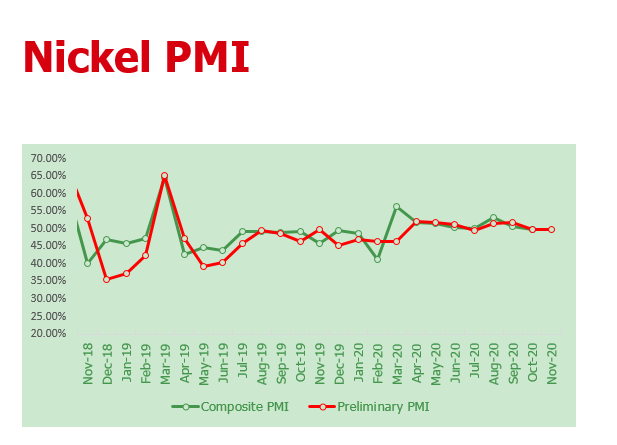


Production sub-index stood slightly higher above 50, with the battery and electroplating sectors still in expansion

The composite sub-index for production in October lost 1.32 points from September to 50.56 in October, staying in expansion.

The production sub-index in the stainless steel sector came in at 50, down 1.14 points from a month ago. Most of the steel makers kept stable production, and total stainless steel output in October is expected to be higher than in September. But output of the #300 series is likely to dip as some stainless steel mills switched to production of the #400 series. The production sub-index in the battery sector stood at 58.77 in October, as new energy enterprises mostly maintained relatively high production amid robust consumption. The production sub-index in the electroplating sector came in at 51.45, as many electroplating plants reported improved production in October though most of them halted production during the National Day holidays.


New orders sub-index fell to contraction, mainly dragged down by the stainless steel sector

The overall sub-index for new orders in October declined 1.79 points on the month to 49.23 in October, falling into contraction. Among the surveyed sectors, the stainless steel sector was the worst performer in terms of new orders, weighing on the overall sub-index. Its new orders sub-index slid 1.9 points from the final reading of September to 48.1 in October, retreating from expansion to contraction, basically in line with early expectations, as mills were in the face of great pressure in selling cold-rolled coil. 


Raw materials inventory sub-index remained in contraction, with producers in the stainless steel and electroplating sectors slowing procurements

The composite sub-index for raw materials inventory in October gained 0.94 point month on month to 48.18 in October, remaining in contraction. The purchasing volume sub-index in the stainless steel sector dropped 2.1 points from the final reading of September to 46.19 in October, while the raw materials inventory sub-index inched up 0.48 point to 47.62. The two sub-indexes that both stood under 50 suggested slowed purchasing activities at steel mills. Although mills slashed purchasing volume of high-grade NPI, their production was barely affected as they replaced with other raw materials such as ferronickel and scrap stainless steel. The raw materials inventory sub-index in the electroplating sector dipped to 49.73 as plants reduced procurements as nickel prices rose consistently after the National Day holidays.


Finished goods inventory sub-index was still in contraction, inventory pressure of cold-rolled coil increased as expected

The overall sub-index for finished goods inventory fell 2.34 points on the month to 47.28 in October, staying in contraction. The finished goods inventory sub-index in the stainless steel sector retreated 3.3 points from the final reading of September to 46.7 in October. Tepid sales led to increased inventories.
 

Data Source Statement: Except for publicly available information, all other data are processed by SMM based on publicly available information, market communication, and relying on SMM's internal database model. They are for reference only and do not constitute decision-making recommendations.

For any inquiries or for more information, please contact: lemonzhao@smm.cn
For more information on how to access our research reports, please contact:service.en@smm.cn
Related News
China's CPI Rises 0.8% YoY, PPI Up 3.8% in August 2026
49 mins ago
China's CPI Rises 0.8% YoY, PPI Up 3.8% in August 2026
Read More
China's CPI Rises 0.8% YoY, PPI Up 3.8% in August 2026
In August 2026, China's Consumer Price Index rose 0.8% YoY, while the Producer Price Index rose 3.8% YoY and 0.4% MoM.
49 mins ago
[SMM Stainless Steel Flash] Šefčovič Confirms in Writing: SMEs Must Pay for EU Steel Regulation to Work
1 hour ago
[SMM Stainless Steel Flash] Šefčovič Confirms in Writing: SMEs Must Pay for EU Steel Regulation to Work
Read More
[SMM Stainless Steel Flash] Šefčovič Confirms in Writing: SMEs Must Pay for EU Steel Regulation to Work
[SMM Stainless Steel Flash] Šefčovič Confirms in Writing: SMEs Must Pay for EU Steel Regulation to Work
EU Trade Commissioner Šefčovič responded on September 1 to a written parliamentary question asking why SMEs were not exempted from the dual burden of CBAM and the Steel Regulation, stating explicitly: "As SMEs represent a significant share of EU operators active in the steel sector, it is not possible to exempt them from the application of the Steel Regulation. This would otherwise undermine the effectiveness of the Steel Regulation." This means small and mid-sized stainless steel importers, processors, and distributors must simultaneously bear the 50% out-of-quota steel tariff and CBAM carbon costs, with the Commission explicitly framing the economic burden on SMEs as a necessary feature, not a flaw, of the policy design. Eurostat data shows large enterprises accounted for 61% of steel import value in 2023, with SMEs at 38.6%, yet no full cumulative impact assessment for SMEs has been published. Critics note the 50-tonne CBAM threshold effectively covers only occasional importers rather than genuine steel traders, and that exceeding the threshold triggers liability on the full annual import volume.
1 hour ago
[SMM Stainless Steel Flash] Spanish Exporters Call to Suspend ETS and CBAM Amid Rising Steel Cost Pressures
1 hour ago
[SMM Stainless Steel Flash] Spanish Exporters Call to Suspend ETS and CBAM Amid Rising Steel Cost Pressures
Read More
[SMM Stainless Steel Flash] Spanish Exporters Call to Suspend ETS and CBAM Amid Rising Steel Cost Pressures
[SMM Stainless Steel Flash] Spanish Exporters Call to Suspend ETS and CBAM Amid Rising Steel Cost Pressures
Spain's Club de Exportadores e Inversores Españoles published a technical note calling for the suspension of EU ETS and CBAM and alignment of carbon prices with levels faced by competitors. The report identifies ETS and CBAM together as acting like an "internal tariff" on European production, with costs passed through electricity, steel, and aluminum prices to downstream processors, while offering no protection to European exporters in third-country markets. For the stainless steel industry, the impact is particularly pronounced: the EU's 50% out-of-quota steel tariff combined with halved quotas has added approximately €1,654 to the average vehicle's steel costs, while hot-rolled coil prices have risen more than 35% since October 2025, far exceeding the Commission's own impact assessment assumption of a 3.25% increase. With CBAM set to expand to 150–180 additional CN codes, compliance cost pressures on the stainless steel supply chain will intensify further, disproportionately burdening small and mid-sized processors and distributors while large steel producers buffer the impact with decades of accumulated free ETS allowances.
1 hour ago
Manufacturing activity across nickel downstream sectors in China retreated to contraction in October - Shanghai Metals Market (SMM)