On the 20th of SMM10, at the 2020 China International Hot galvanizing Technology and Market Application Development Forum held by SMM, Kong Guoping, Deputy General Manager of Yingda Industry (Shanghai) Co., Ltd., delivered a keynote speech on "Application of Induction heating Technology in batch galvanizing".

1. Traditional zinc pot
Kong Guoping pointed out that there are several defects in traditional zinc pots. First of all, the life of steel shell can only be used for 1-2 years due to the corrosion of molten zinc and local high temperature oxidation of steel shell, and the service life is very short.
Secondly, in the process of corrosion of molten zinc on steel shell, Fe and Zn combine to form zinc slag. Moreover, the local high temperature of the steel shell accelerates the formation of zinc-iron compounds (zinc slag) and destroys the balance of zinc slag, resulting in the precipitation of zinc slag. There are more zinc dregs, resulting in an increase in zinc consumption.
In addition, there are some problems that need to be improved, such as high energy consumption, local high temperature caused by zinc steam, nitrogen oxides and carbon emissions, and regular maintenance and replacement of burner combustion system and combustion chamber refractories.
Second, induction heating technology
Induction heating theory


Induction heating zinc pot
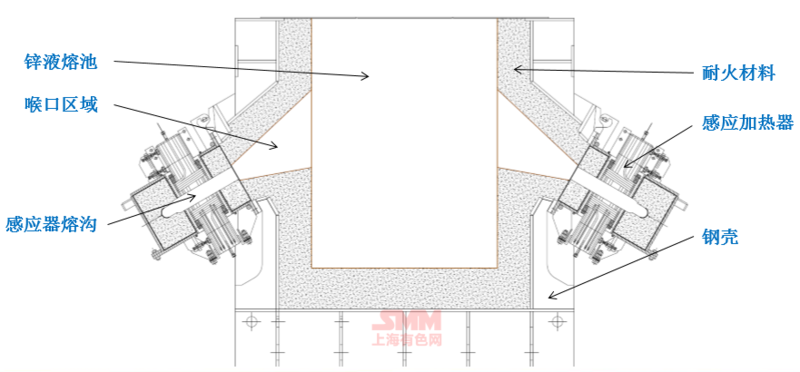
The life of induction heating zinc pot is more than 15 years, and the life of inductor body is more than 8-10 years. Because the liquid zinc is not in contact with the steel shell, the corrosion of the steel shell is avoided, and the direct contact between the liquid zinc and the refractory material avoids the chemical reaction between the liquid zinc and the refractory material.
And the amount of zinc slag will be greatly reduced, reducing zinc consumption. Because the liquid zinc is no longer in direct contact with the steel shell, the Fe, from the steel shell is avoided, thus reducing the intake of Fe and reducing the production of Fe and Zn compounds; the liquid zinc adopts induction heating to avoid the local high temperature phenomenon, and the uniformity of the liquid zinc is higher, except for the zinc slag produced by the Fe brought into the normal galvanized parts, the whole molten zinc and zinc slag will reach an ideal balance and there will be no additional zinc slag.
At the same time, no zinc vapor is produced. Using induction heating, there will be no local high temperature; electric energy will be converted into heat energy without any emission problems.
In addition, due to direct heating, no carbon deposition, low energy consumption and high efficiency. Basically maintenance-free, low maintenance cost.
![Supply-side support lends some strength, SHFE zinc rebounds slightly [SMM zinc futures review]](https://imgqn.smm.cn/usercenter/oTrxc20251217171755.jpg)
![Zinc Price Center Declines, Guangdong Premiums Rise [SMM Guangdong Spot Weekly Review]](https://imgqn.smm.cn/usercenter/PEqzX20251217171755.jpg)
![SHFE/LME zinc price ratio rebounds to around 6.9 and consolidates [SMM Zinc SHFE/LME Price Ratio Weekly Review]](https://imgqn.smm.cn/usercenter/TeRBO20251217171754.jpg)