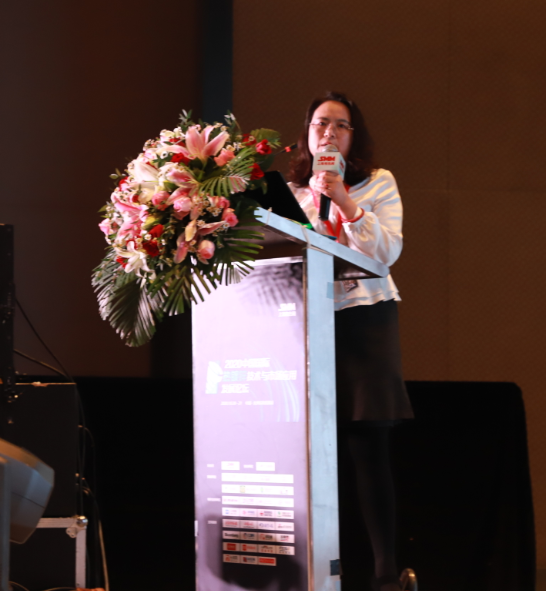
SMM10 March 13: at the "2020 China International Hot galvanizing Technology and Market Application Development Forum" held by SMM, Kang Jinyu, a senior engineer of Qinhuangdao solid waste Management Center, brought you a keynote speech on the development status of hot dip galvanizing industry, major environmental pollution problems, etc. "current situation of environmental protection and pollution control countermeasures in hot dip galvanizing industry".
With the development of industrialization in our country, the problem of anti-corrosion of steel has important economic significance in the whole national economy. In particular, thin steel plate is widely used in automotive, home appliances, construction, mechanical and electrical and container manufacturing and other industries, which is closely related to the lives of the broad masses of people. However, because the steel plate is thin and easy to be scrapped by atmospheric corrosion, people have created many effective measures to prevent steel corrosion, and hot-dip galvanizing is one of the oldest anti-corrosion methods.
I. Development status of hot-dip galvanizing industry
As a kind of metal surface treatment industry, hot-dip galvanizing is an effective metal anti-corrosion method, also known as hot-dip galvanizing and hot-dip galvanizing. It is a process to obtain coating by dipping steel, stainless steel, cast iron and other metals into molten zinc liquid at about 500 ℃. It is the most widely used steel surface treatment method with the best performance-price ratio in the world.
The galvanized coatings commonly used in industry are hot-dip galvanizing, electrogalvanizing, mechanical galvanizing and hot-spraying galvanizing, of which hot-dip galvanizing accounts for about 95% of the total galvanizing, and the amount of zinc used for hot-dip galvanizing accounts for 40% of zinc production in the world. it accounts for about 30% of zinc production in China.
Because hot-dip galvanizing has the advantages of low production cost, easy method, cathodic protection, firm coating, long anti-corrosion life, beautiful appearance and wide adaptability to the environment, it is widely used in power towers, communication towers, railways, road protection, street lamp poles, marine components, building steel structural components, substation ancillary facilities, light industry and other fields.
With the implementation of the western development strategy and the in-depth development of the west-to-east power transmission project, the west-to-east gas transmission project, the south-to-north water diversion project, the three Gorges Project, the rural power network and the urban Electroweb second network, under the stimulation of many policies, China's hot-dip galvanizing industry has entered a new round of high-speed development stage.
Second, the main environmental pollution problems of hot-dip galvanizing.
The emergence and application of hot-dip galvanizing technology has a history of more than 200 years. In people's traditional concept, hot-dip galvanizing has always been regarded as a "high pollution" industry.
The principle of hot-dip galvanizing is that the iron is cleaned, then treated with solvent, then immersed in the zinc solution after drying, and the iron reacts with molten zinc to form an alloyed zinc layer. the production process is as follows: degreasing-water washing-pickling-assisted plating-drying-hot-dip galvanizing-separation-cooling passivation-follow-up cold rolling and so on.
This process will produce waste water, waste gas, noise, solid waste and other problems, especially pay attention to the hazardous waste properties of zinc ash and zinc slag.
Due to the different nature of hazardous waste, the quantity and mode of entry into the environment and the environmental conditions in which it is entered, the final impact or consequence is also different. Based on the fact that hazardous waste with high environmental risk needs to be managed by hazardous waste directory management to implement "priority control", while hazardous waste with small production, dispersion and low risk is managed by the principle of "exemption mode", Wastes that make it clear that environmental risks are acceptable are managed by exclusion.
Policy requirements and countermeasures for pollution prevention and control of hot-dip galvanizing
Among all the anti-corrosion systems of iron and steel, hot-dip galvanizing belongs to the heavy anti-corrosion system, which can not be replaced in the anti-corrosion technology and application of iron and steel in China. At present, the impact of hot-dip galvanizing technology on the environment has increasingly become the key factor for its continued development. Hot-dip galvanizing industry is facing development bottlenecks such as environmental constraints, overcapacity, rising costs, lack of innovation and so on.
How to adapt to the current international and domestic development environment, reduce consumption and increase efficiency, and improve the competitiveness of products is the goal of our efforts. We try to improve the management and environmental awareness of hot-dip galvanizing enterprises and strengthen the supervision function of the government. to promote the sustainable development of hot-dip galvanizing technology and pollution control technology, in order to achieve the purpose of effective pollution prevention and control.
(1) optimize process design and control pollution at source
(2) to improve the management and environmental protection awareness of hot-dip galvanizing enterprises: enterprises comply with the requirements of environmental protection laws and regulations, obtain pollutant discharge permits according to law, and discharge pollutants in accordance with the requirements of pollutant discharge permits; regularly carry out cleaner production audits and pass evaluation and acceptance.
(3) improve the management mechanism and strengthen law enforcement
![Rate Hike Expectations Disrupt, SHFE/LME Zinc Price Ratio Rebounds to Around 7.0 and Fluctuates [SMM Zinc SHFE/LME Price Ratio Weekly Review]](https://imgqn.smm.cn/usercenter/Txorc20251217171755.jpg)
![Off-Season Shadow Looms, Operating Rates of Galvanising Producers Continue to Weaken [SMM Galvanising Weekly Review]](https://imgqn.smm.cn/usercenter/qTzTI20251217171754.jpg)