On 1 September, the EU revealed that it included lithium on its updated list of critical metals. Three days later, the European Commission announced the launch of a new industry alliance, with the aim of building a complete EU supply chain for raw materials like lithium which are considered critical for the region’s digital and environmental transition.
Modelled on the European Battery Alliance which consists of more than 200 companies, governments and research organisations all focused on the manufacture of batteries for the automotive sector, this alliance will focus on metals and rare earths that will be used in the synthesis of magnets for batteries and electronic devices.
Striving for “self-reliance”
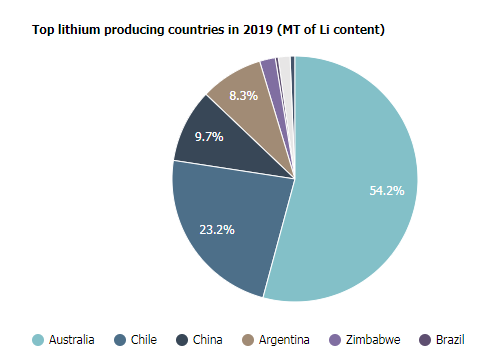
With only around 11% market share of lithium supply, Europe remains dependent on imports not only on raw materials and components to support its battery requirements, but also on those materials that feed into the broader battery ecosystem, the EC is currently preparing an action plan to determine how much materials will be needed by 2030 and 2050 and then to work towards becoming self-sufficient.
Presently, the EU imports around 98% of its rare earths from China, 71% of its platinum from South Africa, 85% of its niobium from Brazil and 78% of its lithium from Chile and 98% oft borates from Turkey. What makes this critical metals list announcement different from the previous one in 2017 is the realisation that this level of raw material dependency is unsustainable and action is now being taken to reverse the situation.
While definitely not the most scarce material, lithium is featured prominently on the list of critical materials. Other metals include bauxite, titanium, strontium. These metals are not necessarily used in batteries, but are important raw materials that form part of the broader green economy.
The impact of COVID
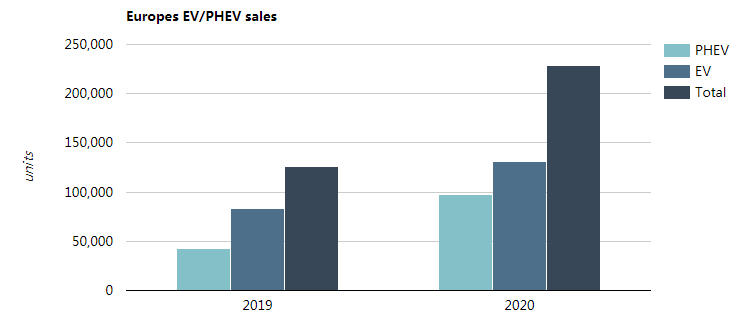
Notwithstanding the impact of COVID19 on global investment and economies, Europe’s lithium boom seem in place. Looking at the automotive data, one notes that the virus has barely put a dent in the European car makers’ sales.
Quarter 1’s sales broke records with an 81% increase of deliveries of EV and PHEV sales to Europe. This increase was fuelled by a new average fleet emissions quota of 95g/km which is impossible to be reached by any brand without using a Plug-in or EV. As such we expect to see the continued adoption of these vehicles in the near future.
If anything the pandemic sealed the Continent’s resolve to reduce its dependence on China for lithium supplies, and accelerated the EU’s drive to support mines and processing plants and plug the domestic supply chain gap.
Surplus may persist in the short term
While production and sales of EV’s and PHEVs have increased, the numbers have not exactly been mind-blowing. To date, European car makers have treated EV sales as “compliance cars” and have produced the minimum amount to achieve the CO2 targets. However, now the gloves are off and no longer are car manufacturers adopting a technology-neutral approach. Investment announcements by Euro automakers have topped over EU145bn ($158.31bn) for EV’s, which shows the region’s commitment to electrification and clean technology.
There is no doubt that as European continues to displace ICE vehicles with EV’s, demand for lithium will increase substantially from these levels.
It is estimated that 0.8kg/kWh of lithium carbonate is needed in a lithium-ion battery (LiB). Refined lithium demand is expected to rise to 900kt by 2025 from 225kt LCE in 2018. Of this, demand from LiBs is expected account for 495kt or 55% of this total compared to 140kt in 2018.
Before COVID, supply was forecast to reach 1.5m tonnes by 2025 on a LCE basis. 400,000 tonnes of this was expected to come from new projects that are steadily ramping up supply. We are forecasting delays to this supply by around 18 months-2 years.
Suffice to say, over the short term, demand for lithium compared to the potential supply looks quite bleak and we do not expect there to be any supply constraints. There is a caveat, that if continue to see a rapid uptake of EV’s, with quarter on quarter growth similar to what we’ve seen in 1Q then there could be an accute deficit as early as next year until the delayed supply comes online. However, we expect that initially, demand will remain relatively supressed but over the long term, as EV’s gain market share, the need for lithium will rise exponentially.
How to gain exposure to European lithium
It is expected that Europe will first procure local supply before looking to import lithium from other sources. There are several listed companies with exposure to the European lithium market. These include:
European Lithium (ASX: EUR) (FRA:PF8)(VSE:ELI): is developing the Wofsperg Lithium Project located just south of Vienna, Austria. The company is aiming to be the first local lithium supplier into an integrated European LiB supply chain.
Infinity Lithium: (ASX: INF) is an Australian minerals company that is developing the San Jose Industrial Lithium project in Spain. The company’s long term goal is to be a preferred supplier to the European LiB supply chain and EV industry at large.
Savanna Resources (LON: SAV) is developing the Mina do Barrosso Lithium Project, a hard rock operation in Portugal that is looking to convert its spodument concentrate in China.
European Metals Holdings (ASX, LON: EMH) has just received approvals to develop the company’s Cinovec lithium and tin project in Czech Republic. This project is believed to be the largest deposit of lithium in Europe and is now fully funded up to the decision to construct.
![[SMM Analysis] New Technologies in Lithium Carbonate Production: Pathways and Bottlenecks](https://imgqn.smm.cn/usercenter/gcOsy20251217171726.jpg)
![[SMM Analysis] August 2026 Lithium Carbonate Market: Mid-Month Rally, End-Month Retreat Amid Supply Recovery](https://imgqn.smm.cn/usercenter/Jgxij20251217171726.jpg)