WTO service trade barometer fell to an all-time low but remained resilient in key areas

Published: Sep 18, 2020 08:39 (GMT+8)
[WTO service trade barometer falls to an all-time low but key areas remain resilient] the World Trade Organization ((WTO)) released its latest report on Thursday (17 days EDT). Despite the fact that the global service trade index fell to a record low in the second quarter, WTO believes fundamentals remain strong and trade in services has a chance of bottoming out.

SMM: the World Trade Organization ((WTO)) released its latest report on Thursday (17 EST). In the second quarter, the index of global trade in services fell to a record low. Nevertheless, WTO believes that fundamentals are still strong and trade in services has a chance to bottom out and rebound.

According to (Services Trade Barometer), the WTO barometer of trade in services, the barometer index of global trade in services fell to 95.6 in the year to June, down from 96.8 in the first quarter, the lowest on record and significantly below the benchmark value of 100, indicating that global trade in services may still be well below expectations.

The growth rate of trade in services has been slowing since the second half of 2019, and the recent contraction in trade in services reflects the slowing pace of global economic growth and the impact of the outbreak of COVID-19.

Although the index is expected to remain below trend in the second half of this year, recovery in areas such as air passenger transport will make a strong contribution to the economy.

There is still resilience in key areas.

The WTO service trade barometer mainly measures service categories such as service PMI, financial services, air transport, container transport and construction, hoping to measure the growth momentum of global trade in services and identify trend turning points.

At present, most of the sub-indices of the index are still below the trend level, but some indicators show signs of bottoming out, indicating a degree of resilience in these areas in the face of outbreaks.

Among them, air passenger transport (49.2) was the hardest hit by the pandemic, reflecting a sharp reduction in travel when the epidemic had not yet been brought under control. The contraction in the sector has been large enough to drag on the total volume of global trade in services, although it seems to have stabilized recently.

However, the Container Shipping Index (92.4), the Construction Index (97.3) and the Global Services Purchasing managers Index (PMI,97.0) showed signs of improvement. The rise in PMI is noteworthy because it is the most forward-looking component of the services barometer.

At the same time, the (ICT) index of communications technology services fell to 94.6, despite strong demand for these services during the pandemic.

As of mid-September, the financial services index recorded 100.3, the only part of the barometer of trade in services that maintained expectations.

2020 Zinc Die casting Industry Summit Forum
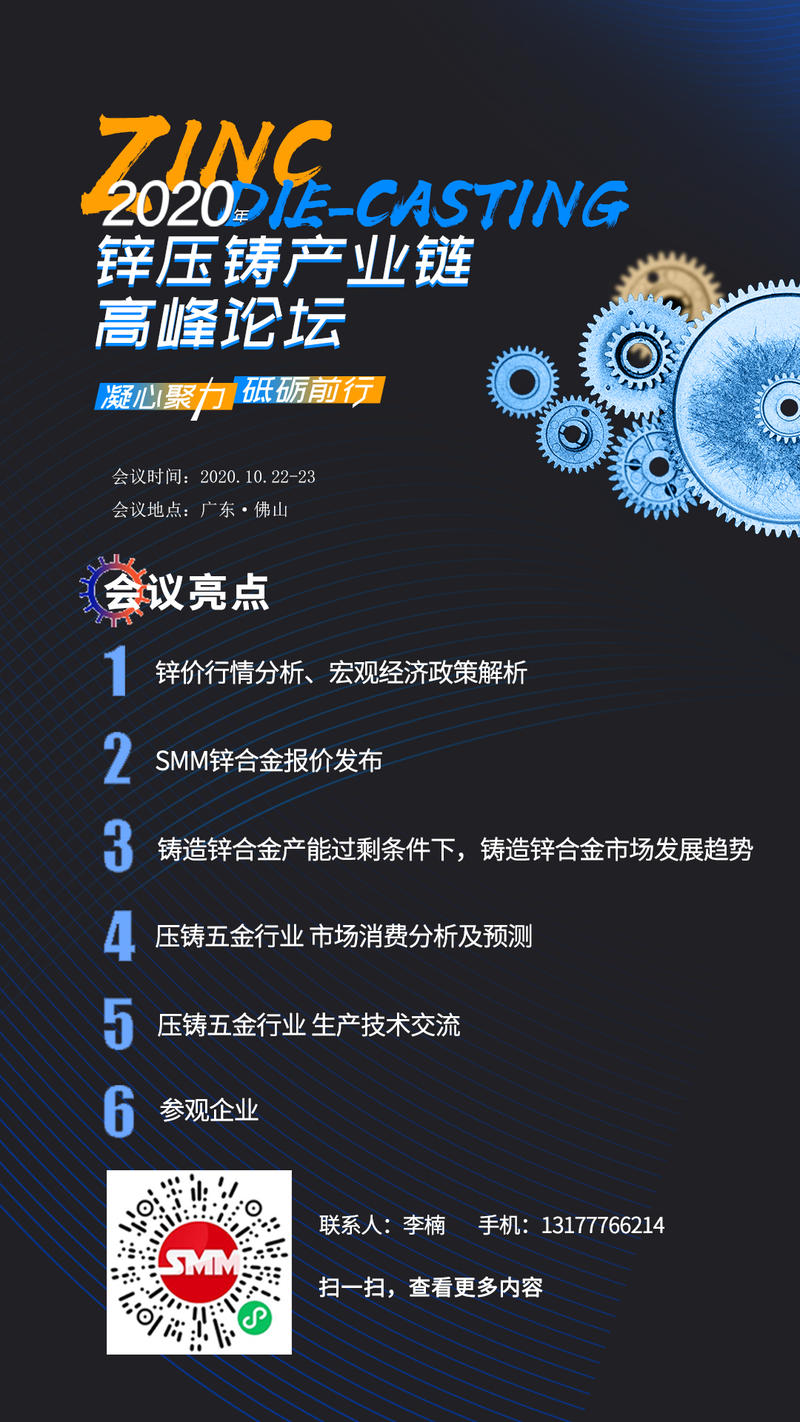
Scan the code to participate in the meeting or apply to join the SMM Die casting Zinc Industry Exchange Group

Data Source Statement: Except for publicly available information, all other data are processed by SMM based on publicly available information, market communication, and relying on SMM's internal database model. They are for reference only and do not constitute decision-making recommendations.

For any inquiries or for more information, please contact: lemonzhao@smm.cn
For more information on how to access our research reports, please contact:service.en@smm.cn
Related News
What Could a Cobre Panamá Restart Mean for Global Copper Supply? [SMM Analysis]
3 hours ago
What Could a Cobre Panamá Restart Mean for Global Copper Supply? [SMM Analysis]
Read More
What Could a Cobre Panamá Restart Mean for Global Copper Supply? [SMM Analysis]
Cobre Panamá could again become a major source of global copper supply if Panama and First Quantum agree on a new operating framework. The mine produced 330.9 kt of copper in 2023 and historically supplied around 1% of global output. While stockpile processing has resumed, fresh mining remains suspended. Any restart would likely be phased, with timing dependent on negotiations, legal conditions and operational remobilisation.
3 hours ago
Vedanta Plans $2.3 Billion Expansion in India and Saudi Arabia, and Advances Tuticorin Smelter Restart
8 hours ago
Vedanta Plans $2.3 Billion Expansion in India and Saudi Arabia, and Advances Tuticorin Smelter Restart
Read More
Vedanta Plans $2.3 Billion Expansion in India and Saudi Arabia, and Advances Tuticorin Smelter Restart
Vedanta has unveiled a major investment plan, under which Vedanta Copper intends to invest $2.3 billion in India and Saudi Arabia over the next three to four years, targeting annual copper production of more than 1 million tonnes by 2030. The company aims to produce 500,000 tonnes annually in both India and Saudi Arabia, alongside existing production of 100,000 tonnes in Fujairah, UAE. Around $2 billion will be invested in Saudi copper mining, smelting and rod projects, with an investment decision on the proposed Saudi copper smelter expected this quarter. Vedanta is also seeking to restart its Tuticorin copper smelter in India, which has been closed since 2018. The company expects a court ruling within three months and, subject to approval, plans to invest $250 million in refurbishing the facility, targeting a restart within eight to nine months and annual copper output of 250,000 tonnes. Meanwhile, its Silvassa facility is operating at around 95% capacity, with annualised copper cathode production exceeding 245,000 tonnes.
8 hours ago
London BTC flags copper and antimony at Nevada Black Star
10 hours ago
London BTC flags copper and antimony at Nevada Black Star
Read More
London BTC flags copper and antimony at Nevada Black Star
London BTC Company Limited (LSE:BTC, OTCQB:VINZF) announced on 5 October 2026 initial on-site pXRF results from its Black Star gold-critical minerals project in Pershing County, Nevada. A maiden programme collected 69 rock-chip samples along a 2.5km corridor between the Western and Eastern targets. pXRF readings showed antimony up to 0.44% Sb, copper up to 30.0% Cu, bismuth up to 0.73% Bi and silver up to 811 ppm Ag, with the antimony-copper association appearing at both ends of the corridor. The signature mirrors a historical 1985 sample 120m south of the claims (>1% Sb, 2% Cu, 700 ppm Ag). Earlier due-diligence sampling returned up to 16.23 g/t gold and 50.5 g/t silver. Samples are now with MSALABS for laboratory assays, with full multi-element geochemistry including antimony, tungsten and copper to follow. Copper, as a by-product credit, adds strategic appeal under US critical-minerals policy, though results remain preliminary field readings.
10 hours ago