SMM: according to the latest data of motor vehicle traffic insurance, in July 2020, the number of new energy vehicles insured in China was 90400, an increase of 166.53% over the same period last year. The cumulative number of vehicles insured reached 397100 from January to July, down 30.26% from the same period last year.
Focusing on car-building new power enterprises, in July 2020, the dangerous number of car-building new forces once again exceeded 10,000 to reach 12743, an increase of 11.19% over the previous month, a sharp increase of 432.73% over the same period last year, and the growth rate was much higher than that of the new energy market as a whole. With the gradual increase in the delivery of new products, the cumulative insurance volume of car-building new forces reached 57200 from January to July, an increase of 72.81% over the same period last year, which shows that new power enterprises have gradually grown into one of the important sources of sales contribution to the new energy market.
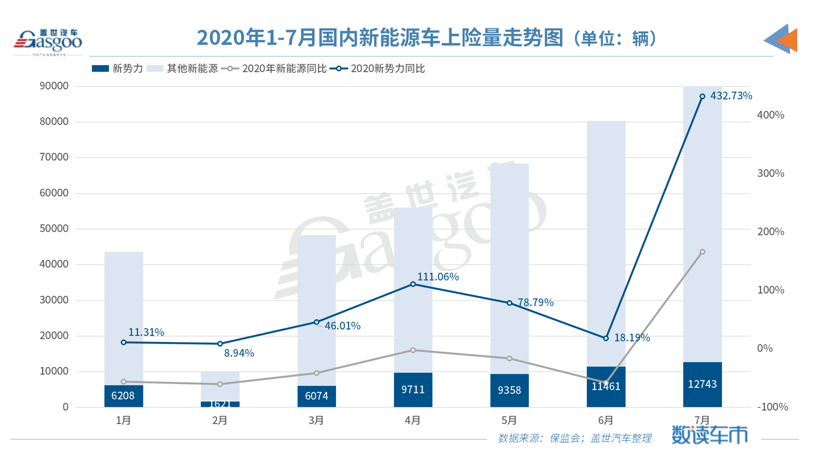
The number of new forces at risk was 12700 in July, and Xiaopeng returned to the second place.
Judging from the cumulative risk ranking of new power enterprises from January to July, the top five are still Weilai, ideal, Xiaopeng, Weima, and Nezha. The insurance volume of these five head enterprises in the first seven months was close to 51000, accounting for 90% of the total insurance volume of new car-building forces.
Among them, Xilai Automobile and ideal Automobile are significantly ahead of other enterprises, with a cumulative insurance volume of more than 10,000 vehicles in the first seven months, 17628 and 12184 respectively, ranking firmly in the top two in the new car-building forces from January to July. Xiaopeng and Weimar are in the trend of catching up with each other all the year round, basically hovering between the third and fourth places, and the insurance volume of Xiaopeng cars from January to July is 8185, which is higher than that of Weimar. The fifth place is still Nashi, with a cumulative insurance volume of 5853 in the first seven months.
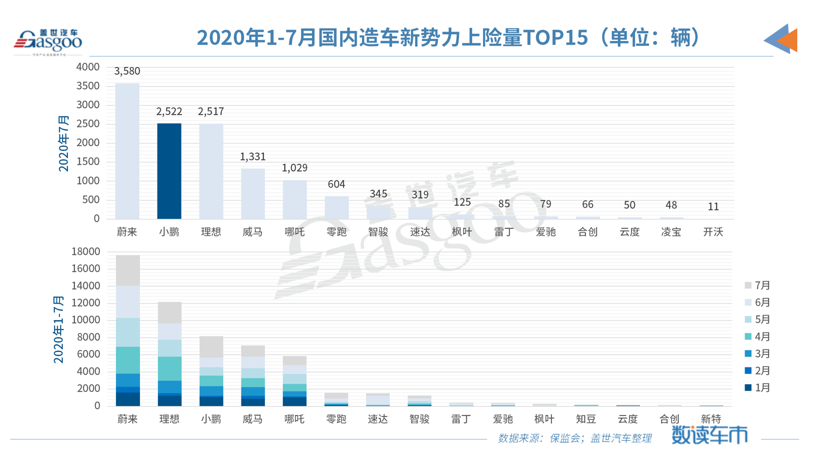
Specifically, the insurance volume of Lulai cars in July was 3580, four times that of the same period last year, of which ES6 registered a total of 2615 vehicles in July, up 288% from January to July last year, accounting for 80.71% of the total insurance volume of Lulai cars this year. In the domestic pure electric passenger car insurance volume of TOP 15 models from January to July, ES6 ranks fourth after Baojun E100. In addition, the new ES8, which began delivery in April, insured 923 vehicles in July, up 463 per cent from a year earlier.
At this year's Chengdu auto show, Weilai unveiled its third model, the EC6, which sold at 368000 yuan before the subsidy, and the first batch of vehicles is expected to begin delivery in late September. Li Bin, founder and CEO of Xilai Automobile, said in an interview with the media that the increase in production capacity of the Weilai Jianghuai plant is in steady progress and will increase by 25% by September at the latest, when the monthly production capacity will be close to 50000 units. With the abundance of models and the improvement of factory capacity, the next market performance is worth looking forward to.

As for Xiaopeng Automobile, with the large-scale delivery of its second production model, P7, Xiaopeng car insured 2522 vehicles in July, an increase of 130% over the previous month, rapidly rising to the second place in the new power of car-building in July, and achieved its best results in a single month in 2020. Specifically, as the Zhaoqing plant gradually passed the capacity climbing period, and the large-scale delivery ceremony held in Beijing, Shanghai, Zhaoqing, Guangdong and Chengdu on July 17, Xiaopeng P7 increased by more than 450% month-on-month to 1719 vehicles in July, promoting the domestic pure electric passenger car TOP 15 model in one fell swoop. In addition, the market performance of Xiaopeng G3 is also relatively stable, with 803 vehicles insured in July and 5989 vehicles insured from January to July, of which 80% are insured by individual users.
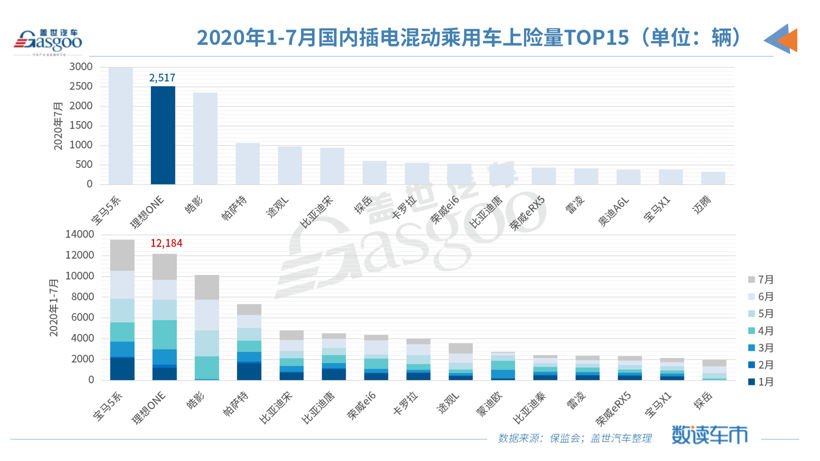
In terms of ideal cars, sales of ideal ONE picked up after a successful IPO trip to the United States on July 30 this year. In July 2020, the sales volume of the ideal ONE was 2517, an increase of 33.1% from June to June, with a cumulative insurance volume of 12184 vehicles from January to July, ranking second among the insured TOP 15 models of plug-in hybrid passenger vehicles in China from January to July.
It is worth mentioning that in the previous existence of a certain "pain point" offline channels, the ideal car began to improve. As of Aug. 10, ideal Motor has 25 retail centers across the country and covers 21 cities, according to official data. From August to September, ideal automobile retail centers in Foshan, Hefei, Lanzhou, Dalian, Wuxi, Xiamen, Guiyang, Harbin and Shenyang are scheduled to open one after another. In terms of after-sales service, as of August 10, the after-sales service network of ideal Automobile (including maintenance center and authorized sheet spray center) has covered 39 cities across the country. It is expected to be distributed to Changchun, Xining, Jiaxing, Jinhua, Quanzhou, Linyi, Weifang, Yantai, Baoding, Nantong, Shaoxing and other cities in the third quarter.
Non-operating new cars accounted for more than 90%, and 73.84% were individual users.
Specifically, with regard to the ownership of new cars by the new forces of car-building, of the 57200 new cars at risk in the first seven months, only 748 new cars were used for rental, accounting for 1.3%. This proportion is far lower than the rental share of nearly 15% of the overall domestic new energy passenger car market. Correspondingly, new car-building forces account for more than 90% of new cars that are not in operation, of which individual users account for 73.84% and unit users account for 24.85%.
Compared with the overall production and sales data, the proportion of individual users in the risk volume has become a key factor to assess the core competitiveness of a product. Chen Qingtai, chairman of the China Electric vehicle Association of 100 people, has pointed out that whether pure electric vehicles are used as private cars or shared cars, it is of great benefit to further promote the development of China's new energy vehicle industry, but in terms of product and industry competitiveness, private purchase quantity is an important reference sign.
Compared with the traditional car enterprises, the new power enterprises pay more attention to the real user demand and user experience in product positioning and development, and regard the personal consumer market as the home field of their competition. From the current proportion of the ownership of the insurance volume of the new power, the product positioning focusing on the consumer market is beginning to show its effect. at the same time, the insurance data from the consumer side also confirms the market acceptance and recognition of the new power products. As mentioned above, the Xiaopeng G3 has a cumulative insurance volume of 5989 vehicles from January to July, of which more than 80% are insured by individual users.
Some analysts point out that Xiaopeng Automobile relies on strong Internet thinking and user thinking, reconstructs its own system with consumers as the core, and is fully close to consumers from the industrial chains of research and development, manufacturing, sales, and so on. the high proportion of individual users is the inevitable result of the sound growth of its system.
More than 30% of new cars go northward to Shenzhen and Guangzhou, and Shanghai ranks first in the country in July.
In addition, from the specific flow direction of new cars, the current mainstream car-building new forces mainly flow to Guangdong, the Yangtze River Delta, Beijing-Tianjin-Hebei and so on. Among them, 17819 vehicles were insured in the four first-tier cities of Shenzhen and Guangzhou, accounting for 31.17% of the total insured in the first seven months. In addition, Zhengzhou 1-7, which has a strong new energy automobile industry cluster, has a total of 3033 new power models, second only to Guangzhou in the new power TOP 15 city ranking fifth.
Analysts pointed out that the regional flow of car-building new power models is closely related to where the industrial clusters are located. The country also promotes new energy first in developed cities, and then popularizes it in other provinces and cities, which can be seen in the subsidy policy of new energy vehicles mainly flowing to cities.
Take Shanghai, which is the most risky city in July this year, as an example. In terms of car purchase cost, Shanghai subsidizes 5000 yuan in charging fees for those who buy pure electric vehicles and plug-in hybrid vehicles before the end of 2020. In the use link, Shanghai's supporting services are becoming more and more perfect. Qiao Li, manager of the New Energy Division of Shanghai International Automobile City (Group) Co., Ltd., said: "at present, the vehicle-to-pile ratio in Shanghai is close to one-to-one. In the first seven months of this year, the number of new energy vehicles promoted in Shanghai exceeded 40, 000, and the cumulative number of new energy vehicles promoted reached 346000." It is reported that with the promotion of the "new infrastructure" work, Shanghai plans to build 100000 new rechargeable terminal facilities between 2020 and 2022 to further ensure the development of the local new energy vehicle industry.
In addition, Beijing will issue 20, 000 new energy minibuses to "car-free families" at one time in 2020. at present, more than 180000 families have applied. Guangzhou gives a comprehensive subsidy of 10, 000 yuan per car to individual consumers to buy new energy vehicles. Shenzhen, on the other hand, relaxes the application conditions for individual new energy vehicles, and subsidizes 20,000 yuan per car for newly purchased pure electric passenger vehicles and 10,000 yuan per car for newly purchased plug-in hybrid passenger vehicles.
Summary: in July this year, the production and sales of new energy vehicles in China achieved positive growth for the first time since the beginning of this year, which led to a month-on-month and year-on-year increase in the dangerous volume of new car-building forces, but judging from the overall market environment, the road for the survival of new car-building forces will still have a long way to go. At present, the risk of new power is only focused on a few leading enterprises, and most of these enterprises are so troubled by funds that they plan to go public one after another. however, landing in the capital market is only the first step of its "long march", and there is still a long way to go. If the new power enterprises want to go further on the road of building cars, it is a long-term solution that they have to rely on products and services to speak, respect the laws of the automobile industry, return to the common sense of building cars, and create safe and outstanding products.
Click to understand and sign up for the 2020 China Automotive New Materials Application Summit Forum.
Scan the QR code above to view the business cards of the participating companies and sign up online

Scan the QR code and follow the official account of Wechat, a new energy source of SMM, cobalt and lithium.