[SMM Daily Review] non-ferrous metals generally fell in Shanghai, lead, nickel and tin fell by more than 1%, coke rose by more than 2%, and the last phase of crude oil went green.

Published: Jul 23, 2020 16:45 (GMT+8)

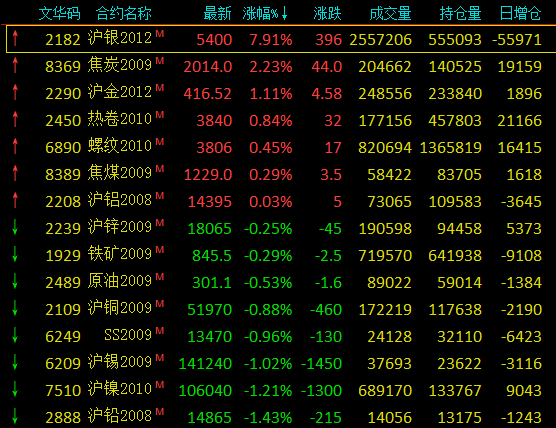
SMM7 March 23: most of the non-ferrous metals market fell today. By the end of the day, Shanghai lead fell 1.43%, Shanghai Nickel fell 1.21%, Shanghai Tin fell 1.02%, Shanghai Copper fell 0.88%, Shanghai Zinc fell 0.25%, Shanghai Aluminum rose 0.03%, copper. Since mid-May, LME inventory has continued to decline. As of July 22, LME copper inventory dropped to 145000 tons, nearly 50% lower than in mid-May. Among them, inventory fell to 4500 tons in Asia, 98500 tons in Europe and 42000 tons in America. The proportion of written-off warehouse receipts has risen to more than 50%, of which the proportion of written-off warehouse receipts in Asian warehouses is as high as 94.44%. The space for destocking in Asia has been reduced to a historical position, and the amount of deliverable in the short term is very limited. Recently, supply problems have been simmering in major copper-producing countries in South America, a strike by copper miners in Chile is still simmering, and protesters in Peru recently attacked a convoy at the Las Bambas copper mine. SMM expects imports of copper to decrease month-on-month in August, and import parity may open up opportunities.

[SMM Analysis] LME copper inventory continues to decline overseas consumption recovery, recently there are goods arriving in Hong Kong, rising discount is under pressure.

In terms of black, thread rose 0.45%, hot coil rose 0.84%, stainless steel fell 0.96%, coke rose 2.23%, coke rose 0.29%, iron ore fell 0.29%. According to SMM research, the operating rate of blast furnace in the fourth week of July was 90.07%, down 0.23% from last week. The reduction mainly comes from the overhaul of blast furnaces affected by flooding in some steel mills. It is estimated that the operating rate of blast furnace is expected to be high and stable next week. In the past week, there has been a lot of rain, which has led to the high water level of the Yangtze River. as a result, some docks along the line have been sealed, the transportation of raw materials and finished materials have been affected to a certain extent, and some steel mills have carried out maintenance of blast furnaces. The relationship between supply and demand has improved significantly, and the domestic financial market has rebounded sharply after a sharp fall in the previous few days, boosting market sentiment. It is expected that in the short term, due to the positive macro aspects and improved fundamentals, the market is expected to run strongly, but we need to be aware of the risk of rising and falling caused by the negative short-term news and the rapid rise of the disk.

[SMM Steel Analysis] the operating rate of transport blast furnace affected by flood fell again

Last week, crude oil and distillate stocks in the United States unexpectedly increased and fuel demand fell, as a sharp increase in cases of new crown virus infection hit fuel consumption in the United States, the last issue of crude oil fell 0.53%, the JEIA said on Wednesday. Some analysts said that under normal circumstances, fuel stocks would be largely digested, but the surge in the number of new crown cases has strangled the strength of sha's recovery. The oil market reacted unexpectedly calmly to the unexpected increase in crude oil stocks announced by the EIA and the escalation of tensions between the United States and China.

As of today's day close:
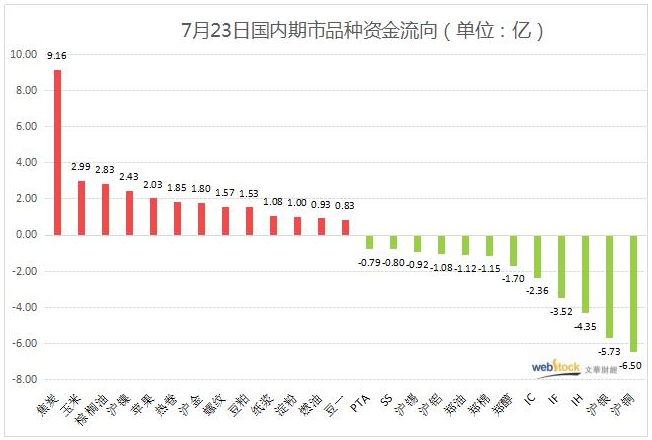
Today's capital flow

The domestic commodity market as a whole is still dominated by net capital inflows, with a net inflow of 1.515 billion yuan into the Mandarin Commodity Index. The black department was once again popular with funds, with an inflow of 1.276 billion yuan, of which a sharp rise in coke received 916 million additional funds. The corn broke out suddenly, gaining 89000 hands to increase the position, and the inflow of capital was nearly 300 million yuan. Non-ferrous plate continued to adjust, 589 million funds continued to flee. Precious metal plate showed signs of profit flight, outflow of 393 million yuan, of which Shanghai Bank suffered 74500 holdings reduction, outflow of 573 million yuan.
A brief comment on SMM analysts on July 23rd

Copper: today, the main force of Shanghai copper opened at 51950 yuan / ton in the morning. after the opening, the center of gravity of copper price fluctuated narrowly around 51920 yuan / ton position, and then declined due to more flat entry into the disk, and explored the intraday low of 51590 yuan / ton position. Copper prices rebounded at a low level, with the center of gravity rising about 100 yuan / ton to close at 51750 yuan / ton at noon. Opening in the afternoon, Shanghai Copper was operating smoothly near the 51710 yuan / ton first line. Near the end of the day, bullish copper prices rose to close at 51970 yuan / ton, down 460 yuan / ton today, or 0.88%. During the day, 09 contracts reduced positions by 2190 to 118000, mainly by long positions, while trading volume increased by 23000 to 172000. 08 during the contract day, positions were reduced by 2763 to 75000, mainly by long positions, while trading volume decreased by 19000 to 72000. Copper in Shanghai fell today, mainly as escalating tensions between China and the United States hit market optimism. Last night, under the influence of the US political provocation demanding the closure of the Chinese consulate in Houston, the copper night market in Shanghai opened low and the center of gravity shifted somewhat. Tensions between China and the United States continued to grow, investors were unnerved by new diplomatic disputes, and risk aversion rebounded to weigh on copper prices. Today, Shanghai copper negative, KDJ opening expansion, but there are still 5, 10-day moving average adhesion to the bottom. Wait for the outer disk guidelines at night to test whether the bulls can push again to support copper prices to continue to rise and stand firm at the 52000 mark.

Aluminum:

Lead: within a day, the 2009 contract for Shanghai lead is opened at 14835 yuan / ton. In early trading, Shanghai lead adjusted horizontally between the intraday moving average and the 20-day moving average. in the afternoon, Shanghai lead continued to fluctuate, with long and short games fierce, with high positions reaching 14915 yuan / ton and low positions reaching 14820 yuan / ton, basically getting rid of night lows. At the end of the day, it closed at 14850 yuan / ton, down 130 yuan / ton, down 0.87%, the position increased by 929 to 22654, and the trading volume increased to 20791. Shanghai lead closed at Erlianyin, generally supported by the 20-day moving average, the low adjustment of the pressure-bearing daily average is mainly, the KDJ index is exposed downwards again, while the 10-day moving average above is bent down, the pressure becomes heavier, and the technical surface has a negative trend, but considering the fundamental cost support of regenerated lead, and the downstream trading activity is better, it is expected that Shanghai lead will still test the support strength of the 20-day moving average at night.

Zinc:

Nickel:

Tin:

< updating >

"Click to sign up: 2020 Tin Industry chain Trading Summit

Data Source Statement: Except for publicly available information, all other data are processed by SMM based on publicly available information, market communication, and relying on SMM's internal database model. They are for reference only and do not constitute decision-making recommendations.

For any inquiries or for more information, please contact: lemonzhao@smm.cn
For more information on how to access our research reports, please contact:service.en@smm.cn
Related News
Selkirk Copper Targets H2 2028 Restart of Minto Mine Following Positive PEA
1 hour ago
Selkirk Copper Targets H2 2028 Restart of Minto Mine Following Positive PEA
Read More
Selkirk Copper Targets H2 2028 Restart of Minto Mine Following Positive PEA
Selkirk Copper Mines has outlined a potential restart of the past-producing Minto copper-gold-silver mine in Yukon, Canada, following the completion of a Preliminary Economic Assessment (PEA) that supports first concentrate production in the second half of 2028.​ The PEA outlines a 13-year mine life based on combined open-pit and underground mining, with operations designed around an average mining and milling rate of 4,100 mt/day. At peak production, the project is expected to produce approximately 27,200 mt/year of copper-equivalent contained in concentrate, equivalent to around 48,700 mt/year of high-grade copper-gold-silver concentrate.​ Initial capital required to re-establish production is estimated at C$186 million. Using the study's planning prices of US$5.00/lb copper, US$3,600/oz gold and US$50/oz silver, the PEA estimates an after-tax NPV at a 7% discount rate of C$494 million, an after-tax IRR of 47.8% and a payback period of approximately 1.9 years from first production.​ Minto benefits from substantial existing infrastructure from its previous operations, including a 4,100 mt/day processing plant as well as existing open-pit and underground infrastructure. Selkirk Copper said assessments of the site's existing infrastructure and equipment found that the majority remains in good working order and requires only minor attention and refurbishment.​ The company is targeting first concentrate production in H2 2028, followed by full ramp-up of mining, milling and concentrate production by H1 2029. A feasibility study is scheduled to begin in Q4 2026, while amended permit applications are also expected to be submitted during the fourth quarter. Selkirk Copper said a restart decision is targeted following completion of the feasibility study and receipt of permit amendments in H2 2027.​ The Minto PEA outlines a potential pathway for a previously producing copper operation to return to the market by 2028, supported by existing processing and mining infrastructure that could reduce the capital and construction requirements compared with a greenfield project. However, the 27,200 mt/year peak production figure represents copper-equivalent contained in concentrate rather than contained copper alone. The restart also remains subject to further feasibility work, permitting and project execution, making progress toward a restart decision in H2 2027 an important milestone to watch.
1 hour ago
Tschudi Copper Mine Targets Early-2027 Mining Restart in Namibia
1 hour ago
Tschudi Copper Mine Targets Early-2027 Mining Restart in Namibia
Read More
Tschudi Copper Mine Targets Early-2027 Mining Restart in Namibia
Consolidated Copper Corp (CCC) is targeting an early-2027 restart of open-pit mining at the Tschudi copper mine in northern Namibia, with an estimated US$30–40 million of development capital required to bring mining operations back online.​ Under the planned heap-leach restart, Tschudi is expected to reach run-rate copper cathode production of more than 14,000 mt/year over an initial 10-year mine life. CCC expects to complete a definitive feasibility study for the heap-leach mining restart in September 2026, with open-pit mining targeted to recommence in early 2027.​ The planned restart relates specifically to open-pit mining at Tschudi. Copper processing operations were restarted in 2024 using existing stockpiles, with CCC reporting production of more than 7,600 mt of copper cathode conforming to LME Grade A specifications as of June 2026. Tschudi previously produced approximately 75,000 mt of copper cathode between 2015 and 2020 before being placed on care and maintenance.​ The operation already has significant processing infrastructure in place, including a 2.88 million mt/year SX/EW plant. According to CCC, the US$30–40 million restart capital would primarily cover dewatering, mining mobilisation and demobilisation, a mobile crushing plant and development of a leach pad.​ CCC is also studying a larger expansion targeting Tschudi's sulphide resources. The concept includes construction of a 3 million mt/year flotation plant alongside the existing SX/EW operation, potentially increasing average annual production to approximately 30,000 mt of copper-equivalent over more than 10 years. The expansion remains under study and is separate from the planned heap-leach mining restart.​ The planned restart of open-pit mining at Tschudi could strengthen Namibia's copper supply by supporting run-rate cathode production of more than 14,000 mt/year if the project proceeds according to schedule. Existing SX/EW infrastructure and the relatively modest US$30–40 million restart capital requirement could support a faster return to mining compared with a greenfield development. However, the early-2027 restart remains a company target, with completion of the definitive feasibility study and subsequent mine mobilisation among the key milestones to watch.
1 hour ago
KCM Restarts Nchanga Smelter Following US$40 Million Rehabilitation
1 hour ago
KCM Restarts Nchanga Smelter Following US$40 Million Rehabilitation
Read More
KCM Restarts Nchanga Smelter Following US$40 Million Rehabilitation
Konkola Copper Mines (KCM) has restarted operations at its Nchanga Smelter in Zambia following the completion of a US$40 million rehabilitation programme, marking the facility's first major refurbishment in more than eight years.​ The smelter, which has an annual production capacity of 311,000 mt, was shut down for 106 days to allow comprehensive rehabilitation works to be carried out. The shutdown was initially planned to last 60 days but was extended after inspections identified additional critical works that needed to be completed.​ KCM Deputy Chief Executive Officer Satish Kumar said the rehabilitation forms part of efforts to rebuild the company and secure the long-term future of its operations following Vedanta Resources' return to KCM.​ According to KCM Smelter and Refinery Director Yoram Kapai, more than 1,500 people from KCM and its business partners participated in the rehabilitation programme. The company said the works were completed without any major injuries.​ The restart restores operations at a key processing facility within KCM's integrated copper operations in Zambia. Attention will now turn to the smelter's operational performance following the extended maintenance period and KCM's broader efforts to rebuild production across its mining and processing assets.​ The restart of the Nchanga Smelter removes a temporary processing constraint at KCM following the 106-day shutdown. With annual capacity of 311,000 mt, the facility is an important part of KCM's copper processing chain. The US$40 million rehabilitation could support improved operational reliability following years of limited major refurbishment, while the pace at which KCM increases mine supply and utilisation of its processing assets will remain important in determining the impact on Zambia's overall copper production.
1 hour ago