EAF operating rates fell as wet season dampened demand

Published: Jul 08, 2020 11:35 (GMT+8)
Chinese electric arc furnace (EAF) steelmakers operating rates came off from highs as of early July, as their in-plant inventories piled up as the wet season deterred the release of end-users demand. Elevated costs of feedstock steel scrap and weaker-than-expected rebar prices have driven more than half of EAF steel mills into losses.

SHANGHAI, Jul 8 (SMM) – Chinese electric arc furnace (EAF) steelmakers operating rates came off from highs as of early July, as their in-plant inventories piled up as the wet season deterred the release of end-users demand.


Elevated costs of feedstock steel scrap and weaker-than-expected rebar prices have driven more than half of EAF steel mills into losses. This also accounted for the slower operation at EAF steel plants. 


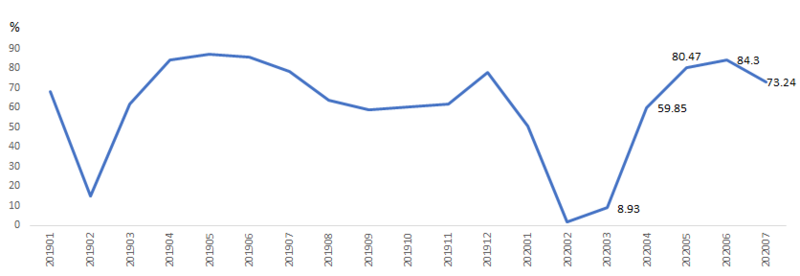
As of July 7, operating rates across independent EAF steel mills in China stood at 73.24%, down 4.49 percentage points from a week ago and down 11.52 percentage points from a month earlier, according to an SMM survey.


Operating rates across EAF steel mills in China (Source: SMM)

The operating rates will unlikely recover much in the near term as prices of steel scrap will highly likely stay firm on tight supplies and continued heavy rainfall expected in east, south-west and central China, where most of Chinese EAF capacity is located in, will keep demand subdued.


End-users consumption will diverge among different regions. While shipments at sellers have improved on the eased impact of rainy weather in some areas, this failed to significantly reduce steel inventories at social warehouses and at EAF steelmakers.
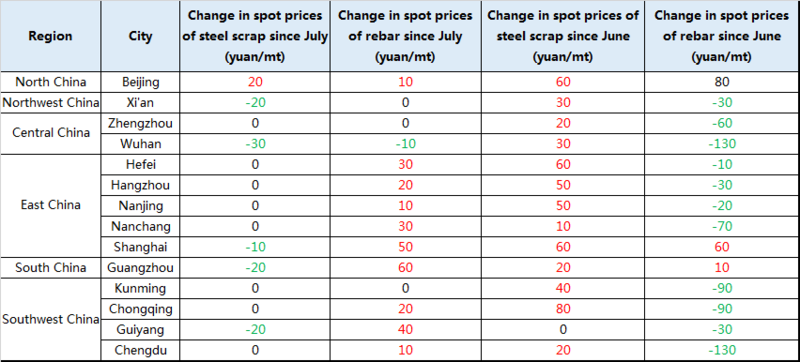


In east China, the average operating rates at EAF steel mills have slipped to 78%, from 84% in early June. Most plants reported marginal losses and have curtailed their production time. 


A representative steelmaker in east China said it currently operates at a rate of 60% with production losses of below 100 yuan/mt, as compared with a rate of 80% at the start of July.


The operating rates across EAF steel mills in central China have declined steeply to 35%, from 67% a month ago, primarily weighed by weakness in demand. Maintenance and overhauls are commonly seen in Henan. 


A major producer in central China faced significant inventory pressure amid poor sales, with mounting stocks of all specifications. It halted production for one-week maintenance on July 5, but it could be compelled to extend the maintenance if demand remains sluggish. 


In south China, the average operating rates dipped from 88% to 83% over the past month. However, the rates have shown signs of picking up on recovering demand as the rainy season draws close to an end. 


According to an SMM survey, a representative steel mill in south China was on the verge of losses. It has ramped up to full capacity on expectations of demand recovery, following after it cut the operating rates to 80% on slow shipments in mid-June. 


The EAF operating rates in south-west China dropped from 100% to 91% over the past month, mainly pressured by elevated inventory at plants. Currently, most local EAF mills are able to break even. 


A representative steel plant in south-west China has concluded maintenance and reached full operation, but it still faces heavy pressure from in-plant stocks, which are nearly threefold of the normal levels. 


Data Source Statement: Except for publicly available information, all other data are processed by SMM based on publicly available information, market communication, and relying on SMM's internal database model. They are for reference only and do not constitute decision-making recommendations.

For any inquiries or for more information, please contact: lemonzhao@smm.cn
For more information on how to access our research reports, please contact:service.en@smm.cn
Related News
Western Mining Subsidiary Receives 17-Year License for Qinghai Polymetallic Mine
16 hours ago
Western Mining Subsidiary Receives 17-Year License for Qinghai Polymetallic Mine
Read More
Western Mining Subsidiary Receives 17-Year License for Qinghai Polymetallic Mine
On September 22, Western Mining announced that its wholly owned subsidiary, Qinghai Ganxin Mining Development Co., Ltd. (“Ganxin Mining”), recently obtained a Mining License issued by the Department of Natural Resources of Qinghai Province. The mine, named the Geermu Tuwenchahan Iron Polymetallic Mine of Qinghai Ganxin Mining Development Co., Ltd., covers iron, copper, gold, molybdenum, zinc, lead, and silver as the permitted mining commodities. The mining license is valid from August 3, 2026, to August 30, 2043.
16 hours ago
Korea Zinc's $7.4B US Project Passes Environmental Assessment, Set for 2029 Trial Operations
Sep 21, 2026 17:02 (GMT+8)
Korea Zinc's $7.4B US Project Passes Environmental Assessment, Set for 2029 Trial Operations
Read More
Korea Zinc's $7.4B US Project Passes Environmental Assessment, Set for 2029 Trial Operations
On September 21, Korea Zinc announced that its $7.4 billion US manufacturing project had passed the environmental impact assessment. The facility is scheduled to begin trial operations in 2029 and commercial production the following year, producing 11 critical minerals, 12 non-ferrous metals and semiconductor-grade sulfuric acid. In April, Korea Zinc said it had completed the acquisition of a local zinc smelter and other related companies. The company plans to implement the project by expanding and upgrading the existing facilities.
Sep 21, 2026 17:02 (GMT+8)
Australia Reviews Anti-Dumping Duties on Galvanized Steel from India, Malaysia, Vietnam Amid Zinc Concerns
Sep 11, 2026 18:30 (GMT+8)
Australia Reviews Anti-Dumping Duties on Galvanized Steel from India, Malaysia, Vietnam Amid Zinc Concerns
Read More
Australia Reviews Anti-Dumping Duties on Galvanized Steel from India, Malaysia, Vietnam Amid Zinc Concerns
On September 9, 2026, Australia initiated its second sunset review of anti-dumping measures on galvanized steel sheet from India, Malaysia and Vietnam, and separately launched a sunset review of countervailing measures on imports from India. The review covers July 2025-June 2026, with the final report expected by February 11, 2027. As galvanized steel is the largest end-use sector for zinc, the measures directly affect export costs and competitiveness, potentially impacting Australia’s domestic zinc demand and supply chain. Maintaining the duties would provide some protection for domestic steel and coating capacity, while termination could increase low-priced imports and affect regional zinc consumption. The final outcome remains subject to the authorities’ determination.
Sep 11, 2026 18:30 (GMT+8)