[SMM hot volume] the regional strength pattern changes quietly, how does the follow-up hot volume price change?

Published: Jul 07, 2020 16:43 (GMT+8)

SMM Steel July 7, this week, the mainstream market resources are expected to arrive 151000 tons, an increase of 3000 tons over last week, the increase is mainly reflected in the Lecong market. The volume of goods affected by the price difference between the north and the south in Shanghai is still on the low side, and the recent arrival volume in Tianjin continues to maintain stability.

Table 1: comparison of arrival in mainstream markets

Source: SMM Steel

Shanghai market: from the point of view of recent arrival, the volume of goods in this market continues to be small, the supply of resources is still tight, and the fundamental performance of supply and demand is better than that of other markets, which forms a strong support for the spot price of the market. Coupled with the market macro-environmental preference, the mentality of traders is warmer than in the previous period, and the willingness to raise prices is enhanced, so it is expected that spot prices in the market will maintain a strong trend of volatility in the short term.

Figure 1: comparison of arrival volume and spot price in Shanghai market

Source: SMM Steel

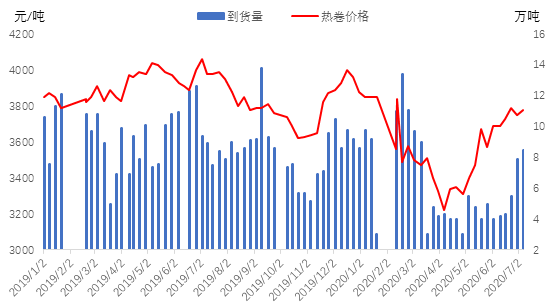
Lecong market: the volume of goods arriving this week continues to increase, and the increment mainly comes from steel mills such as Wangang, Liugang and Chaoyang of Angang, which further increases the supply pressure in the market. At the same time, according to SMM's understanding, due to the influence of continuous overcast and rainy weather, there are more thread pressure, superimposed on the recent increase in agreement volume of hot coil steel mills, resulting in difficulties in capital flow among most traders, prompting it to speed up the pace of shipments to withdraw funds, and also to suppress the spot price of hot coils in the market. But do not worry too much is that South China is about to come out of plum, it is expected that after plum, the construction site resumes, the spot price of thread still has room to rise, which will lead to a rise in spot prices of hot rolls.

Figure 2: comparison between the volume of goods from the market and the spot price
Source: SMM Steel

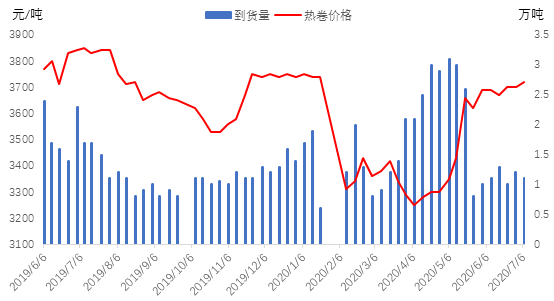
Tianjin market: this week, the market volume remains low, the fundamentals are in a tight balance between supply and demand, and spot prices also show a narrow fluctuation trend. At the same time, according to SMM, the current inventory of traders in the market is low, and the willingness to reduce the price is weak, but the price is subject to terminal purchasing caution, so it is expected that spot prices in the market will remain in a narrow volatility trend in the short term.

Figure 3: comparison of arrival volume and spot price in Tianjin market
Source: SMM Steel


Data Source Statement: Except for publicly available information, all other data are processed by SMM based on publicly available information, market communication, and relying on SMM's internal database model. They are for reference only and do not constitute decision-making recommendations.

For any inquiries or for more information, please contact: lemonzhao@smm.cn
For more information on how to access our research reports, please contact:service.en@smm.cn
Related News
Western Mining Subsidiary Receives 17-Year License for Qinghai Polymetallic Mine
19 hours ago
Western Mining Subsidiary Receives 17-Year License for Qinghai Polymetallic Mine
Read More
Western Mining Subsidiary Receives 17-Year License for Qinghai Polymetallic Mine
On September 22, Western Mining announced that its wholly owned subsidiary, Qinghai Ganxin Mining Development Co., Ltd. (“Ganxin Mining”), recently obtained a Mining License issued by the Department of Natural Resources of Qinghai Province. The mine, named the Geermu Tuwenchahan Iron Polymetallic Mine of Qinghai Ganxin Mining Development Co., Ltd., covers iron, copper, gold, molybdenum, zinc, lead, and silver as the permitted mining commodities. The mining license is valid from August 3, 2026, to August 30, 2043.
19 hours ago
Korea Zinc's $7.4B US Project Passes Environmental Assessment, Set for 2029 Trial Operations
Sep 21, 2026 17:02 (GMT+8)
Korea Zinc's $7.4B US Project Passes Environmental Assessment, Set for 2029 Trial Operations
Read More
Korea Zinc's $7.4B US Project Passes Environmental Assessment, Set for 2029 Trial Operations
On September 21, Korea Zinc announced that its $7.4 billion US manufacturing project had passed the environmental impact assessment. The facility is scheduled to begin trial operations in 2029 and commercial production the following year, producing 11 critical minerals, 12 non-ferrous metals and semiconductor-grade sulfuric acid. In April, Korea Zinc said it had completed the acquisition of a local zinc smelter and other related companies. The company plans to implement the project by expanding and upgrading the existing facilities.
Sep 21, 2026 17:02 (GMT+8)
Australia Reviews Anti-Dumping Duties on Galvanized Steel from India, Malaysia, Vietnam Amid Zinc Concerns
Sep 11, 2026 18:30 (GMT+8)
Australia Reviews Anti-Dumping Duties on Galvanized Steel from India, Malaysia, Vietnam Amid Zinc Concerns
Read More
Australia Reviews Anti-Dumping Duties on Galvanized Steel from India, Malaysia, Vietnam Amid Zinc Concerns
On September 9, 2026, Australia initiated its second sunset review of anti-dumping measures on galvanized steel sheet from India, Malaysia and Vietnam, and separately launched a sunset review of countervailing measures on imports from India. The review covers July 2025-June 2026, with the final report expected by February 11, 2027. As galvanized steel is the largest end-use sector for zinc, the measures directly affect export costs and competitiveness, potentially impacting Australia’s domestic zinc demand and supply chain. Maintaining the duties would provide some protection for domestic steel and coating capacity, while termination could increase low-priced imports and affect regional zinc consumption. The final outcome remains subject to the authorities’ determination.
Sep 11, 2026 18:30 (GMT+8)