[SMM scrap Copper column] scrap copper procurement is still fierce when waste enterprises start work one after another.

Published: May 18, 2020 17:54

Daily review of spot trading of scrap copper

Today, the spot price of electrolytic copper in Shanghai quoted a price of 140 yuan / ton to 170 yuan / ton for that month's contract, 43210 yuan / ton to 43300 yuan / ton for Pingshui copper, and 43220 yuan / ton to 43310 yuan / ton for copper / ton. Shanghai copper morning market opened low and directly rose back to 43100 yuan / ton first-line shock, today to change the month to 2006 contract quotation, early trading inquiry is active, the holder quotes 150 ~ 170 yuan / ton, good copper can be a small amount to 150 yuan / ton, flat copper price down to 140 yuan / ton transaction is active, the trading atmosphere is slightly better than last Friday. In the second trading session, the supply of copper with low price and flat water has been difficult to find. The rising water of good copper is 160 yuan / ton to 170 yuan / ton, and the standing price of copper water in Pingshui is more than 150 yuan / ton, but the trading heat is not as hot as the morning market, and it is just needed downstream. Wet copper keeps rising water around 110 yuan / ton. Today, the market quotation is firm, the holder still intends to push up the water, the source of low-rising water is highly favored by the market, the transaction is mainly based on the receipt of goods by traders, and the trend of firm quotation will continue.

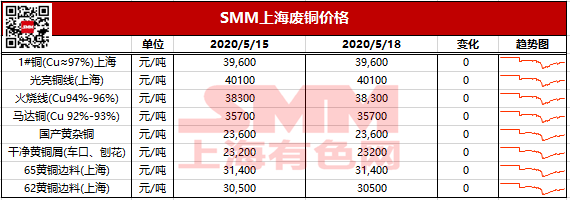
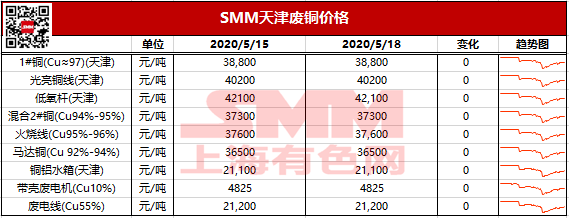
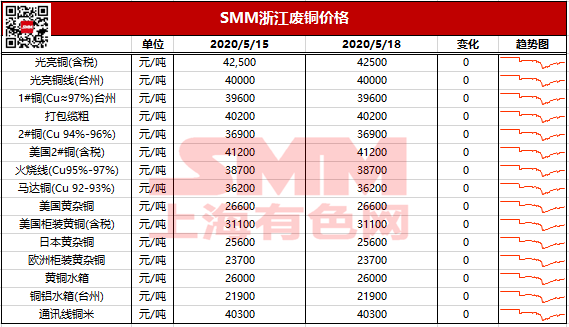
The price of bright copper in Guangdong is 39900 yuan / ton ~ 40200 yuan / ton, the same as the previous trading day, the price difference of fine waste is 699 yuan / ton, down 80 yuan from the previous month. (the ticket point is calculated as 5.9%) as the waste enterprises start work one after another, the downstream manufacturers maintain a large number of receipts, and the competition for the supply of goods is still fierce. Customs data show that the import of scrap copper in April was 80597 physical tons, down 1.76% from the previous month, and 56.24% lower than the same period last year. From January to April, imports totaled 305680 physical tons, down 44.37% from the same period last year. As overseas scrap copper exports began to be blocked one after another in late March, domestic scrap copper imports in April were in line with the trend of month-on-month decline; while the cumulative import volume almost halved compared with the same period last year, except for supply-side factors, there are also reasons why importers grabbed imports in July last year, resulting in a large base.

Local quotations for scrap copper
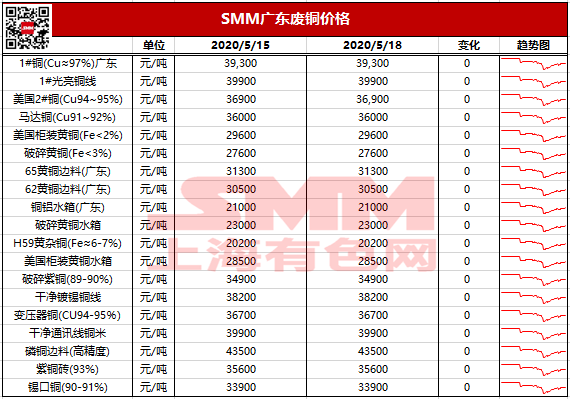
Import profit and loss of scrap copper

"Click to participate in the second China (Yingtan) Copper Industry Summit Forum and the 15th China International Copper Industry chain Summit"

"these enterprises have signed up! (part of the list of participants is attached)

To sign up for the summit or apply to join the SMM industry exchange group, please scan the code:

Data Source Statement: Except for publicly available information, all other data are processed by SMM based on publicly available information, market communication, and relying on SMM's internal database model. They are for reference only and do not constitute decision-making recommendations.

For any inquiries or for more information, please contact: lemonzhao@smm.cn
For more information on how to access our research reports, please contact:service.en@smm.cn
Related News
Zambia's Hichilema Re-elected, Focus Shifts to Copper Production Growth and Infrastructure Challenges
3 hours ago
Zambia's Hichilema Re-elected, Focus Shifts to Copper Production Growth and Infrastructure Challenges
Read More
Zambia's Hichilema Re-elected, Focus Shifts to Copper Production Growth and Infrastructure Challenges
President Hakainde Hichilema’s re-election provides greater policy continuity for Zambia’s mining sector, but the focus is now shifting from investment commitments and macroeconomic stabilisation toward whether the country can translate its expanding copper project pipeline into sustained production growth.​ Official results confirmed Hichilema’s second-term victory on August 18, with around 60% of the vote. For mining investors, the result reduces uncertainty around the policy direction that has underpinned Zambia’s recent push to attract capital into copper and other strategic minerals.​ Zambia is targeting annual copper production of 3 million tonnes by 2031, nearly triple current output levels. The strategy depends on a combination of brownfield expansions, new mine developments and continued exploration, making execution over the next several years critical to determining whether the target can be achieved.​ The main constraint is increasingly infrastructure rather than geological potential. Mining companies have highlighted electricity availability as one of the most important risks to future production growth, with industry estimates indicating that roughly 2,000 MW of additional power capacity will be required to support the planned expansion of the mining sector.​ Climate risk adds further complexity. Zambia’s heavy dependence on hydropower leaves the system exposed to weak rainfall and reservoir inflows, while the developing 2026–27 El Niño raises the possibility of renewed pressure on electricity supply. Reuters notes that previous drought-related shortages constrained mining activity and remain an important risk to the country’s copper-growth outlook.​ From a copper-market perspective, Hichilema’s second term therefore represents a transition from policy continuity to delivery. Zambia has attracted renewed mining investment and built a substantial project pipeline, but reaching the 3 million-tonne target will depend on whether new mines and expansions can be brought online alongside sufficient power, infrastructure and financing.​The next phase of Zambia’s copper story will therefore be measured less by announced investment and more by actual tonnes produced.
3 hours ago
After Delivery, Sharp Drop in Copper Prices Curbs Suppliers' Shipments [SMM Secondary Copper Daily Review]
9 hours ago
After Delivery, Sharp Drop in Copper Prices Curbs Suppliers' Shipments [SMM Secondary Copper Daily Review]
Read More
After Delivery, Sharp Drop in Copper Prices Curbs Suppliers' Shipments [SMM Secondary Copper Daily Review]
9 hours ago
LME Copper Inventories Rise by More Than 10kt in Two Days, Copper Prices Touch $14,000 at Low Levels
9 hours ago
LME Copper Inventories Rise by More Than 10kt in Two Days, Copper Prices Touch $14,000 at Low Levels
Read More
LME Copper Inventories Rise by More Than 10kt in Two Days, Copper Prices Touch $14,000 at Low Levels
LME copper inventories increased for two consecutive trading sessions. On August 14, LME copper inventories increased by 2,850 mt to 207,800 mt, and on August 17, inventories further increased by 15,700 mt to 223,600 mt. The cumulative increase over the two trading sessions was 18,600 mt, representing a growth rate of about 9.1%. In particular, warehouse inflows reached 17,500 mt on August 17, driving a sharp rebound in inventories that day. In terms of warrant structure, as of August 17, LME copper registered warrants increased to 123,100 mt, up by 20,000 mt from August 14. Registered warrants increased significantly and the ratio of cancelled warrants declined; as inventories increased, intraday copper prices touched a low of around $14,000/mt.
9 hours ago
[SMM scrap Copper column] scrap copper procurement is still fierce when waste enterprises start work one after another. - Shanghai Metals Market (SMM)