[SMM analysis] China's bauxite imports increased by 9.99% in the first quarter compared with the same period last year. What will be the trend in the second quarter?

Published: May 17, 2020 22:01
Source: SMM
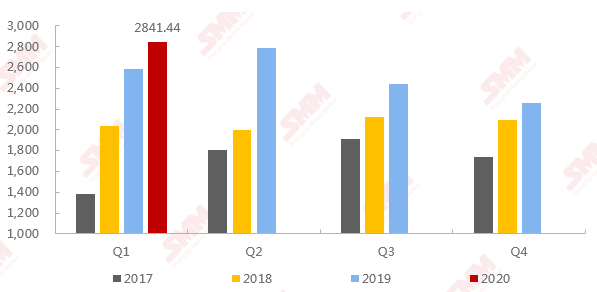
SMM, May 17, according to the Chinese Customs, China imported a total of 28.4144 million tons of bauxite in the first quarter of 2020, an increase of 26.01% month-on-month and 9.99% year-on-year, a record high (based on 8-digit customs code 26060000).

SMM, May 17, according to the Chinese Customs, China imported a total of 28.4144 million tons of bauxite in the first quarter of 2020, an increase of 26.01% month-on-month and 9.99% year-on-year, a record high (based on 8-digit customs code 26060000).

Figure 1. China's quarterly bauxite imports from 2017 to 2020 (in 10,000 tons)
Data sources: China Customs, SMM

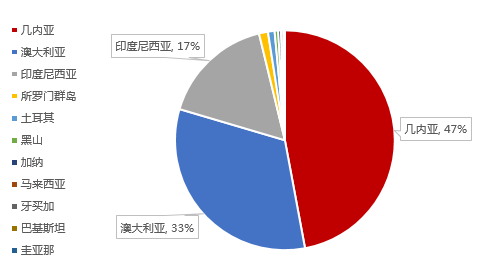
By country, China imported 13.374 million tons from Guinea in the first quarter of this year, almost the same as the same period last year; Australia imported 9.237 million tons, an increase of 22.95 percent over the same period last year; and Indonesia imported 4.727 million tons, an increase of 46.45 percent over the same period last year. Imports from Solomon 374000 tons, Turkey 276000 tons, Montenegro 148000 tons, Ghana 117000 tons, Malaysia 98000 tons, Jamaica 62400 tons, the rest from Pakistan, Guyana and Sierra Leone very small imports.

The main reasons for the increase in imports in the first quarter are as follows: first, since the fourth quarter of 2019, alumina plants in Henan and Shanxi have completed technical transformation, and the demand for minerals from Guinea and Indonesia has increased; second, sea freight has fallen, and the reduction of transportation costs has boosted the shipping of mining enterprises and the willingness of domestic buyers to purchase. Third, the domestic epidemic suppressed the resumption of mining in the northern region after the year, and some alumina plants increased the use of imported ore, which also stimulated the growth of imports. However, since late March, the prices of domestic mines have fallen too low relative to imported mines, and the prices of caustic soda and coal have also dropped significantly. the advantages of alkali consumption and energy cost of using imported ores have been weakened by high ore prices and freight charges. Shanxi-Henan-Chongqing alumina plants have reduced their imported ore production lines, involving an annual production capacity of about 2 million tons. Therefore, in the second quarter, the imported ore market still needs to continue to pay attention to the marginal demand changes of alumina plants in inland areas and the changes of internal and external ore price.

Figure 2. National proportion of bauxite imports in the first quarter
Data sources: China Customs, SMM

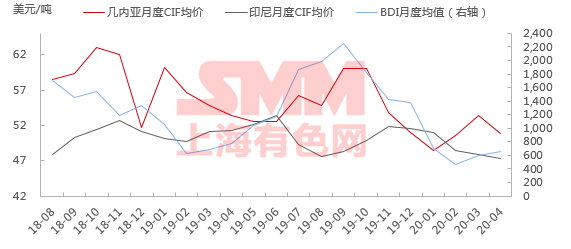
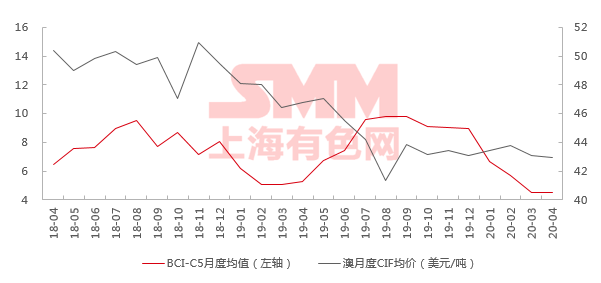
On the price side, due to the sharp drop in sea freight rates from the end of 2019 to March 2020, the average CIF prices from Guinea, Indonesia and Australia, the three major sources of bauxite, fell almost at the same time.

Figure 3. Comparison of monthly average Import CIF Price and BDI trend between Guinea and Indonesia
Data sources: China Customs, SMM

Figure 4. Comparison of monthly average CIF Price and BCI-C5 trend of Australian imports
Data sources: China Customs, SMM

(SMM Li Hao 021Mui 5166 6863)
Data Source Statement: Except for publicly available information, all other data are processed by SMM based on publicly available information, market communication, and relying on SMM‘s internal database model. They are for reference only and do not constitute decision-making recommendations.

For any inquiries or to learn more information, please contact: lemonzhao@smm.cn
For more information on how to access our research reports, please contact:service.en@smm.cn
Related News
Fed Governor Milan Pushes for Over 100 Basis Points Cut, Contradicts Barkin on Caution
23 hours ago
Fed Governor Milan Pushes for Over 100 Basis Points Cut, Contradicts Barkin on Caution
Read More
Fed Governor Milan Pushes for Over 100 Basis Points Cut, Contradicts Barkin on Caution
Federal Reserve Governor Milan pointed out that it is necessary for the US Fed to cut interest rates by more than 100 basis points this year. At the same time, he is very much looking forward to the performance of Kevin Warsh as Fed Chairman. However, Richmond Fed President Barkin emphasized that monetary policy must remain cautious until inflation fully pulls back to the target level, thereby ensuring the stability of the labour market.
23 hours ago
Democratic Senators Demand Delay in Fed Nomination Amid Criminal Investigation
23 hours ago
Democratic Senators Demand Delay in Fed Nomination Amid Criminal Investigation
Read More
Democratic Senators Demand Delay in Fed Nomination Amid Criminal Investigation
All 11 Democratic members of the US Senate Banking Committee jointly sent a letter to the committee's chairman, Tim Scott, requesting that all nomination processes for the prospective Fed Chairman, Kevin Warsh, be postponed until the criminal investigation into current Fed Chairman Powell and other board members is concluded. However, Scott stated that Warsh's confirmation was a done deal.
23 hours ago
Fed to Keep Large Banks' Capital Levels Unchanged, Postpones Stress Test Reforms Until 2027
23 hours ago
Fed to Keep Large Banks' Capital Levels Unchanged, Postpones Stress Test Reforms Until 2027
Read More
Fed to Keep Large Banks' Capital Levels Unchanged, Postpones Stress Test Reforms Until 2027
The US Fed has announced that it will maintain the capital levels of large banks unchanged during the upcoming stress test cycle (corresponding to the 2026 cycle). At the same time, the US Fed is planning multidimensional reforms to this annual test, aiming to enhance its transparency. The US Fed's Vice Chair for Supervision, Bowman, revealed that adjustments to the stress capital buffer requirements for large banks will be postponed until 2027. This move is intended to provide the US Fed with sufficient time to evaluate potential flaws that may be exposed in its testing models when assessing banks' financial conditions under simulated economic downturn scenarios.
23 hours ago